
Every year after the World Junior Hockey Championship ends, most NHL clubs assemble their amateur scouting staff to have mid-season meetings. When I was the scouting director in Florida, we tried to meet around the third week of January and schedule an opportunity for our staff to watch our NHL club live.
Holding meetings while the team is at home can be motivating and stressful at the same time. If the team was playing well, our meetings would have a more energetic feel. If the team was struggling to string together wins and fading in the playoff race, the meetings were exponentially more stressful.
This is pro sports after all, and winning solves everything at the NHL level.
With most, if not all, teams having concluded their mid-season meetings recently I’m positive their process would have included some very healthy debate about how their priority lists and prospect rankings are being built.
With the stretch drive of the season on the horizon, I’m starting to feel more comfortable with the trajectory of most of the prospects on my list, but I can’t say for certain my draft order today will look the same come June. A lot of work remains to be done and some of the players on my original draft list have started to slide, while others have taken their games to new heights and are trending upwards.
Here’s my up-to-date 2026 NHL draft ranking for January:
No. 1: Ivar Stenberg, LW, 5-foot-11, 183 pounds, Frolunda (SHL)
Stenberg was outstanding for Sweden at the world juniors and continues to produce high-end offence at the SHL level playing for Frolunda in Sweden’s top pro league. He averages between 15-18 minutes per game and has produced 7G-21A, on pace for one of the most historic offensive seasons for a draft eligible prospect at that level. He plays with exceptional detail in all three zones and is a calculating playmaker offensively. Stenberg leads by example with his mature approach to the game.
NHL Projection: First-line forward. Even strength/power play.
No. 2: Keaton Verhoeff, D, 6-foot-4, 208 pounds, North Dakota (NCAA)
Verhoeff was added to Canada’s lineup in the middle of the round-robin at the world juniors and ended up contributing four assists in five games. The big and rangy defenceman has elevated his game to another level since returning to North Dakota. He has now produced 6G-11A and is on pace for one of the most productive seasons for a draft eligible defenceman in recent history. Verhoeff has contributed 2G-4A in the six games he’s played since the WJC and averaged between 20-22 minutes per game in ice time. The bulk of his shifts come at even strength and on the power play. He’s gaining more confidence with his entire game and is using his size and outstanding passing ability to his advantage.
NHL Projection: Top pairing defenceman. Even strength/power play
No. 3: Gavin McKenna, LW, 5-foot-11, 170 pounds, Penn State (NCAA)
McKenna played to his identity offensively at the WJC representing Canada and ended the tournament with 4G-10A in seven games. He was especially dangerous on the power play and was a huge part of the reason why Canada finished the tournament with the top ranked power-play unit.
Since returning to Penn State McKenna, like Verhoeff, has taken his game to another level. He’s only been held off the score sheet once in six games and has produced 6G-3A, including a hat-trick versus Wisconsin. There’s no doubt in my mind that McKenna is going to produce offence at the NHL level. Notably, his defensive game and compete off the puck have been trending positively since he returned to Penn State and has impressed me just as much as his offence.
Here’s an example of McKenna exiting the offensive zone and positioning himself appropriately defensively. His coordination and ability to knock the puck down, then turn back around to attack offensively again, doesn’t allow his opponent time to gap up and take away space, which leads to McKenna depositing the puck in the back of the Wisconsin net:

NHL Projection: First-line forward. Even strength/power play.
No. 4: Caleb Malhotra, C, 6-foot-1, 182 pounds, Brantford Bulldogs (OHL)
The 2026 draft class is somewhat thin on elite centres, but Malhotra is a player who I value a great deal. He is getting between 19 and 22 minutes per game of ice time for the Bulldogs and is a complete player who’s being deployed in all situations. Malhotra’s combination of speed, skill, smarts and compete stand out as projectable elements of his game that he will take to the pros. He’s trustworthy and can play up and down the lineup. Malhotra has produced 23G-38A so far this season and he’s plus-27 defensively. He could approach 100 points by the end of the year without sacrificing detail on the defensive side of the game.
NHL Projection: First-line forward. Deployed in all situations.
No. 5: Chase Reid, D, 6-foot-2, 188 pounds, Sault Ste. Marie Greyhonds (OHL)
Reid is a player to keep a close eye on down the stretch and into playoffs at the junior level. He logs a ton of ice time for the Greyhounds in all situations and heavily impacts the game on both sides of the puck. He averages over a point per game (18G-27A in 40GP) and on pace for around 25 goals. Reid is active with and without the puck, pinches down to extend plays and is very competitive overall.
NHL Projection: Top pair. Deployed in all situations
No. 6: Tynan Lawrence, C, 6-foot-1, 185 pounds, Boston University (NCAA)
Lawrence is a highly skilled two-way centre who combines speed and smarts to drive offence. He recently made the move to Boston University from Muskegon in the USHL. Lawrence puts defenders on their heels and is a constant threat with a high volume of puck touches and a sophisticated offensive repertoire. He wants the puck. Equal parts passer and shooter. He’s a relentless forechecker who comes away with possession more often than not. Lawrence can be deployed in every situation and trusted in key moments.
NHL Projection: Top six scoring forward.
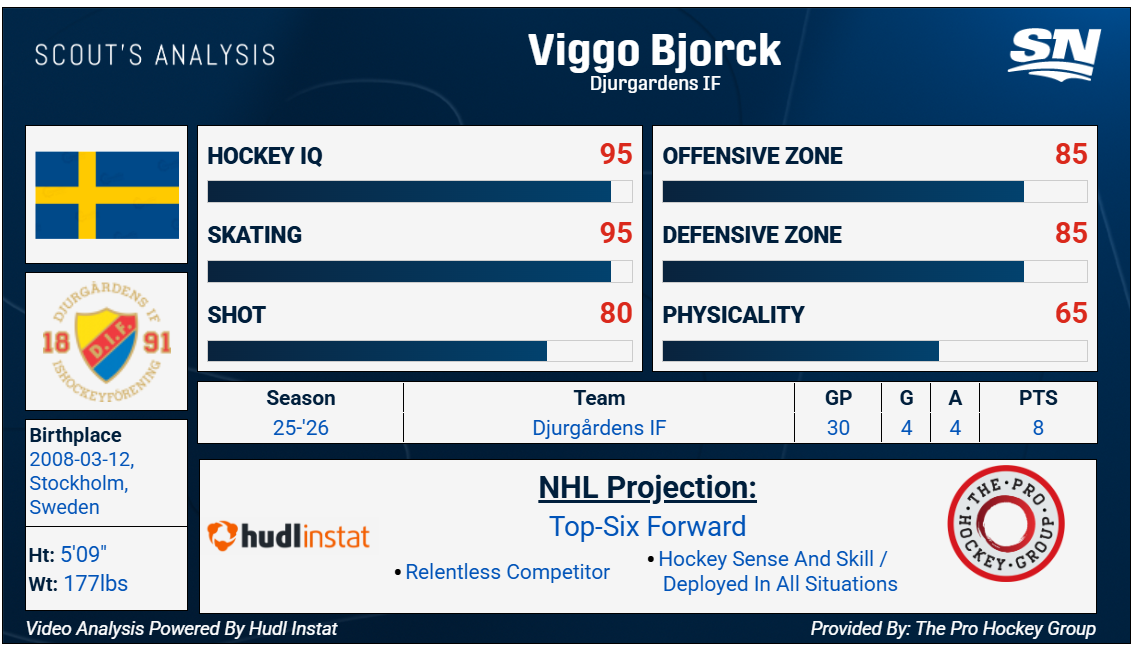
No. 7: Viggo Bjorck, RW, 5-foot-9, 177 pounds, Djurgardens (SHL)
Bjorck was outstanding at the world juniors playing for Sweden (3G-6A) and a key part of the reason the Swedes walked away with the gold medal. But he provides more than just offence. Bjorck can match-up against top opponents and kill penalties. He plays quick and fast and, despite his stature, he’s always around the play in traffic. He’s equal parts play driver and shooter. Bjorck sets up on his weak side in the offensive zone to one-time pucks from the perimeter or make plays through open seams.
NHL Projection: Top six forward. Deployed in all situations.
No. 8: Carson Carels, D, 6-foot-2, 202 pounds, Prince George Cougars (WHL)
Carels is another intriguing prospect who, like most of the players in the top end of this draft class, can be trusted in a variety of roles. He’s a fantastic skater who closes on his opponents aggressively in the defensive zone and can lead the rush and produce offensively. Carels averages over 24 minutes per game of ice time. He’s produced 12G-28A so far this season and he’s a plus-11 defensively.
NHL Projection: Top pairing. Deployed in all situations.
No. 9: Daxon Rudolph, D, 6-foot-3, 206 pounds, Prince Albert Raiders (WHL)
Rudolph’s overall game is on the rise. Deployed in all situations. Defends with purpose. Uses his length and strength to his advantage in the defensive zone. Bodies up. Competes in the trenches. On the power play he is proving he can beat goalies at the junior level from long range. Also adds an extra layer off the rush, with and without the puck on his stick. Leaning towards becoming a complete player. A dual threat. Trustworthy. Logs over 23 minutes per game.
NHL Projection: Potential top pair. Deployed all situations.

No. 10: Alberts Smits, D, 6-foot-3, 205 pounds Jukurit (Liiga)
Smits is a big, mobile, modern-day defenceman who impacts all three zones with his skating and puck play. He’s willing to take some risk offensively, driving play and pinching down to extend plays in the offensive zone, but he has the hockey IQ and growing defensive awareness to be trusted in a variety of roles.
NHL Projection: First or second pair.
No. 11: Ethan Belchetz, LW, 6-foot-5, 228 pounds, Windsor Spitfires (OHL)
Belchetz’s combination of size and skill are attractive and make life miserable on opponents when he is fully engaged. He’s a strong skater with a long reach and the kind of length that makes it difficult to defend ‘stick on puck.’ Belchetz leans goal scorer more than playmaker. His first instinct is to generally direct the play on net. He has the hockey sense and ability to be deployed in a variety of roles. Belchetz is on pace to score over 40 goals this season.
NHL Projection: Top six forward. Goal scorer.
No. 12: Adam Novotny, LW, 6-foot-1, 204 pounds, Peterborough Petes (OHL)
The WJC provided a glimpse into the kind of player Novotny can be when he isn’t producing offence. He remains an offensive threat who leans goal scorer more than natural playmaker, but it’s his commitment on the defensive side of the play that has shown exponential growth. He uses his size and strength to win battles and has shown much more willingness to slide into shooting lanes and block shots. He’s more engaged and involved in all three zones. His combination of power, skill, and physicality on both sides of the puck are attractive at this stage of his development.
NHL Projection: Top-six forward. Power scorer.
No. 13: Oscar Hemming, LW, 6-foot-4, 195 pounds, Boston College (NCAA)
Hemming is settling into the college game and asserting himself physically. He doesn’t shy away from battling and finishing his checks. Hemming has solid puck touch and sees the ice. In time I anticipate he will start to find more pucks in high danger scoring areas and deposit his chances in the back of the opponent’s net. His combination of size and smarts are attractive elements.
NHL Projection: Top-six power forward. Leans goal scorer in time.
No. 14: Ryan Lin, D, 5-foot-11, 177 pounds, Vancouver Giants (WHL)
Lin is a mid-size transitional defender who quarterbacks the power play. He’s a play driver and fantastic skater. His ability to read the play and engage defensively is evolving. Lin seems to never leave the ice in Vancouver. There are many nights he plays north of 26 minutes for the Giants. He’s deployed in all situations at the junior level, but I envision that at the pro level his primary roles will be at even strength and the power play.
NHL Projection: Second pair. Power play quarterback.
No. 15: Marcus Nordmark, RW, 6-foot-2, 187 pounds, Djurgardens (Sweden J20)
Nordmark is an intriguing target in the middle of the first round. His combination of size, puck skill and skating ability project Nordmark as a potential top-six NHL forward. His ability to change pace off the rush provides a deceptive element and makes him unpredictable to defend. Equal parts playmaker and shooter. Nordmark is being deployed in all situations at the J20 level in Sweden.
NHL Projection: Top-six forward. Versatile.
No. 16: Oliver Suvanto, C, 6-foot-3, 207 pounds, Tappara (Liiga)
Suvanto is a true power forward who plays a valuable role as a middle-six, potential top-six, winger and complements more darting and skilled linemates. He does have better than average skill himself and can provide secondary offence. He’s very difficult to move off the crease. Engages along the wall in the offensive and defensive zone and is hard to play against. Not elite in any one category, but he has a very effective approach overall. Opens up time and space for the rest of his group when he is on the ice.
NHL Projection: Middle-six power forward.
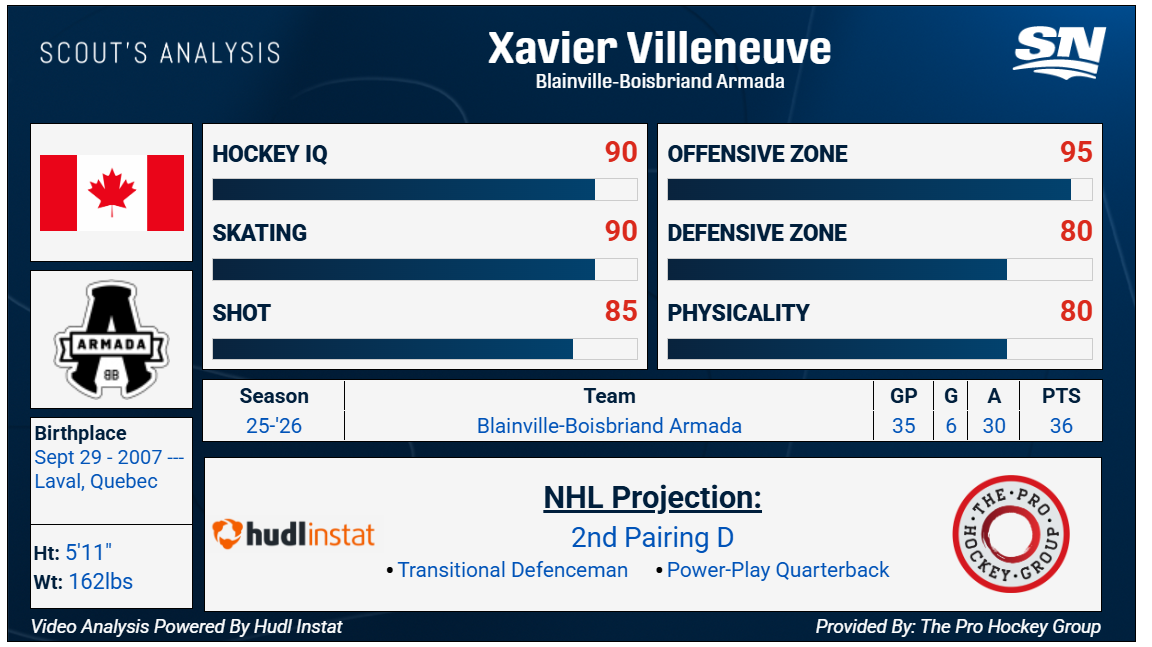
No. 17: Xavier Villeneuve, D, 5-foot-11, 162 pounds, Blainville-Boisbriand Armada (QMJHL)
Villeneuve is the most active offensive defenceman in the 2026 draft class. He craves having the puck on his stick and making plays in the offensive zone. He quarterbacks the power play and has become more of a shooting threat in addition to his elite vision and playmaking. Villeneuve competes to the best of his ability every shift. He’s engaged in the play and is always noticeable. There’s some risk/reward with this approach, but he works to win pucks back defensively and — despite his stature — engages physically.
NHL Projection: Second pair. Transitional defenceman and power-play quarterback.
No. 18: Elton Hermansson, RW, 6-foot-1, 181 pounds, MoDo (Allsvenskan)
Hermansson has spent time at the J20 and pro level with MoDo this winter. He’s a creative thinker with the puck on his stick. I believe Hermansson projects as equal parts playmaker and shooter. He’s responsible defensively and has some bump to his game on occasion. In time he will add more strength to his frame, which should result in more power and separation with his skating in open ice.
NHL Projection: Middle-six forward.
No. 19: William Hakansson, D, 6-foot-4, 207 pounds, Lulea (SHL)
Not all defencemen are required to produce offence. A player like Hakansson matches up against top lines, kills penalties and leans on opponents physically. He’s a solid skater who makes a solid first pass. When teams become contenders, they value having players like Hakansson on their roster. He will average around 20 hard minutes in a shutdown role.
NHL Projection: Second pairing defensive defenceman.
No. 20: Ilia Morozov, C, 6-foot-3, 200 pounds, Miami (NCAA)
Morozov is one of the youngest players in college hockey and a big part of the reason Miami of Ohio is on the rise as a program. He’s averaging over 20 minutes per game with all of his ice time coming at even strength and the power play. He’s a bit streaky offensively and has some work to do in the face-off circle, but his overall foundation of skill and size is attractive in this area of the first round.
NHL Projection: Middle-six forward. Combination size and power.
No. 21: Pierce Mbuyi, LW, 5-foot-11, 168 pounds, Owen Sound Attack (OHL)
Mbuyi will never leave me wanting more effort. He works to his maximum ability every night, averages over 20 minutes per game of ice time, and he’s deployed in all situations. He plays quick and averages over a point per game as well. Mbuyi is streaky. He has recently been having stretches of five-game point streaks followed by five game droughts. The fact he does more than just provide offence lands him in this slot at this stage of the season.
NHL Projection: Middle-six forward. Can be deployed in all situations.
No. 22: J.P. Hurlbert, LW, 5-foot-11, 176 pounds, Kamloops Blazers (WHL)
Hurlbert leans shooter and goal scorer more than natural playmaker. He possesses a lethal release from the weak side flank, especially on the power play when setting up in the face-off circle. His three zone detail ranges at times, but tends to be average overall. Not a pure burner in open ice. Sturdy strong in traffic. Hurlbert is currently tied for the scoring lead in the WHL with 31G-41A through 46 games.
NHL Projection: Middle-six forward.
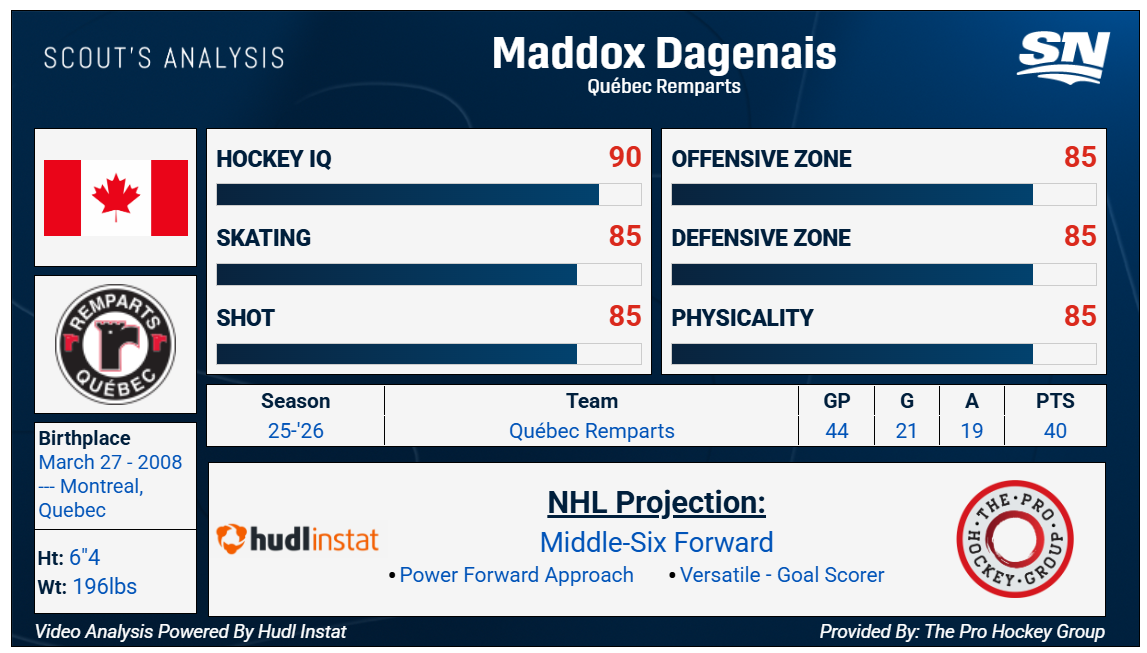
No. 23: Maddox Dagenais, C, 6-foot-4, 196 pounds, Quebec Remparts (QMJHL)
Dagenais provides an intriguing combination of power, skill, and high end compete. He tracks down opponents off the puck with proper routes to take away time and space and create turnovers. He plays a heavy style along the boards and never shies away from contact. Offensively, he leans shooter but also has a creative side to his game. His hockey sense provides coaches with the option to deploy him in a variety of roles. Infectious approach. Leads by example.
NHL Projection: Middle-six forward. Ability to slot into any line and in a variety of roles.
No. 24: Liam Ruck, RW, 5-foot-11, 176 pounds, Medicine Hat Tigers (WHL)
Ruck has been on a heater offensively and now finds himself third in the WHL scoring race with 28G-38A through 47GP. He’s a developing story and a player to keep a close eye on heading towards June. Ruck competes extremely hard and he’s consistently involved. He doesn’t shy away from working to win battles against bigger opponents and he’s being rewarded for his effort. He’s averaging over 20 minutes per game and being deployed in all situations.
NHL Projection: Middle-six forward. Potential better-than-secondary offence.
No. 25: Juho Piiparinen, D, 6-foot-1, 201 pounds, Tappara (Liiga)
Piiparinen isn’t likely to produce much offence, but he’s a very reliable defender who has the commitment and ability to match-up against top six forwards. The bulk of his ice time will always come at even strength and the penalty kill. He gaps up effectively by taking proper routes to kill plays and makes responsible decisions with the puck. He’s not the flashiest prospect, but he provides projectable value with his approach.
NHL Projection: Second pair match-up defenceman and penalty-killer.
No. 26: Malte Gustafsson, D, 6-foot-4, 200 pounds, HV71 (Sweden J20)
Gustafsson is a big body defender with room to add more weight and strength. I appreciate his skating mechanics and his overall presence in the defensive zone. He’s averaging over 23 minutes of ice time at the J20 level and is being deployed in all situations. I don’t envision Gustafsson providing anything more than secondary/depth offence, but he’s a fluid skater and capable distributor.
NHL Projection: Second pairing, two-way defenceman.
No. 27: Nikita Shcherbakov, D, 6-foot-5, 187 pounds, Ufa (Russia)
Shcherbakov is an outstanding skater for his size. He covers a ton of ground with his length and has the look of a player who should produce more offence than he does. At worst he projects as a two-way, match-up defender but my feeling is he has the potential to impact the game in all situations as he matures.
NHL Projection: Second pairing, two-way defenceman.
No. 28: Nikita Klepov, LW, 6-foot, 180 pounds, Saginaw Spirit (OHL)
Klepov’s offensive upside is intriguing. He has outstanding puck touch and is best described as equal parts shooter and distributor. His three-zone detail ranges, but his offensive upside wins out for me for now. My expectation is that he will evolve and play the game quicker and more detailed before he arrives at the NHL level.
NHL Projection: Middle-six forward. Likely the kind of forward who needs a top-six role to maximize his offensive potential.
No. 29: Egor Shilov, C, 6-foot, 177 pounds, Victoriaville Tigres (QMJHL)
Shilov craves the puck in the offensive zone. He reads the play and is adept at finding quiet ice. Pucks are on and off his stick in a hurry. Leans shooter more than playmaker or play driver, but he does have an extra gear in transition at times and will surprise opponents entering the offensive zone to create shooting lanes. But he’s far from a complete player. Adequate defensively, but not always engaged. Deployed at even strength and the power play. Has the skill to be a difference maker offensively when fully engaged.
NHL Projection: Top-six potential. Requires a scoring role.
No. 30: Alexander Command, C, 6-foot-1, 183 pounds, Orebro HK (U20)
In my opinion, Command is one of the most complete players at this stage of the first round. I appreciate the detail he plays with and the fact he influences the game with his combination of goal scoring and playmaking. He doesn’t shy away from competing in the trenches. Command is flat out trustworthy in a variety of ways and can slot into any one of the top three lines if needed.
NHL Projection: Middle-six forward. Potentially better-than-secondary offence.
No. 31: Mathis Preston, RW, 5-foot-11, 177 pounds, Vancouver Giants (WHL)
Preston’s season has been somewhat uneven and includes him being traded from Spokane to Vancouver. Preston needs to play an “in your face” style that’s armed with speed and offence. He’s willing to block shots and take a hit to make a play. There’s a lot I like about Preston’s game, but I’m hoping he can have more of an offensive influence down the stretch. He’s competitive and skilled enough.
NHL Projection: Middle-six forward.
No. 32: Wyatt Cullen, LW, 6-foot, 172 pounds, USNTDP (USHL)
Cullen is a creative playmaker and difficult to defend. He’s deceptive with fantastic vision. Cullen has the ability to draw attention and dish pucks to open linemates in high danger areas. He works to win pucks with his quickness. He’s a better-than-average threat off the rush, but it’s his small areas escapes and agility that stand out. Leans distributor more than shooter. Has the skill to drive a line. Bulk of his ice time will always come at even strength and the power play, but he has the hockey sense to kill penalties if required.
NHL Projection: Middle-six forward. Speed and skill to potentially develop into a top-six player.