
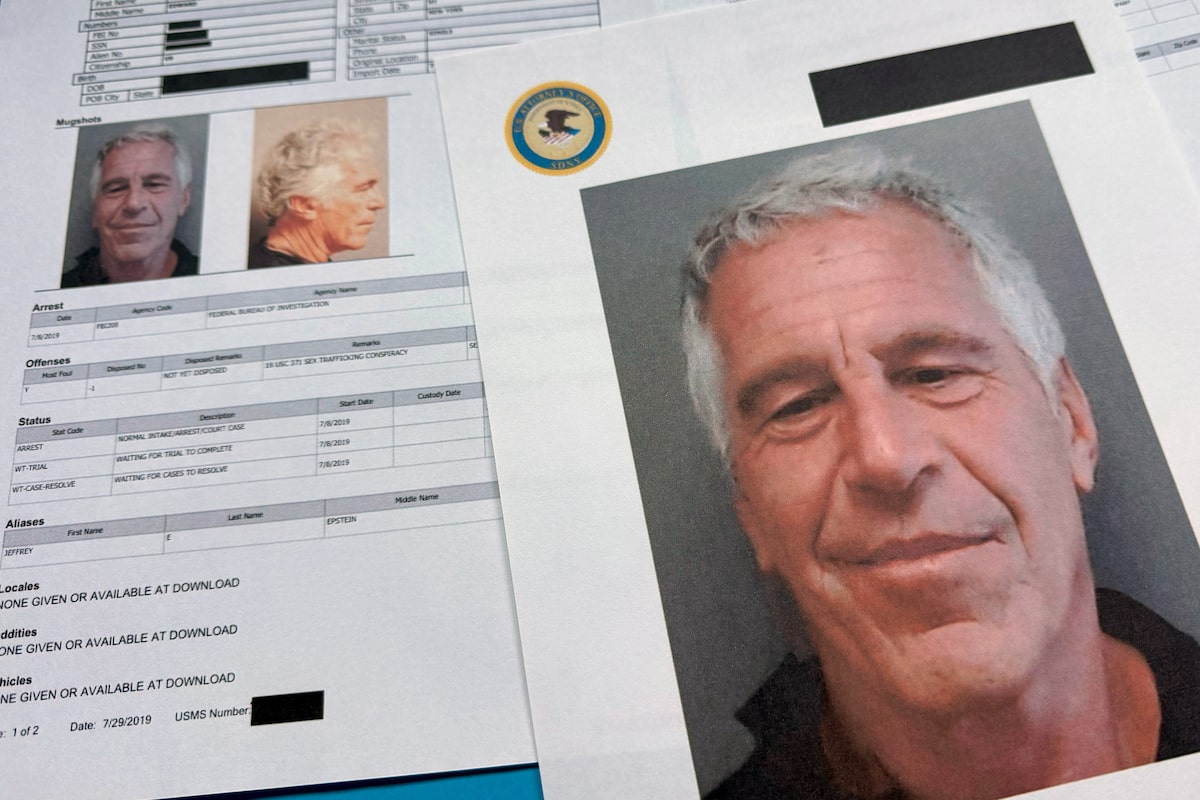
Documents that were included in the U.S. Department of Justice’s release of the Jeffrey Epstein files are seen on Jan. 2.Jon Elswick/The Associated Press
Convicted sex offender Jeffrey Epstein made repeated trips to Vancouver, where he attended the TED conference, met with high-profile tech leaders and, on at least one occasion, sought to hide his presence.
Records released by the U.S. Department of Justice on Friday contain new details about the late Mr. Epstein’s ties to Canada, showing that he entered the country despite a criminal record, which would have made him inadmissible for entry. He was convicted in 2008 in Florida of sex crimes against minors.
Deputy Attorney-General Todd Blanche said the department was releasing more than three million pages of documents in the latest Epstein disclosure, as well as more than 2,000 videos and 180,000 images.
In 2018, Canadian authorities prevented Mr. Epstein from coming into the country.
But e-mails show that he stayed in Vancouver luxury hotels in earlier years, including in 2014 and 2016.
Deputy Attorney-General Todd Blanche says U.S. Justice Department was releasing more than three million pages of documents in the latest Epstein disclosure, as well as more than 2,000 videos and 180,000 images.J. Scott Applewhite/The Associated Press
In one e-mail from late 2015, an associate of Mr. Epstein suggests that he took steps to mask his identity while booking a trip to Canada. The e-mail contains a discussion of a bill at the Fairmont Waterfront in Vancouver.
“Please remind me why we did not use JE card?” Bella Klein, an accountant, wrote in a Dec. 15, 2015, e-mail, using Mr. Epstein’s initials.
The response: “because Jeffrey does not want his name associated with the reservation as it is during the TED conferences. …” The identity of who sent that e-mail is redacted.
David Shribman: The Epstein affair has turned the MAGA narrative on its head
Global Affairs Canada did not respond to a request for comment Friday. Neither did TED, whose Vancouver conferences Mr. Epstein attended.
Fairmont Waterfront communications manager Olivia Frankel responded with an e-mailed statement: Citing guest privacy, she said, “it is our long-standing practice not to comment on or confirm the presence of any individual guests, past or present.”
Congressional Democrats, who have been key to pushing for the release of case files on Mr. Epstein, are arguing that Friday’s release is only about half of the files that have been collected.
The documents contain hundreds of friendly text messages between Mr. Epstein and Steve Bannon in the months leading up to Mr. Epstein’s suicide in August, 2019.
On June 28, 2019, Mr. Epstein messaged Mr. Bannon, a conservative activist who had served as Trump’s White House strategist earlier in the President’s first term: “Now you can understand why trump wakes up in the middle of the night sweating when he hears you and I are friends.” The context is not discernible from that exchange. Mr. Bannon responded: “Dangerous.”
On July 6, 2019, Mr. Epstein was arrested on federal sex-trafficking charges. He was found dead in his cell just over a month later.
Billionaire Elon Musk also e-mailed Mr. Epstein about visiting his infamous island compound.
In a late November, 2012, exchange, Mr. Epstein inquired how many people Mr. Musk would like flown by helicopter to the island he owned – Little Saint James in the U.S. Virgin Islands.
“Probably just Talulah and me,” Mr. Musk responded, referencing his partner at the time, actress Talulah Riley. “What day/night will be the wildest party on =our island?”
An e-mail exchange with Elon Musk is shown in this image released by the U.S. Department of Justice.U.S. Justice Department/Reuters
Spokespersons for Mr. Musk’s companies, Tesla and X, didn’t immediately respond to e-mails seeking comment Friday. Mr. Musk has maintained that he repeatedly turned down the disgraced financier’s overtures.
In 2014, Mr. Epstein was on the confirmed guest list for a meeting held at Vancouver’s Blue Water Cafe on March 17, around the close of that year’s TED program.
The list also featured prominent tech icons: Amazon founder Jeff Bezos, Google founders Sergey Brin and Larry Page, former Apple executive Tony Fadell, Israeli entrepreneur Yuri Milner, 23andMe co-founder Anne Wojcicki and other prominent investors and artists.
The Decibel: The Epstein scandal and the Canadians who knew him
Also on the list were two men with ties to Canada, Toronto-born conservative commentator David Brooks and Montreal-born Jeff Skoll, the first president of eBay.
The e-mails suggest that Mr. Epstein travelled to Vancouver by private jet, with one in 2014 indicating that he arrived at a terminal then operated by Landmark Aviation.
An itinerary for the dates around that tour includes a note reminding Mr. Epstein that a sex-offender registry wanted him to supply an updated photo.
Epstein’s e-mails paint a picture of his influence and connections even after conviction
Documents released to date do not contain records of previous attempts by Mr. Epstein to secure permission to enter Canada.
However, in 2018, he applied to the Canadian consulate in Los Angeles for a temporary-resident permit, which would let him enter Canada as a criminal, saying he intended to attend TED in Vancouver. The consulate refused his application.
Such a permit “can be issued only in exceptional circumstances that might be best described as humanitarian and compassionate, or on occasion, when compelling Canadian interests are served,” the consulate wrote.
In Mr. Epstein’s case, “there are insufficient grounds to merit the issuance of a permit.”
With a report from Associated Press