
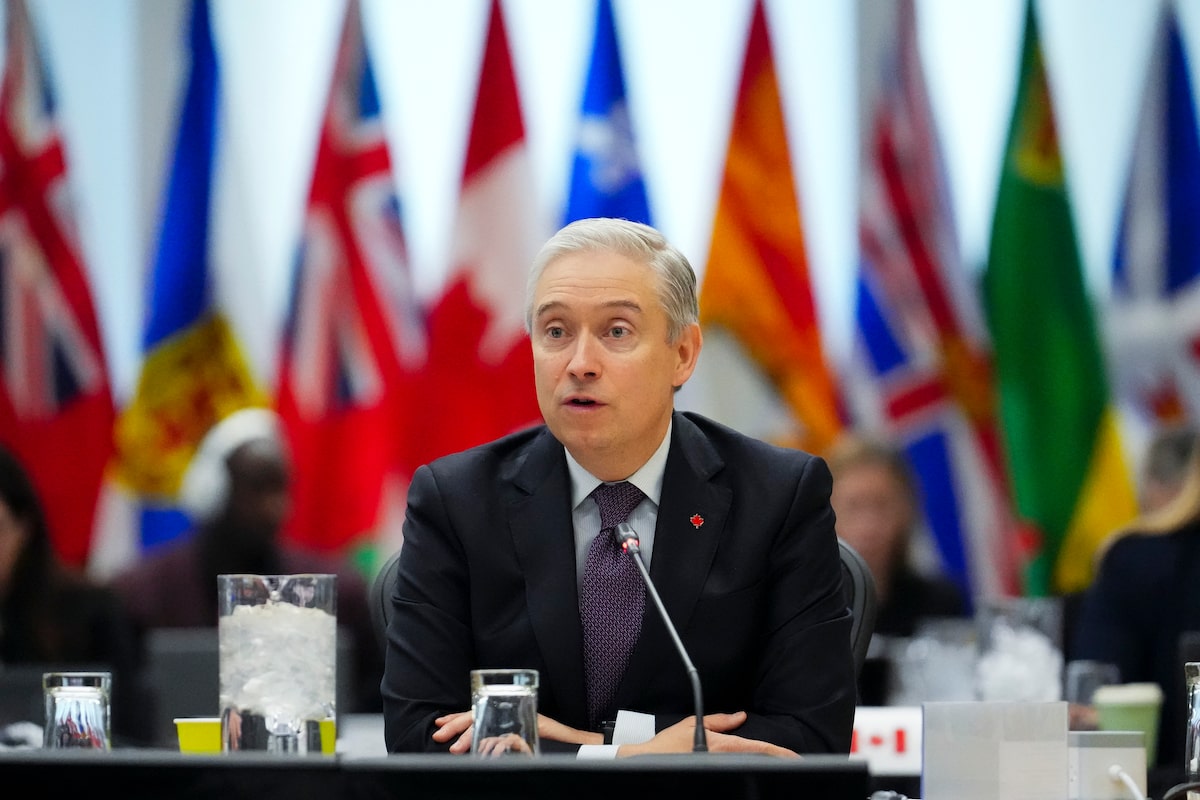
Finance Minister François-Philippe Champagne at a meeting with provincial and territorial finance ministers in Ottawa in December, 2025.Sean Kilpatrick/The Canadian Press
Canada is officially assuming a leadership role in the establishment of a new multinational bank dedicated to financing defence projects, according to the federal government.
The country was one of 13 at a meeting Friday morning, co-hosted by Ottawa and the Defence, Security and Resilience Bank, or DSRB, to discuss next steps for the bank, which will help finance a sector that has been traditionally shunned by financial institutions in Canada.
In a post to X on Friday afternoon, federal Finance Minister François-Philippe Champagne said, “Canada was pleased to host discussions with more than ten nations today on the Defence, Security and Resilience Bank – an initiative to bring together likeminded partners to mobilise capital and support collective security.”
Isabelle Hudon, chief executive officer of the Business Development Bank of Canada, attended Friday’s meeting and will continue to represent Canada in future negotiations, during which the bank’s charter and headquarters location will be decided.
“It’s a moment to meet, and it won’t be easy, but it’s worth going to this and trying hard,” she said in an interview.
Ms. Hudon said the first round of negotiations among the bank’s anchor nations will likely begin in March. It’s unclear who the other anchor nations are but participating countries will include NATO members and their Indo-Pacific allies.
Canada in the running to headquarter new multinational defence bank
The statement by Mr. Champagne is the first public endorsement of Canada’s participation in the multilateral lending institution at the federal level. Until now, lobbying for Canada’s involvement in the DSRB, and its potential to host the headquarters, has been largely at the provincial and municipal government level.
“We’re pleased to see Canada step into this role on the back of the Prime Minister’s speech in Davos,” said Kevin Reed, president of the bank’s development group, referencing Prime Minister Mark Carney’s message at the World Economic Forum about a ruptured international order.
Meanwhile, Canadian cities such as Ottawa, Montreal and Toronto have been aggressively campaigning to land the headquarters of the bank, despite not yet receiving confirmation that the head offices will be in Canada. British Columbia Jobs Minister Ravi Kahlon and Ontario Premier Doug Ford have also endorsed hosting the bank in their respective provinces.
This race to the hypothetical top comes, in part, from a desire to land the 3,500 defence finance jobs the bank is expected to create, according to Mr. Reed. That, and being the global hub for meetings of member countries.
A week ago, the Ontario government unveiled its own “bid book” detailing Toronto’s pitch to host the bank, which it launched in December last year. The province has chosen to back the city’s efforts, despite an equally bullish pitch by Ottawa, where leaders in the capital city and neighbouring Gatineau are working together on a campaign.
The DSRB is the brainchild of Rob Murray, CEO of the bank’s development group and founding architect of NATO’s Defence Innovation Accelerator for the North Atlantic, as well as its Innovation Fund.
BDC targets rockets, semiconductors as first investments under new defence strategy
The bank will be owned by its member countries, which will be asked to contribute in two ways: paid-in and callable capital. The former is an upfront contribution made when a country joins the bank, like a down payment. The latter is a promise to provide extra money if the bank is ever in a crisis – a factor that will help secure an AAA rating for the bank.
Ms. Hudon said Canada’s financial contribution to the bank could be more than $1-billion but this is not yet finalized. Initial contributions made by NATO members will count toward their commitment to spend the equivalent of 5 per cent of GDP on defence.
The Royal Bank of Canada is the first Canadian institution to announce its support of the DSRB, alongside JPMorgan Chase & Co., ING Group NV, Deutsche Bank, Commerzbank AG and Landesbank Baden-Württemberg.