
DEVELOPMENT PLANNING
January 30, 2026 by Anthony Teles  1.7K
1.7K
College Park Proposal Revision Swaps Tower Heights, Bumps Supertall Slightly
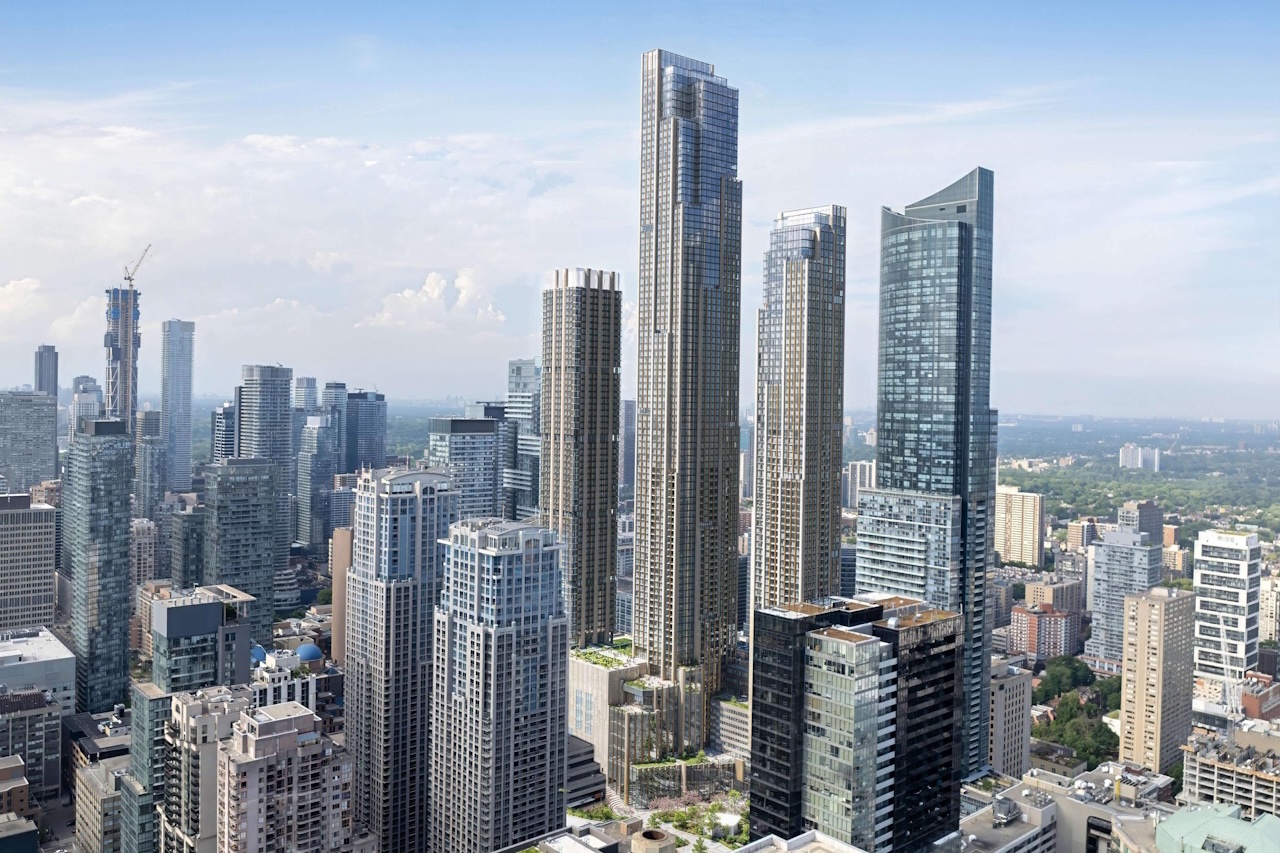
Revised plans have been filed for the College Park redevelopment at Yonge and College streets in Downtown Toronto, amending the three-tower mixed-use proposal with refinements to the massing, rental suites, and phasing. Designed by Hariri Pontarini Architects for GWL Realty Advisors, the new plan lops 10 floors off the top of the north tower and adds the same to the south tower, effectively swapping 65- and 75-storey building locations, while retaining a central 96-storey ‘supertall’ building of over 300 metres, while giving that tower a slight height boost.
Looking northeast to the revised College Park Redevelopment, designed by Hariri Pontarini Architects for GWL Realty Advisors
College Park is at the southwest corner of Yonge and College streets, and is addressed to 420 through 444 Yonge Street and 1 through 23 College Street. The site is currently occupied by the historic College Park complex and neighbours, and is noted for its seven-storey Art Deco volume housing retail, office, and cultural uses including the Carlu event venue on the seventh floor, a residential rental building to the south, and a modern office tower to the west.
Looking southwest to College Park, image courtesy of GWL Realty Advisors
Originally constructed between 1928 and 1930 as Eaton’s College Street department store, College Park was conceived as a monumental Art Deco complex by Ross & Macdonald, intended to rival the scale and ambition of early 20th-century North American commercial landmarks. Acquired by GWL Realty Advisors in 2000, the complex underwent a major restoration that returned the seventh-floor auditorium to public use as the Carlu event venue. In July, 2025, an initial development application was submitted. Now, Urban Strategies Inc. has submitted revised Zoning By-law Amendment and Official Plan Amendment applications to the City of Toronto on behalf of the developer.
Previous design by Hariri Pontarini Architects for GWL Realty Advisors
The revised proposal maintains the general site layout introduced in July, 2025 of three new residential towers rising from an expanded and restored podium. With 10 floors have been transferred from the North Tower to the South Tower, new heights from their lowest main ground level doors reach 235.23m (North — 65 storeys) and 271.15m (South — 75 storeys), while the Central Tower, still 96 storeys, and with a previous top height of 333.37m, would now read as 344.29m. The 10 storey redistribution maintains the general density of the redevelopment while reducing the redevelopment’s impact on Old City Hall and New City Hall heritage view corridors. These changes plus other tweaks to the podium result in a slight reduction in the Floor Space Index from 20.94 to 20.89 times coverage of the site, and a Gross Floor Area (GFA) trimmed marginally from 236,304m² to 235,771m².
Height transfer diagram, image from submission to City of Toronto
Total residential GFA increases slightly from 164,263m² to 166,004m², with minor adjustments to condominium GFA (rising) and rental GFA (reduced). Non-residential uses would total 69,767m², down from 72,041m², and continue to include retail, flexible commercial space, hotel accommodation, daycare, and cultural uses, with retail and hotel areas increasing while flexible commercial space is reduced.
Looking northeast to the redesigned College Park Redevelopment, designed by Hariri Pontarini Architects for GWL Realty Advisors
Across the site, the resubmission proposes 2,339 residential units, a modest increase from 2,334 units previously, delivered across a mix of rental replacement, purpose-built rental, and condominium housing. All rental housing would be consolidated within the north tower, including 216 rental replacement units, down from 244 in the July, 2025 plan, while restoring a like-for-like replacement by bedroom type and reducing surplus replacement units, increasing the proportion of two- and three-bedroom units from 34% to approximately 44% through adaptable and convertible layouts. Vertical circulation across the three towers would be provided by 20 residential elevators, with six elevators each in the 65- and 75-storey towers and eight elevators in the 96-storey tower, yielding an average ratio of roughly one elevator per 117 units, meaning that high speed motors will be necessary to provide prompt response times.
Programming diagram, image from submission to City of Toronto
Resident amenities are expanded, with total amenity space increasing from 11,467m² to 12,284m². Indoor amenity areas rise notably from 5,616m² to 6,892m², while outdoor amenity space is reduced from 5,892m² to 5,392m². Outdoor amenities atop the podiums will see trellis structures added in several areas to mitigate wind effects. Public realm improvements extend to the open space network at ground level as well, where on-site parkland dedication increases from 530m² to 600m², consolidated into a single contiguous space adjoining the existing Barbara Ann Scott Park. A canopied trellis structure is now planned at ground level as well, also to mitigate windspeeds at ground level.
Ground floor plan, designed by Hariri Pontarini Architects for GWL Realty Advisors
Heritage conservation continues to be overseen by ERA Architects. The approach prioritizes extensive in-situ retention of the original building, including full conservation of the Yonge and College street facades and partial retention of the south and west elevations, alongside a new podium addition that interprets the original design’s scale and materiality. Interior restoration would reinstate the ground level Arcade and revitalize the seventh-floor Carlu spaces.
Looking northeast to the podium, designed by Hariri Pontarini Architects for GWL Realty Advisors
Below grade, the redevelopment would retain a three-level underground garage with parking spaces remaining at 76 spaces, unchanged from the July, 2025 proposal. Bicycle parking increases from approximately 2,980 to 3,189 spaces. A key operational change relocates bicycle parking serving the north tower into that tower’s base building, shifting access from Hayter Street to College Street to make it far more convenient for North Tower residents.
The site functions as a major pedestrian gateway to College subway station via an existing entrance embedded within the complex, along with a new south entrance, already under construction. TTC surface transit routes also serve College, Carlton, Bay, and Yonge streets on the edges of the complex.
An aerial view of the site in orange and surrounding area, image from submission to City of Toronto
College Park sits within one of Toronto’s most intensely developing stretches of the Yonge Street corridor. North of the site, nearby projects include The G2 with towers proposed to rise 31 and 33 storeys, a proposed redevelopment at 475 Yonge featuring 75- and 78-storey towers, and an 80-storey proposal at 2 Carlton. To the south, major projects include the 66-storey proposal at 415 Yonge, a 75-storey tower planned at 399 Yonge, the 85-storey Concord Sky currently under construction, an 85-storey proposal at 372 Yonge, and the Chelsea Green development, envisioned as three towers ranging from 31 to 90 storeys.
UrbanToronto will continue to follow progress on this development, but in the meantime, you can learn more about it from our Database file, linked below. If you’d like, you can join in on the conversation in the associated Project Forum thread or leave a comment in the space provided on this page.
* * *
UrbanToronto’s research and data service, UTPro, provides comprehensive data on construction projects in the Greater Golden Horseshoe—from proposal through to completion. Other services include Instant Reports, downloadable snapshots based on location, and a daily subscription newsletter, New Development Insider, that tracks projects from initial application.
