
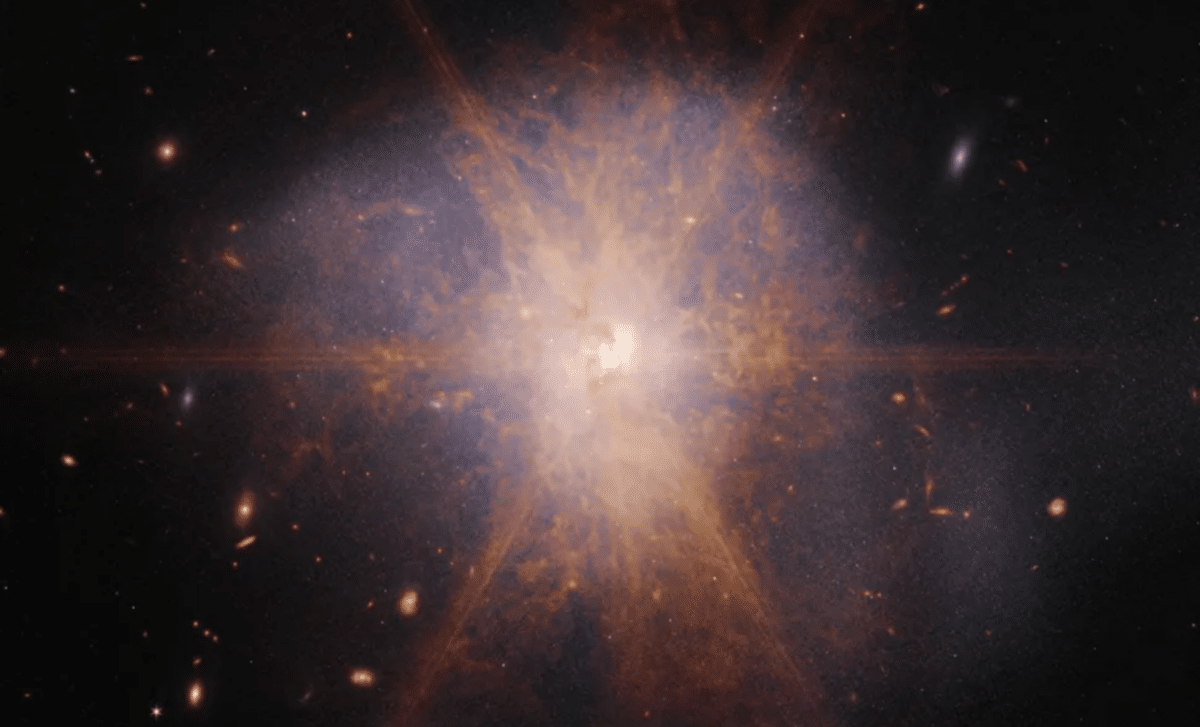
In a new study published in The Astrophysical Journal Letters, a team of astronomers has uncovered extraordinary details about the forces shaping the merging galaxy system Arp 220. Using the advanced capabilities of the Atacama Large Millimeter/submillimeter Array (ALMA), researchers have mapped the magnetic fields within Arp 220, providing the most detailed picture of this cosmic collision to date. These findings reveal a “magnetic superhighway” through which violent galactic winds travel at incredible speeds of 1.1 million miles per hour.
The Role of Magnetic Fields in Galactic Mergers
The merging galaxy system Arp 220, located approximately 250 million light-years from Earth, has long been of interest to astronomers due to its powerful star formation and energetic processes. However, the new study, published in The Astrophysical Journal Letters, provides a deeper understanding of how magnetic fields shape the galaxy’s winds and outflows.
“We used ALMA to map the orientation and strength of magnetic fields in the twin galaxies,” said Enrique Lopez-Rodriguez, the team leader from the University of South Carolina.
This detailed map shows how the magnetic fields not only influence the winds but also guide them along structured paths, affecting how gas, dust, and metals are expelled into space.
This discovery is pivotal in understanding the mechanisms behind the rapid evolution of galaxies in the universe. The magnetic fields, previously thought to play only a passive role, are now recognized as active participants in the formation of cosmic structures. This new information reshapes our understanding of galaxy mergers and their outcomes, including how the debris from such events can seed the intergalactic medium with material necessary for future star formation.
Unveiling the Magnetic Superhighway
The most striking feature of the study is the discovery of what the scientists describe as a “magnetic superhighway.” This channel of magnetized gas is a direct result of the powerful winds emanating from the twin cores of Arp 220. “This revealed previously unseen details about Arp 220’s dust-enshrouded cores and molecular outflows,” stated Josep Miquel Girart, the study’s lead in the observational work, and a researcher at the Institut de Ciències de l’Espai. The magnetic fields act like a highway, guiding material and cosmic rays away from the galaxy’s dense central regions, extending far beyond the galactic boundaries.
The discovery of the magnetic superhighway marks a breakthrough in our understanding of how galaxies evolve under extreme conditions. The magnetic fields are not only guiding the outflows but are crucial in regulating the rate at which material is expelled from the galaxy, providing insights into the mechanisms that may influence galaxy growth and star formation.
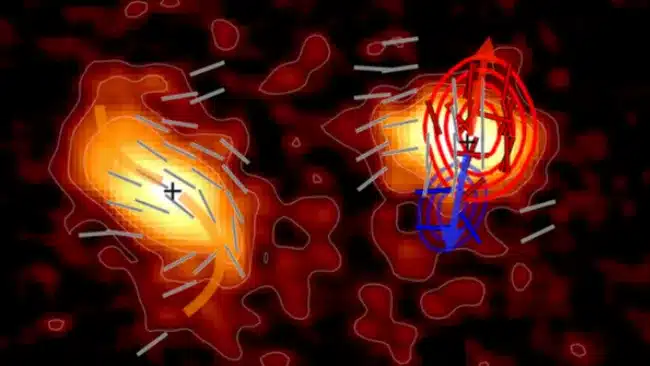 The magnetic fields of the galactic disk and dusty and molecular outflow of the merging galaxy Arp220 observed by ALMA. (Image credit: Lopez-Rodriguez, E. (USC; polarization data), Girart, J.M. (ICE-CSIC and IEEC; polarization data); (Barcos-Muñoz, L. (NRAO; 3GHz data))
Powerful Winds and Star Formation in Arp 220
Arp 220’s twin cores are undergoing intense star formation due to the merger of two spiral galaxies. The new study reveals that the galaxy’s powerful outflows, which carry gas, dust, metals, and cosmic rays at speeds 1,500 times faster than the speed of sound on Earth, are significantly influenced by magnetic fields. These winds, believed to be driven by star formation and black hole activity, are now shown to be shaped by the magnetic structures within the galaxy.
The fast-moving molecular outflows from Arp 220 not only carry material away from the galaxy but also influence its overall structure and growth. The alignment of the magnetic fields with these outflows ensures that the material is directed in specific pathways, contributing to the dynamic evolution of the system. This finding challenges previous assumptions that magnetic fields only play a passive role and emphasizes their active role in controlling the flow of matter.
Magnetic Fields and Their Role in Galaxy Evolution
One of the most compelling aspects of the study is the revelation that the magnetic fields within Arp 220 are hundreds to thousands of times stronger than those found in our own Milky Way galaxy. This makes the magnetic forces in Arp 220 a powerful agent in shaping the galaxy’s structure and evolution. These strong magnetic fields regulate the movement and cooling of gas, influencing when and how new stars are born.
The researchers also found that these intense magnetic fields are responsible for regulating how material is lost from the galaxy, offering a new perspective on the life cycle of galaxies. By shaping the winds that escape the galaxy’s core, the magnetic fields play a key role in controlling how galaxies evolve and interact with the intergalactic medium. This finding has profound implications for understanding the future of galaxies and their ability to continue forming stars over billions of years.