
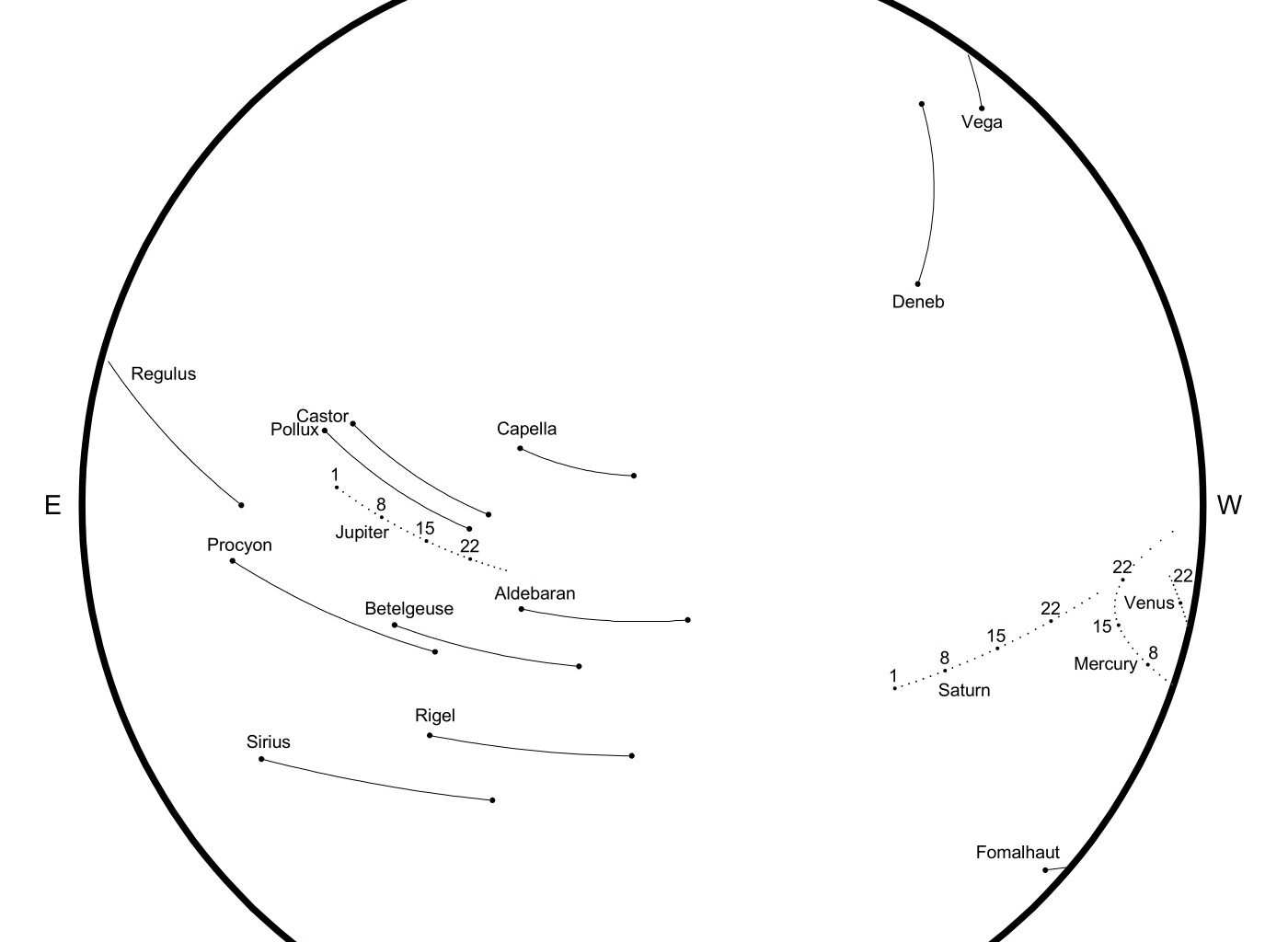
In the skies of Earth in February, six of the seven other planets—all except Mars—can be seen in the early evening, but not all at once.
Look for the two innermost planets in twilight: Mercury is best in the second and third weeks, before dropping down and fading quickly in the final week. If you have an unobstructed view toward the west, you can begin noticing Venus below Mercury by midmonth. Venus will slowly improve, reaching its highest position in twilight in June and remaining an “evening star” through September. The four giant outer planets can all be seen in a dark sky at nightfall, although Saturn and Neptune sink very low in the west by month’s end.
On Feb. 1, the full moon rises nearly at the same time the sun sets. By nightfall, the moon is about 15° up in the east-northeast to east, with 1.4-magnitude Regulus, heart of Leo, the Lion, just risen 14° to the moon’s lower left. Jupiter shines at magnitude -2.4 in the east, nearly 30° to the moon’s upper right and nearly halfway from horizon to overhead. Note the “Twin” stars Pollux and Castor, of magnitude +1.1 and +1.6, respectively, now 9° and 10.3° to Jupiter’s lower left and left. After the moon and Jupiter, the next brightest object in the sky at nightfall is the star Sirius, of magnitude -1.4, blue-white in color, and twinkling noticeably.
On Feb. 2, the moon, one day past full, rises in the east just before the end of evening twilight. Using binoculars, look very near the moon’s upper left edge and try to spot the star Regulus. By first light of dawn on Feb. 3, the moon and star will be more than 5° apart in the western sky, with Regulus to the moon’s lower right.
On Feb. 3 at nightfall, the waning moon hasn’t risen yet, and Saturn presents itself as a star of magnitude +1.1, about 22° up in the west-southwest. Using binoculars, look for a 1° by 3° rectangle of stars to the lower left of Saturn. Its two upper stars, of fifth magnitude, are each 1° from Saturn tonight, forming an isosceles triangle. The rectangle’s two lower stars, near magnitude 4.5, are each 3.6° from Saturn, making another isosceles triangle. The four stars, in the constellation Pisces, the Fishes, form part of a little-known asterism, Testudo, the Turtle. A telescope shows the rings of Saturn, on Feb. 3 tipped 2.3° from edge-on, and can show Neptune as a faint, 7.9-magnitude “star,” 1.5° to the upper right of Saturn, and 1.8° to the upper right of 29 Piscium, the upper left star of the rectangle.
For the rest of February, Saturn and Neptune can be seen as close in the sky as they will be until the year 2132. Saturn overtakes Neptune at intervals of about 35 years; but their conjunctions in 2061 and 2096 will be hidden from view on the far side of the sun. We’ll have more to say below about finding Neptune, as Saturn creeps closer to it until Feb. 20.
The other giant planet is Uranus. Discovered in 1781, before Neptune by 65 years, it appears seven times brighter, at magnitude 5.7, bright enough for the unaided eye in very dark skies, in the same field as the Pleiades star cluster. On Feb. 3, Uranus ends retrograde, so it shifts only 1/4° east against the stars this month. Look 5° south and slightly west of Alcyone, the Pleiades’ brightest star, and 0.8° southwest of 5.7-magnitude 13 Tauri, a close match in brightness to Uranus.
On our evening twilight map accompanying this column, connect, in order, the eastern endpoints of the trails for these seven stars: Sirius, Procyon, Pollux, Castor, Capella, Aldebaran, Rigel and back to Sirius. This is where you will find the stars of the Winter Ellipse, or Winter Hexagon, on February 1. To find where these stars will appear on Feb. 28, connect the west endpoints of the trails. Note Jupiter and Betelgeuse lie inside the polygon. Other evening stars include Deneb sinking into the northwest, and Regulus, heart of Leo, the Lion, rising in the east-northeast and climbing into the east. At opposition on Feb. 18 and visible all night, Regulus is plotted on both our twilight maps, evening and morning.
The twilight maps plot only the naked-eye planets and the brightest stars. The three stars of Orion’s belt, of second magnitude, are not plotted, but can be found about midway between Betelgeuse and Rigel. In the sky, you can follow the line of three stars in one direction to find Sirius, the brightest star. Extend the belt in the opposite direction, past Aldebaran and the nearby Hyades, to the very compact Pleiades cluster.
There are currently no planets visible in morning twilight. (Mars rises very shortly before sunrise.) The brightest stars are golden Arcturus, high in the southwest, and blue-white Vega, in the east-northeast. Other bright stars are Altair and Deneb, completing the Summer Triangle with Vega; Spica, about 33° below Arcturus; Antares, the red supergiant heart of the Scorpion, in the south-southeast to south; and Regulus, sinking in the west.
You can follow the waning moon in the morning sky as it passes three bright zodiacal stars: Regulus on Feb. 2-3; Spica on Feb. 6-7; and Antares on Feb. 10-11. In each pair of dates, the closer conjunction appears on the second morning. The southernmost moon occurs in Sagittarius near the tip of the Teapot’s spout on Feb. 12. The lunar crescent is easily seen for three additional mornings, through Feb. 15.
Let’s return our attention to the western sky at dusk, where Mercury has begun its best evening apparition of this year. At magnitude -1.0 on Feb. 10, it’s easily visible low between the west-southwest and west, provided your view is unobstructed. Look earlier, and you might catch Venus before it sets, 6° to the lower right of Mercury. After Venus sets and the sky darkens a bit, Saturn becomes visible, within 23° to the upper left of Mercury. Jupiter shines in the east, 107° from Saturn. The lineup of planets Mercury-Saturn-Jupiter visible to unaided eye is 129° long.
Remember that the two faint outer planets are also part of the lineup. On Feb. 15, Neptune is 0.91° due north of Saturn, i.e., on a line from Saturn to its upper right, toward the North Star. Now both planets fit into the same low-power telescopic field. Uranus has barely moved away from the position described for Feb. 3.
On Feb. 18 is perhaps this month’s most spectacular sight: a thin, 3 percent young crescent moon with earthshine illuminating its upper side, and the planet Mercury very close to the lower right of the moon’s sunlit side. Try taking photographs at different stages of twilight. An earlier shot in a brighter sky will show Venus 8° below Mercury, but may not show earthshine so well. A photo in deeper twilight will show Saturn 12° to the upper left of the moon and Mercury. The lineup of seven solar system bodies, Venus-Mercury-moon-Saturn-Neptune-Uranus-Jupiter, spans 125°.
On the next evening, Feb. 19, the 8 percent crescent moon stands 5° to the upper right of Saturn, while Mercury, still bright at magnitude -0.5, reaches greatest angular distance, 18° from the sun, and climbs to its greatest altitude above the western horizon in twilight.
On Feb. 20, Saturn passes Neptune in their closest visible approach until more than a century from now. Before the sky darkens fully, locate Saturn 17° below the 15 percent crescent moon. Next, through a telescope, look for the 7.9-magnitude planet 50’ (arcminutes) to the right of Saturn, and 2° to the upper right of the fifth-magnitude star 29 in Pisces. The best time to look is shortly before the end of twilight, before the rare planet pair drops any lower!
Mercury lingers 10° to the lower right of sinking Saturn Feb. 22-26, while fading sharply from magnitude 0 to +1.2, and starting retrograde against the stars on Feb. 25. By Feb. 27, when it passes 4.5° to the upper right of Venus, the innermost planet fades through magnitude +1.6 and may be lost in bright twilight. Venus, take over!
Meanwhile, the moon continues its eastward trek through the zodiac. On Feb. 23, the 45 percent fat crescent passes narrowly north of the main stars of the Pleiades, with the leading dark edge covering 5.7-magnitude outlier 18 Tauri in a telescopic event at 6:52 p.m. in Palm Springs. On the next evening, the 57 percent moon passes a wide 11° north of Aldebaran, the Bull’s eye. On Feb. 25, the month’s highest and northernmost moon, at 68 percent, stands 6° east of Elnath, or Beta Tauri, tip of the Bull’s northern horn.
On Feb. 26, the 78-percent moon passes within 5° north of bright Jupiter. Compare the moon-planet separation to that of the Twins, Pollux and Castor, nearby. On the next evening, the 87 percent moon appears within 5° southeast of Pollux.
At dusk on Sunday, March 1, the star Regulus will appear 5 to the degrees lower left of the 98 percent moon, which closes in on the star all night, falling just short as they set in the brightening dawn on Monday. Overnight on Monday to Tuesday, March 2-3, the moon will be full, with a special event: A total lunar eclipse, the first of two major lunar eclipses visible from California this year.
When most or all of the moon is immersed within Earth’s shadow, the shaded portion is not completely dark, but typically takes on a coppery reddish or rusty color, from sunlight which has passed through Earth’s atmosphere and been refracted, or bent, into the shadow, to reach the moon. The bluer light passing through lower levels of Earth’s atmosphere has been scattered out in different directions, causing our daytime skies to appear blue.
For the predawn eclipse on Tuesday, March 3, set your alarm to get up and out by 1:50 a.m. if you want to catch the start of partial eclipse. That’s when the moon first starts to enter the umbra, or dark, circular central core of Earth’s shadow. The total eclipse will last for nearly one hour, from 3:04 a.m. until 4:03 a.m. Within that hour, the moon will appear deepest within the shadow, and likely darkest, around 3:34 a.m. Partial eclipse will conclude at 5:17 a.m., when the moon completely exits the umbra.
If you don’t wish to follow the entire three hours and 27 minutes of moon’s encounter with Earth’s shadow, the most impressive 20 minute intervals to follow would be centered on the beginning and end of totality: from 2:54 until 3:14 a.m., and from 3:53 until 4:13 a.m.
Again, that’s early Tuesday morning, March 3. Wishing you clear skies!
The Astronomical Society of the Desert will host a star party on Saturday, Feb. 14, at Sawmill Trailhead, a site in the Santa Rosa Mountains at elevation 4,000 feet; and on Saturday, Feb. 21, at the Santa Rosa and San Jacinto Mountains National Monument Visitor Center. For more information, visit astrorx.org. Check that website also, for a link to “Impromptu Star Parties” which I am planning to offer in the west valley, mostly in Palm Springs.
The Abrams Planetarium Sky Calendar includes illustrations of many of the events described in this column, as well as an evening constellation chart. To subscribe for $12 per year or to view a sample, visit www.abramsplanetarium.org/skycalendar.
Robert Victor originated the Abrams Planetarium monthly Sky Calendar in October 1968 and still helps produce an occasional issue. He enjoys being outdoors sharing the beauty of the night sky and other wonders of nature. Robert Miller, who provided the evening and morning twilight charts, did graduate work in planetarium science and later astronomy and computer science at Michigan State University, and remains active in research and public outreach in astronomy.