
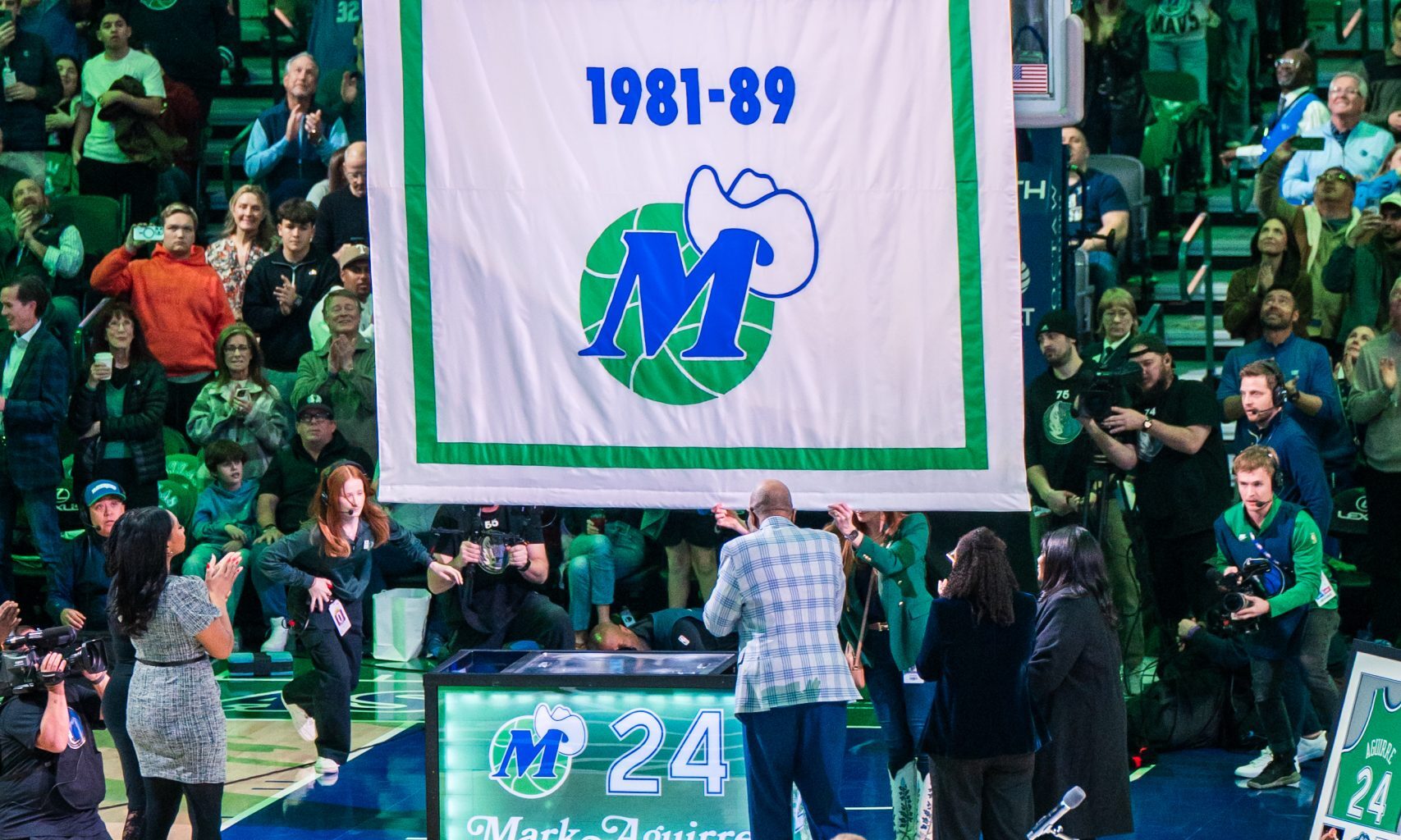
Overview:
The Dallas Mavericks honored Mark Aguirre by retiring his No. 24 jersey, making him the first true star of the franchise. Aguirre, the Mavericks’ first No. 1 overall pick in 1981, became the standard-bearer for a franchise still learning how to compete. He averaged nearly 19 points per game as a rookie, peaked at 29.5 points per game during the 1983-84 season, earned three All-Star selections in Dallas, and finished his Mavericks tenure with 13,930 points – still among the franchise’s all-time leaders. Aguirre’s jersey retirement was about origin, accountability, and the people who shaped both the player and the organization.
DALLAS – The absence has lingered for years, even as the story of the Dallas Mavericks continues to grow. On this night that gap finally closed. Mark Aguirre’s No. 24 was raised into the rafters honoring the franchises first true star and acknowledging a foundation laid long before banners sellouts and playoff expectations became routine in Dallas.
With the ceremony complete, Aguirre now officially takes his place alongside former teammates Rolando Blackman and Derek Harper. Joining the core figures who defined the Mavericks rise in the 1980s. Together they represent the era that transformed an expansion team into a contender and gave Dallas its first basketball identity.
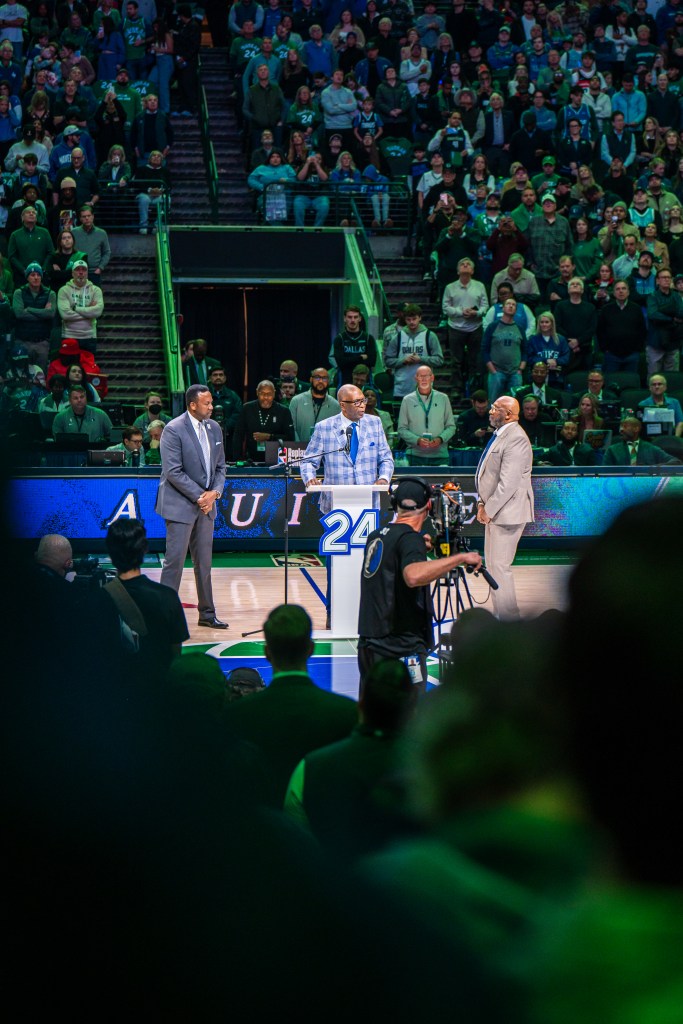 Photo by Darah Hubbard @itsdarah
Aguirre, the Mavericks first No 1 overall pick in 1981 became the standard-bearer for a franchise still learning how to compete. He arrived without ceremony and carried the responsibilities immediately. But the jersey retirement was never only about numbers or accolades. It was about origin accountability and the people who shaped both the player and the organization.
That perspective surfaced early in the press conference when I asked Aguirre about Derrick Rose, whose jersey had been retired earlier in the week, and what Chicago continues to mean to the game of basketball.
“I hope I did a little bit to show what Chicago basketball is all about,” Aguirre said. “Without people like Isiah that’s where it began. He carried that tradition forward. He was an excellent player. He won MVP.”
When it was noted that Rose remains the youngest MVP in NBA history, Aguirre paused before nodding,
“That’s Chicago,” he said. “We expected excellence. When you earned that stripe on your shoulder, you’re part of that group.”
Roots Before the League
“Coming to Dallas and playing for Don Carter shaped who I am. It humbled me”
Mark Aguirre
Aguirre’s story begins on Chicago’s West Side, where basketball was less pastime than lifeline. It was an environment that demanded toughness awareness and resilience, shaping his approach long before the NBA entered the picture. That foundation followed him to the DePaul Blue Demons where he became one of the nation’s most feared scorers under legendary coach Ray Meyer and led DePaul to the 1979 Final Four.
“Coach Ray Meyer laid the foundation for who I became,” Aguirre said. “He gave me room to grow”.
In 1981, Dallas selected Aguirre No 1 overall, making him the first top pick in franchise history and placing immediate responsibility on his shoulders. There was no easing into the role. The Mavericks needed a face, a scorer and a leader, and Aguirre became all three at once.
“Coming to Dallas and playing for Don Carter shaped who I am,” Aguirre said. “It humbled me”
He leaned on the values instilled at home to navigate the transition from Chicago to a new city and a new role.
“My mother made sure I took my faith with me when I came here,” he said. “That helped me.”
Carrying a Franchise
From the moment he arrive, Aguirre became the Mavericks offensive foundation. He averaged nearly 19 point per game as a rookie, peaked at 29.5 point per game during the 1983–84 season, earned three All-Star selections in Dallas and finished his Mavericks tenure with 13,930 points — still among the franchise’s all-time leaders.
“There are no shortcuts in this game,” Aguirre said. “What you put in is what you get out.”
His mindset was uncompromising.
“I gave everything I had,” he said. “If I played against you I wanted to beat you.”
That edge helped lift Dallas from expansion afterthought to Western Conference contender highlighted by a run to the 1988 Western Conference Finals. It was the clearest sign yet that the foundation Aguirre helped pour was beginning to hold weight.
“You can’t just show up and expect success.” Aguirre said. “That doesn’t happen in this league.”
A Brotherhood Forged Before the NBA
As the night unfolded the most emotional moments centered on Aguirre’s lifelong bond with Isiah Thomas, his childhood friend from the same Chicago neighborhood.
“We grew up together,” Aguirre said. “He knows me completely. There’s nothing I can hide from him.”
Thomas later explained why the night carried meaning beyond basketball.
“To see Mark honored like this embraced by the Mavericks organization and the city of Dallas, is a dream come true,” Thomas said. “It’s bigger than anything we experienced on the court.”
Their upbringing was defined by scarcity and survival.
“We were hungry everyday,” Thomas said. “We were just surviving. You couldn’t think about next week or next year. It was hour to hour.”
Basketball provided both relief and direction.
“If it weren’t for basketball taking that mental strain away” Thomas said, “those were very difficult times.”
One and Two, Then Champions
Their parallel paths converged at the 1981 NBA Draft, when Aguirre went No 1 and Thomas No 2 — an outcome Thomas said was never in doubt.
“Dick Motta asked me who the best player in the draft was” Thomas said. “There was no question it was Mark Aguirre. In our neighborhood he was always No 1.”
Though their careers began in different cities — Aguirre in Dallas Thomas in Detroit — the connection never faded.
“We talked everyday,” Aguirre said. “It was always about winning a championship.”
That shared pursuit eventually reunited them as teammates in Detroit where they won NBA titles together. Childhood friends became champions completing a circle that began on Chicago blacktops and extended to the NBA’s biggest stage.
Recognition, At Last
Years later, standing inside the arena for Aguirre’s jersey retirement, the magnitude of the journey still felt surreal.
“We never imagined a life like this,” Thomas said. “We didn’t even know places like this existed.”
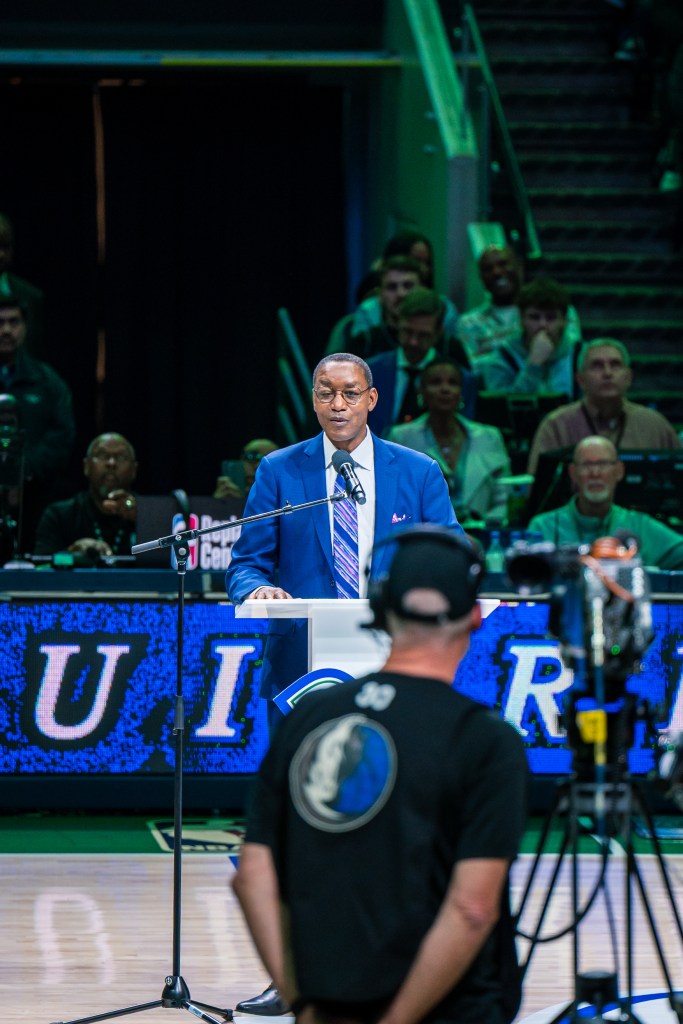 Mark Aguirre’s No. 24 jersey retirement ceremony honors the Dallas Mavericks’ first star, acknowledging the foundation he laid for the franchise. Photo by Darah Hubbard @itsdarah
Aguirre in turn, reflected on the lineage that followed him in Dallas and the standard carried forward by those who came next.
“When I look at the players who came after me, especially Dirk, I have nothing but respect,” he said. “You have to acknowledge greatness.”
For a long time, Aguirre wondered if this night would ever come.
“If it happened it happened,” he said.
But teammates like Blackman and Harper never let him felt overlooked, repeatedly reminding him that the Mavericks story felt incomplete without his name represented above the floor.
The Moment That Sealed It
As the press conference ended emotion replaced words. Thomas stepped onto the podium first and embraced Aguirre. After a pause Thomas motioned for Blackman to join them. The three stood together — Chicago roots Dallas foundation and championship pedigree sharing the same space.
“Teammates,” Aguirre said softly. “Real teammates.”
When No 24 rose into the rafters, it honored a career built on survival, brotherhood, and belief — and the people who made sure Mark Aguirre was never forgotten.
Related