
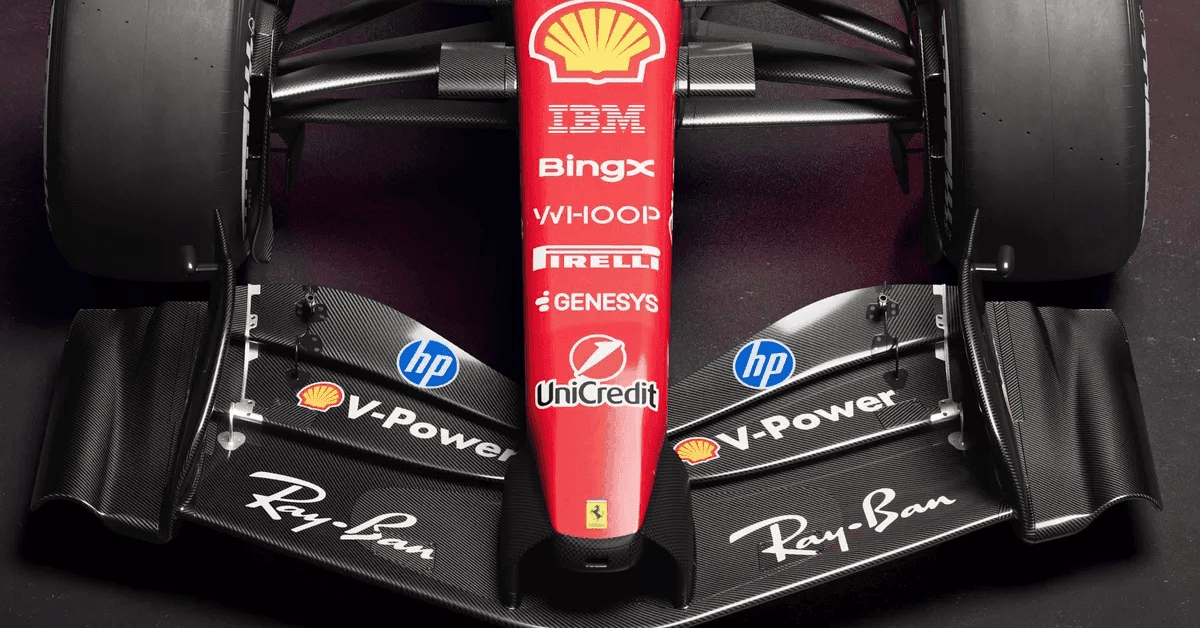
The 2026 technical regulations introduce a major shift in how Formula 1 cars generate aerodynamic downforce and manage the balance between the front and rear axles. This change is not merely regulatory—it is conceptual—and becomes particularly clear when observing the work carried out on the front end of the car, from the first design interpretations and, even more so, Aston Martin’s approach under the technical guidance of Adrian Newey.
To fully grasp the significance of these choices, it is helpful to compare them with the era of Venturi tunnels and modern ground effect, developed between 2022 and 2025. During that regulatory cycle, the floor was the absolute center of performance. Venturi tunnels provided high and relatively consistent downforce, as long as the car operated within a well-defined setup window. When this condition was met, the front-to-rear balance remained consistent throughout a corner, and the front wing retained an active role in fine-tuning front-end behavior. This setup, while highly effective, brought with it conceptual rigidity. Dependence on the floor made cars sensitive to ride-height changes and transitional phases, especially under braking and corner entry. In many cases, the front wing acted as a corrective tool to compensate for platform instability or mechanical deficiencies, maintaining a balance that was largely static.
With the 2026 regulations, this paradigm is being overturned. The FIA deliberately reduces the impact of “pure” ground effect, keeping the floor as the main source of downforce but limiting its ability to generate absolute aerodynamic grip. The floor also becomes more sensitive to longitudinal setup changes, losing efficiency more sharply during braking and corner entry compared to the Venturi-era cars. The result is less continuous downforce and a front end that tends to lose support earlier than in the past. It is in this context that work on the front wing takes on a completely new significance. 2026 wing geometries appear visually simpler, with fewer elements and a drastic reduction in outwash. This simplification should not be interpreted as a loss of sophistication but as a change of function. The front wing is no longer tasked with generating direct downforce to “hold” the front, but rather with managing airflow coherently with the behavior of the floor and the platform.
Aston Martin’s approach fits perfectly within this logic. The solutions adopted on the front end, consistent with the technical philosophy historically associated with Adrian Newey, do not seek maximum downforce but flow control. The front wing works in an extremely clean manner, with a more central load distribution and a deliberate reduction in lateral extremes. The goal is not to push air outward, but to feed the underfloor in a stable and predictable way, reducing sudden balance changes in critical cornering phases. This setup becomes even more relevant when viewed from a dynamic balance perspective. Unlike the 2022–2025 era, 2026 F1 cars can no longer be considered as having a single equilibrium point. Front-to-rear balance varies depending on speed, setup, and driving phase. In this scenario, an aggressive front wing could amplify transitions, while a more neutral and consistent wing allows for a more stable platform.
Adding to this trend is the new power unit. Increased electric contribution and a different energy management strategy make rear-end stability strongly dependent on corner exit power delivery. Battery state of charge and energy usage strategies therefore become integral to the car’s overall balance. In this context, a less aggressive but more predictable front end becomes a rational technical choice, not a conservative one. The overall result is a balance that is slightly more rearward than in ground-effect cars, but above all, less artificial. It is no longer the front wing that “holds the car together,” but the integration between aerodynamics, mechanics, and energy management. The front end becomes a control tool, not a compensatory one.
The work seen on 2026 cars, and especially Aston Martin, clearly anticipates the technical direction of the new era. The 2026 regulations do not reward the most aggressive solution, but the one that is most systemically coherent. Front-to-rear balance is no longer a fixed value but a behavior to be managed. And it is precisely in this ability to control, rather than in visually striking solutions, that the new technical hierarchies of Formula 1 will be defined.

The 2026 F1 regulations therefore mark a pivotal shift where the front end evolves from a compensatory tool into a primary instrument of flow control, dictating the stability of the entire aerodynamic platform. By prioritizing predictable airflow over raw downforce, as seen in Adrian Newey’s latest designs for Aston Martin, teams are adapting to a new era where dynamic balance and energy management are inextricably linked. Ultimately, the 2026 championship will likely be decided by those who best master this systemic integration, proving that the secret to speed in the new hybrid era lies in the sophisticated governance of air rather than mere aggression on the wings.
Feb 1, 2026Alex Marino
Let other Scuderia Fans know about us


