
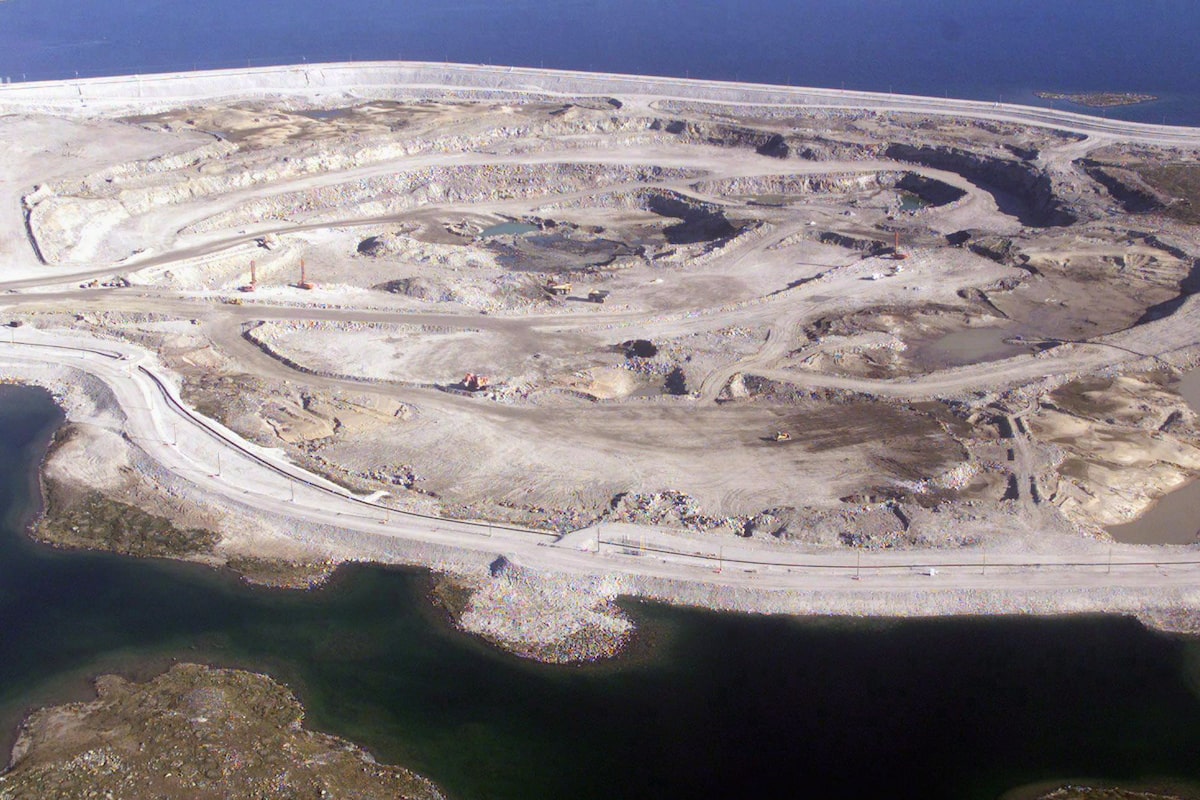
Lac de Gras surrounds the Diavik mine pit about 300 km northeast of Yellowknife, NWT, in July, 2003.ADRIAN WYLD/The Canadian Press
The Canadian diamond industry, which has been a massive boon for the Northwest Territories, is on its last legs. The active mines are reaching end of life, and the value of these precious gems has collapsed due to lab-grown diamonds. The governments in Ottawa and Yellowknife need to accept this reality, and stop spending money to prop up a fading industry.
There was much excitement about the discovery of Canadian diamonds in 1991, and the first stones were mined at Ekati, near Lac de Gras, in 1998. Today, NWT’s three operating mines contribute 20 per cent of its GDP. The mines are the largest private-sector contributors to the economy, with an estimated 3,200 employees, and they have fostered the creation of many Indigenous businesses. But the lucrative industry is set to go off a cliff.
Rio Tinto’s Diavik mine is set to stop operating in March, with several years of reclamation activities to follow. De Beers’s Gahcho Kué is expected to wind down in 2030 or 2031. Ekati had previously been expected to stay open until around 2029 or longer, but its Australian owner, Burgundy Diamond Mines, had a recent near-brush with bankruptcy that has locals fearing the mine could close earlier than planned.
The mine closures have been expected, given the bulk of reachable stones have been extracted. However, short-term pressures on the mines have increased due to the rise of lab-grown diamonds, which can be produced in a matter of weeks, and are identical to the naked eye.
Moissanite versus lab-grown diamonds: Which one should you choose?
Many lovebirds, seeing they can get a diamond for an engagement ring four times the size for the same price, are switching to synthetic stones. Canadian diamonds have long marketed themselves as an ethical alternative to “blood diamonds” that fuel conflict in Africa, but artificial stones can make the same claim. Lab-grown stones are also practical for industrial use, where prices aren’t buoyed by sentimental value. As a result, natural diamond prices have tumbled, pushing most NWT mine owners into losses.
Ekati is being kept afloat by a $115-million loan the federal government issued in December. The loan is from the Large Enterprise Tariff Loan (LETL) facility, which is meant for companies “most impacted by U.S. tariffs and trade disruptions.” It’s an odd fit, given that Ekati’s diamonds are sold primarily in Belgium, although Burgundy notes that rough diamond markets have been impacted by the 50 per cent U.S. tariff on imports from India, where most of the world’s diamonds are cut and polished. The more direct challenge to Ekati is low diamond prices, which Burgundy cited as the reason it suspended production at part of its mine last year.
The federal government loan is a poor use of taxpayer dollars. Not only are natural diamonds a declining industry, but because of Burgundy’s overall weak health, any jobs saved aren’t guaranteed to be around for long. Its June financial report had a “going concern” note saying it wasn’t expected to generate sufficient cash flow to pay its obligations. Even after receiving the loan, Burgundy said if diamond prices didn’t rebound in six to 12 months, it might need more funding.
The federal assistance followed $11.2-million in property tax breaks given to the three mines by the NWT government in April. Ekati received an extra $1.7-million return of money it paid into a carbon-tax fund. Those measures didn’t stop Ekati from cutting several hundred jobs a few months later.
Instead of giving in to pressure to fund declining industries, governments should focus on building a strong economic foundation for future growth. Increased defence concerns could bolster the case for a road through the territory to a port in Grays Bay, Nunavut, but the NWT shouldn’t leave its economic future entirely to the whims of Ottawa decision-makers. In order to reduce the territory’s already heavy dependency on government jobs and federal transfers, a bigger effort should be made to reduce barriers to private sector growth, says Heather Exner-Pirot, director of energy, natural resources and environment at the Macdonald-Laurier Institute.
It’s time for NWT’s government to focus on the territory’s future – not its past. It should take a hard look at permitting times, tax and royalty rates, environmental rules and hiring requirements that drive up costs for business. No single industry can fill the hole left by diamonds, but critical minerals, tourism and fishing all have growth potential. The loss of diamonds will hurt, but creating a better business climate will help foster new industries, whatever they are.