
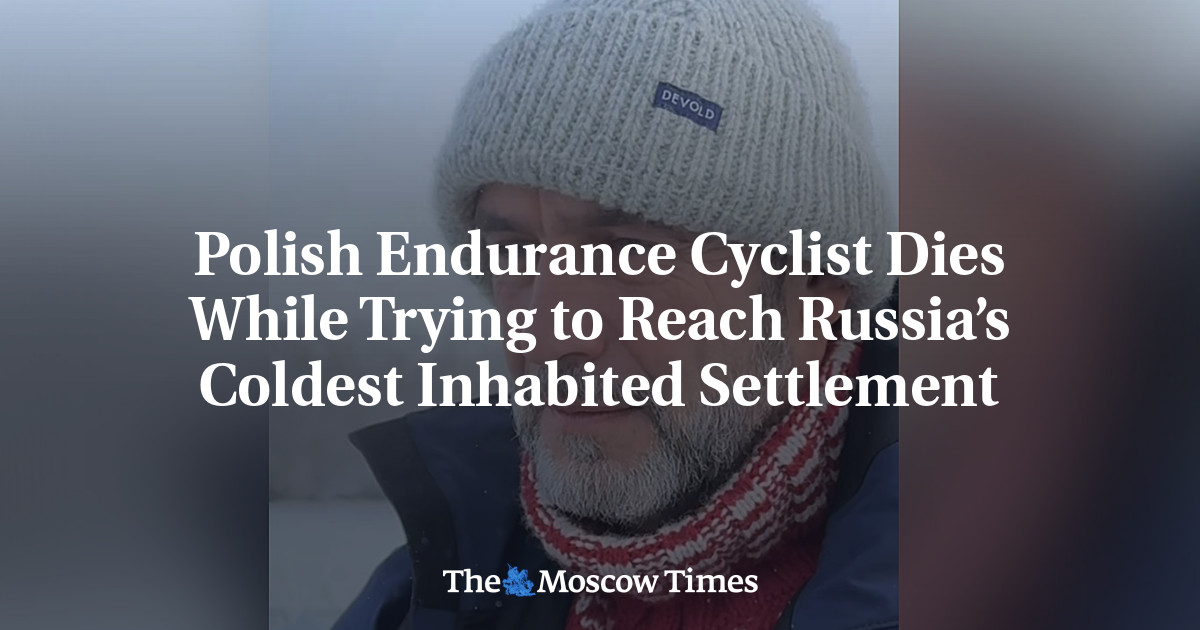
A Polish endurance cyclist has died in the Siberian republic of Sakha (Yakutia) while trying to reach the world’s coldest permanently inhabited settlement by bike, local authorities said this weekend, though the cause of his death remains unknown.
Adam Borejko, 52, was in the middle of a nearly month-long journey from the regional capital of Yakutsk to Oymyakon, a village known as the world’s coldest permanently inhabited settlement. He aimed to cover 914 kilometers (568 miles) during the trip.
Borejko checked in to a hotel along his route in the village of Khandyga on Saturday only to be found dead in his room the following night, emergency authorities in Sakha said on Sunday.
Local police launched an investigation into the cyclist’s death.
Pyotr Novgorodov, who serves as head of Khandyga, told the local news outlet SakhaDay that Borejko’s body would be transferred to Yakutsk on Monday, where an autopsy will determine the cause of death.
Emergency authorities said Borejko had received a safety briefing before embarking on his bike journey on Jan. 25 and that his location was monitored through a tracking device. Borejko was scheduled to arrive in Oymyakon on Feb. 18.
The journey between Yakutsk and Oymyakon was the third and final section of Borejko’s multi-year effort to “overcome the greatest forces of nature” — heat, altitude and cold. Temperatures in Oymyakon are known to drop below minus 50 degrees Celsius (minus 58 Fahrenheit) during the winter.
In March 2023, Borejko cycled across the Sahara Desert and the High Atlas Mountains of Morocco, where temperatures can surpass 50 C (122 F). The following year, he cycled from southern to northern India, crossing the world’s highest rideable passes in the Himalayas at more than 5,000 meters (16,400 feet).
Borejko, a father of four from the northeastern Polish city of Zambrow, said on Instagram he experienced “minor health issues” during a test ride in and around Yakutsk last week.
“I already know this will be the most difficult experience in my life,” he wrote.
In an interview last month, Borejko said: “I feel an inexplicable pull toward Siberia, to Yakutia. Sometimes I sense that, spiritually, I’m closer to the Yakut people than to modern Europe.”