
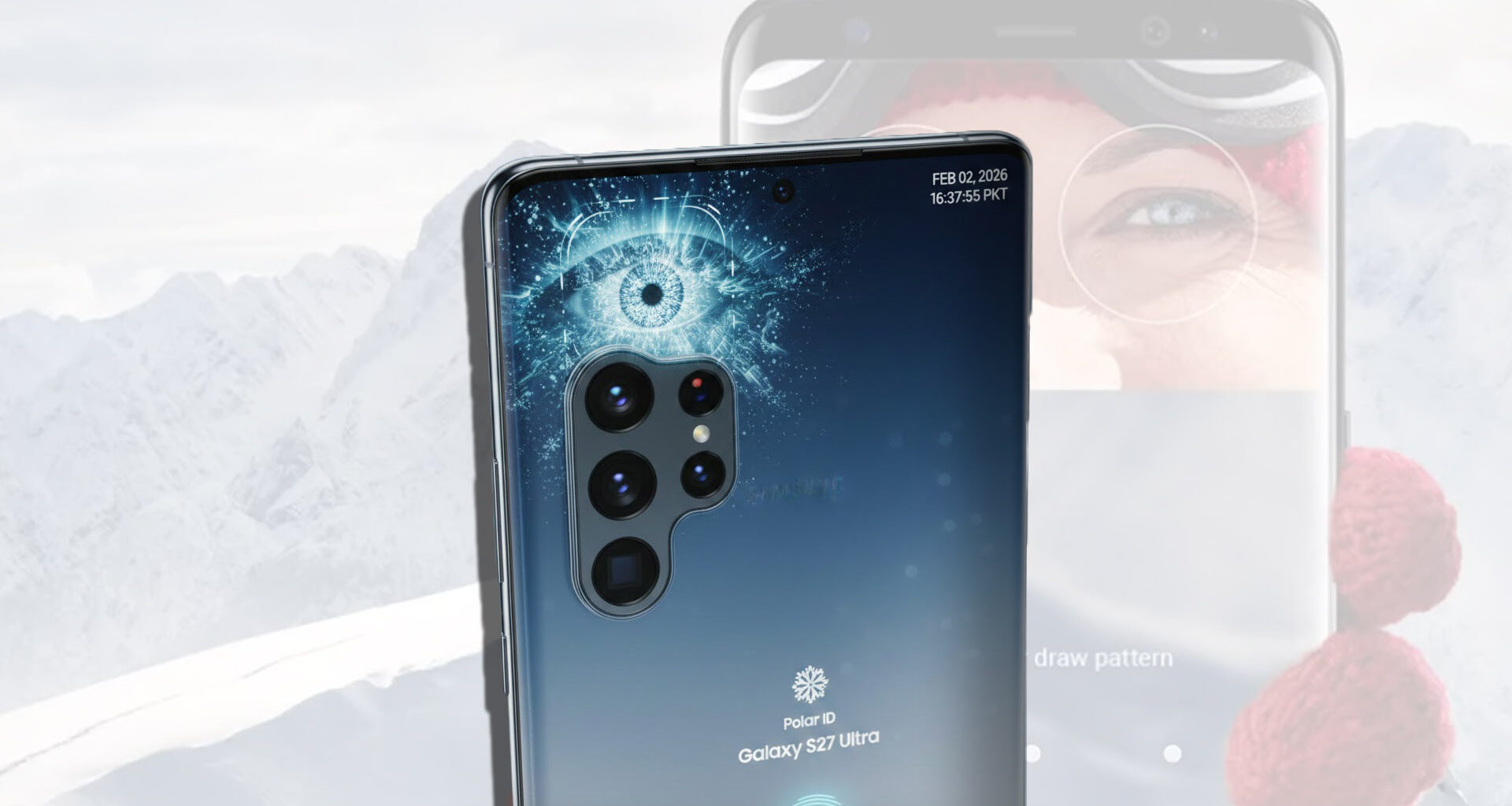
The only time that Samsung came close to replicating Apple’s Face ID technology on its Galaxy smartphones was with its iris scanner, which debuted on the Galaxy S8 lineup. Since then, the company has incorporated the ever-reliable fingerprint scanners on its devices, but the Galaxy S27 Ultra could offer something that’s a tier above Face ID. The latest report mentions the use of Polar ID, which leverages polarized light instead of 3D depth mapping for facial recognition. The use of this technology also removes one glaring obstacle: the need for a cutout to accommodate the necessary components.
Polar ID on the Galaxy S27 Ultra will be difficult to spoof, as inorganic materials reflect light with different polarization states, unlike skin
Details shared by @phonefuturist also explain how Polar ID works, if and when it will be found on the Galaxy S27 Ultra. Like Face ID, a combination of hardware and software is involved, with the device emitting IR light towards the user, with meta-optics filtering the polarized state of the reflected light. Next, a specialized sensor records the image, capturing the visual and polarization data at the same time. Lastly, the Galaxy S27 Ultra’s secure enclave processes this ‘polarization map’ against the stored reference, with the device unlocking if both details match.
For those wondering about spoofing, organic and inorganic material reflect light with entirely different polarization states, making it next to impossible to bypass Polar ID. Additionally, with Face ID requiring a cutout to house components like the IR camera, dot projector, and flood illuminator, Polar ID shrinks this entire stack, with the details mentioning a 50 percent reduced size compared to Face ID. This design advantage will allow Samsung to maintain the front-facing punch-hole cutout style on the Galaxy S27 Ultra.


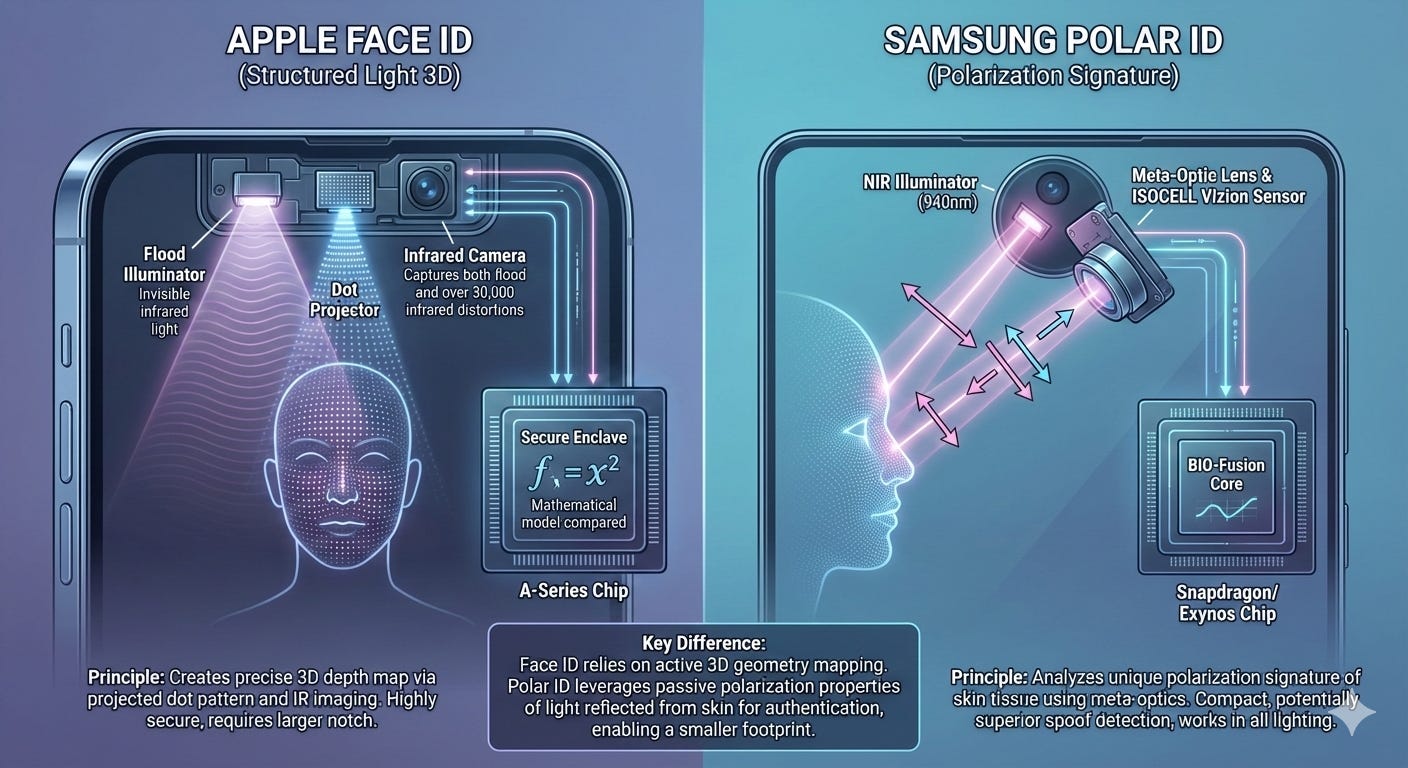
Polar ID is estimated to feature an unlocking time of 180 milliseconds, which is as fast as Apple’s Face ID. This technology is also less affected by external lighting conditions and when wearing objects such as glasses or a mask on the face. Most importantly, Polar ID is expected to be cheaper than Face ID, meaning that, in the future, if Samsung can reach economies of scale, these components can find their way into more affordable smartphones.
News Source: @phonefuturist
Follow Wccftech on Google to get more of our news coverage in your feeds.