

One of the major tech stories that came out of the 2025 Tour de France was the dominance of aero bikes. The reason for this development is speed. Since the pros are now going so fast, averaging more than 40 km/h, even on big mountain days, aero matters all the time. Tadej Pogačar rode all the Tour de France’s road stages on Colnago’s Y1Rs—an unapologetically all-out aero bike—despite having access to the lighter V5Rs. Jonas Vingegaard similarly rode the entire Tour on Cervélo’s S5, even though he could have hopped on the newly launched, super-lightweight R5.
But does this hyper-focus on aero apply to the rest of us? With the opportunity to test the Van Rysel RCR-F, a full-on aero road bike, I decided to find out for myself. Van Rysel may not be familiar to many Canadians, but the brand from Lille, in northern France, has already been supplying the Decathlon AG2R La Mondiale WorldTour team (now Decathlon CMA CGM) with good success for the past two years. The bikes will be available in Canada starting this year, through a small but growing dealer network.
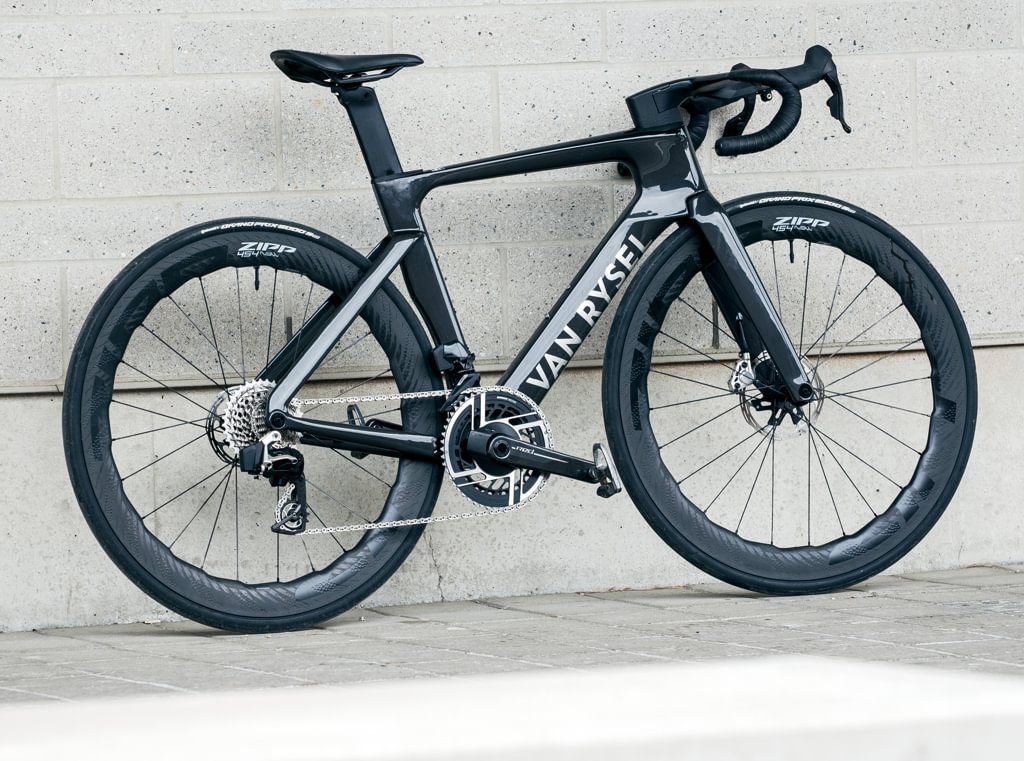 Van Rysel RCR-F Pro II Red PW. Image: Matt Stetson
The aerodynamic features of the Van Rysel RCR-F
The RCR-F, with its deep profile tubes throughout, shows it’s about pure speed. According to the company, the RCR-F (F for fast, natch) is 13.6 W faster than its all-around RCR Pro (at 45 km/h). Van Rysel is confident that the RCR-F is one of the fastest aero bikes currently available. Of course, every brand says this when it launches a new bike. But Germany’s Tour magazine took an RCR-F to a wind tunnel and it just missed out on the lowest drag in the history of the test by a couple of watts. Thus, it’s the fastest bike currently raced in the WorldTour. While that claim isn’t definitive—as no single test is the last word—it is safe to say the RCR-F is among the most aerodynamic options available.
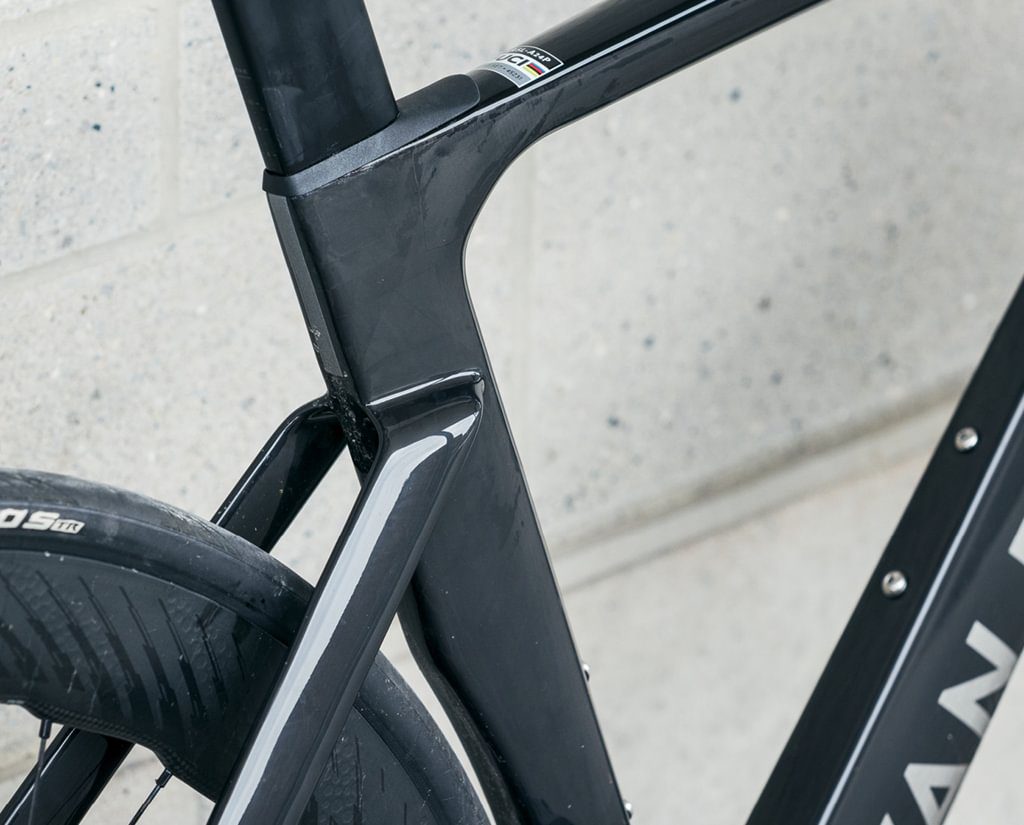 Image: Matt Stetson
A lot of the design focus is placed on the front of the bike, where the RCR-F features one of the deepest headtubes I’ve seen on any bike. The same goes for the one-piece cockpit with its fat wing-shaped tops. Van Rysel put a lot of attention into the design of this bar. It features 12 degrees of flare from hoods to drops. On my test bike, this setup translated to a progressive 37-cm width at the hoods and 42 cm at the drops, allowing me to cut a narrower profile on the hoods and to maintain control at the hooks. The arrangement makes a lot of sense since the rider is 75 to 80 per cent of the total system drag. Anything to improve the aerodynamics of the rider will pay large dividends. Yet, spec’ing narrow bars is something that some brands still struggle with as they put 42 cm or wider bars on their super aero race bikes. That fat top is quite uncomfortable to hold, though if you are spending any length of time on the tops, the RCR-F is probably not the right bike for the job.
With the bike’s stated aero and sprint focus, Van Rysel paid a lot of attention to the drops, too, where designers have added inserts, what the company calls the ErgoDrops, that shapes the hooks into more of pistol grip-like shaping. I am ambivalent about this feature. The ErgoDrops do provide a more comfortable and secure grip, if you are gloveless or wearing thin gloves. With thick winter gloves, I found the inserts a little too bulky to grip comfortably. It is, however, simple to unwrap the bar tape and remove the ErgoDrops if you find you don’t get on with them, which is a good thing as the stock bar is the only one compatible with the RCR-F. Although Van Rysel says it is considering making adapters to allow for other bar-and-stem combos, there is nothing available at this time. Through the dealer you will be able to source different sizes from stock should that be necessary.
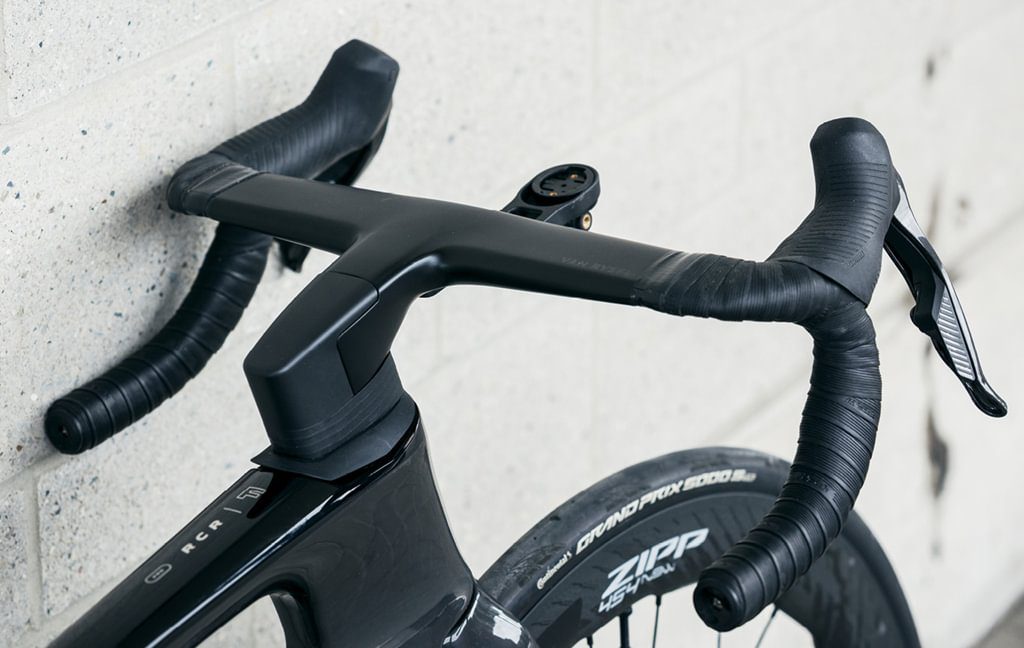 The bar/stem combo is designed in conjuction with Deda. On this size small Van Rysel RCR-F bike, the bar has a 37-cm width at the hoods and is 42 cm at the drops. Image: Matt Stetson
I also found the included (nice) combo head unit and light/action camera mount to be less stout than it should be (less nice). It’s fine if you are running just a head unit, but it flexes more than I like when a light is also attached. I never lost my Garmin, but it would flop in a threatening manner when I went over big bumps. Fortunately, the mount uses a pretty standard two-bolt system, so aftermarket options exist.
The RCR-F’s cockpit is well thought out with split spacers. You can run spacers on top of the stem for height adjustment without re-running brake hoses. But, you will have to cut and bleed brake hoses for a bar swap or when servicing the headset. In other words, all of the usual caveats for a proprietary integrated front end apply. Unfortunately, these maintenance challenges are increasingly the norm for modern road and gravel bikes. At least with an all out aero bike like the RCR-F, the compromises associated with an integrated cockpit in pursuit of aerodynamic gains are somewhat more justified than other types of bikes.
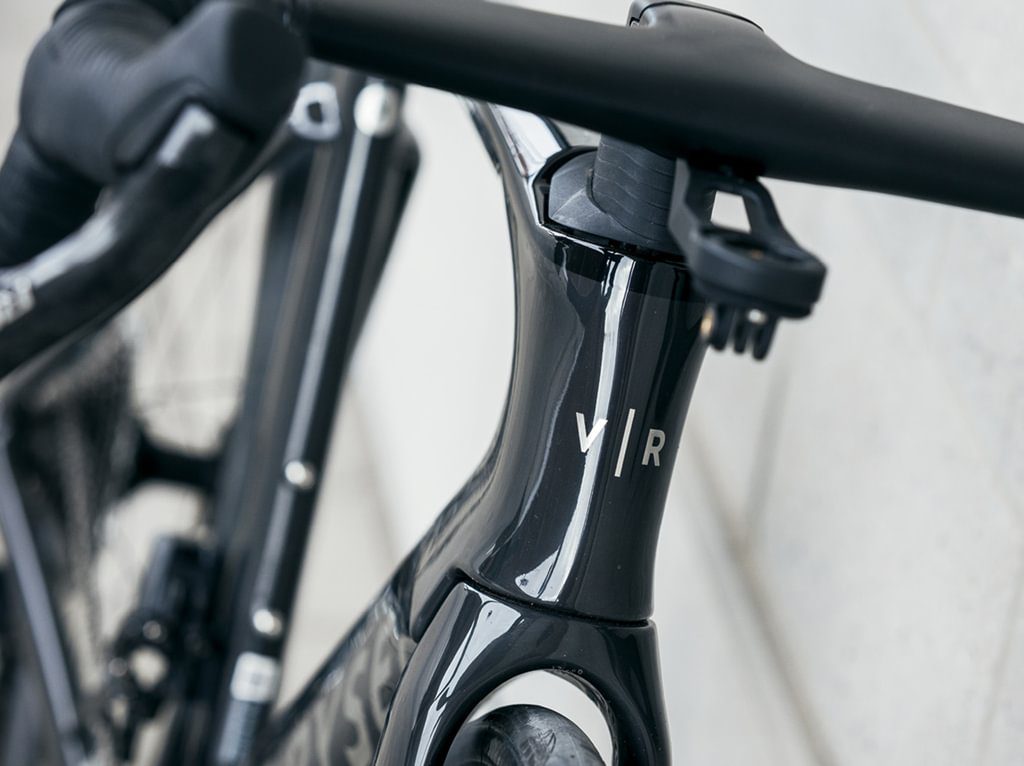 The aero Van Rysel RCR-F head tube. Image: Matt Stetson
The geometry of the RCR-F is quite long and low. Compared with peers, such as the Trek Madone, Specialized Tarmac and Giant Propel, the RCR-F features a longer reach by approximately 1 cm and a lower stack across the range of sizes. It’s great for getting aero, as long as you can handle that kind of position. This longer geometry of the RCR-F’s shines when carving arcing, high-speed corners.
How the Van Rysel RCR-F feels out on the roads
On my initial shakeout rides aboard the RCR-F, I was slightly underwhelmed. It felt competent, as you would expect with a modern flagship carbon race bike, but it wasn’t a stand out. It didn’t help that I got persistent seatpost slippage on those first couple of rides despite ample carbon friction paste applied. After a quick email to Van Rysel, I got a suggestion to ensure that all sliding surfaces of the seatpost wedge were well-greased (along with a helpful diagram for the process), which took care of the issue. It was a good reminder to read the assembly manual carefully if you own one of these carbon-fibre super bikes.
The RCR-F showed its true colours once I met up for a small group ride. On a spirited two-hour ride, I could feel the bike come into its own once speed got faster than 35 km/h. The faster we went, the better it felt. When I glanced down at my Garmin, the watts weren’t notably lower than usual, as if I was pushing 20 W fewer. The feeling was of being able to sustain threshold efforts longer, which is the real-world payoff of a well-designed aero bike. It won’t turn you into Olav Kooij all of a sudden as the real-world savings are a fraction of what wind tunnel tests show and marketing copy claims. What a good aero bike like the RCR-F can do is take the edge off hard efforts just a little, making them slightly more bearable, and help you hold on and keep putting out the watts.
The feeling of added speed also showed up in other subtle ways. On one of my regular test loops, there is a downhill into a T-junction. Depending on traffic, I can sail through carving a wide turn carrying all of my speed or pump the brakes, either way the sight lines are clear for me to assess the situation before committing. My first time down it on the RCR-F, I saw traffic in the intersection and proceeded to stop at my usual brake point, only to have to squeeze the brakes in semi-panic when I realized I was carrying more speed than usual. SRAM’s superb Red calipers were more than up to the task, but I was struck by the feeling of easy speed.
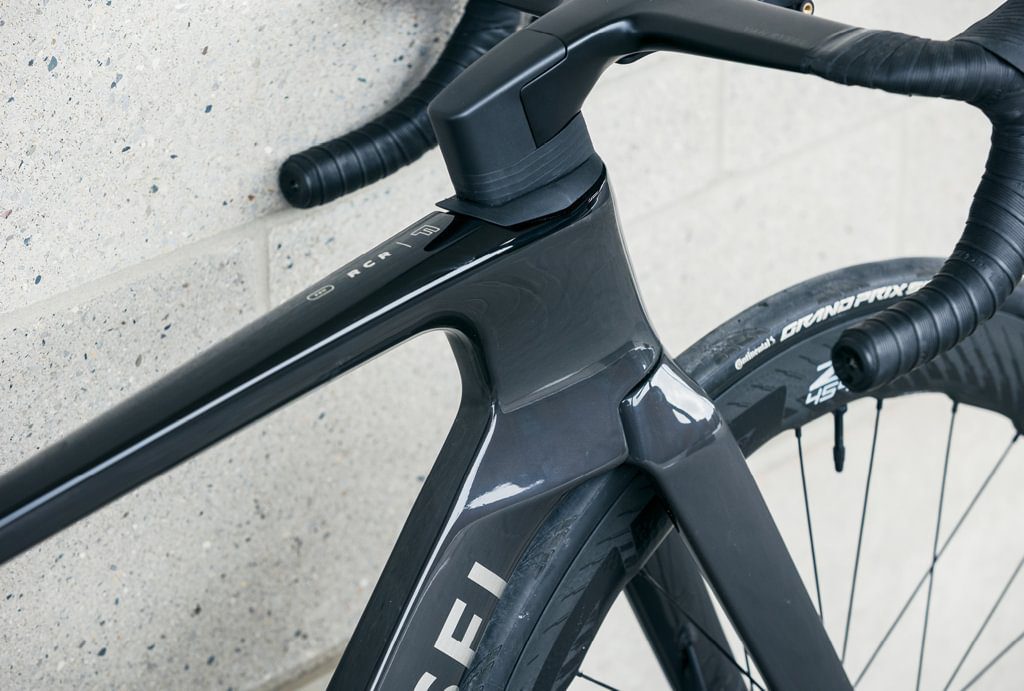 The deep head tube helps the Van Rysel RCR-F cut through the wind. Image: Matt Stetson
For a bike with such deep aero tubing, the ride quality of the RCR-F is quite good. It’s definitely a stiff ride, but not jarringly so. The feeling is one of solidity rather than springiness. This solidity shows itself more on small imperfections on the road rather than big hits. On a stretch near my home, there are painted bike-lane icons that are ever so slightly raised. They announce their presence more clearly on the RCR-F than other bikes I’ve ridden. When I rode over bigger road imperfections, potholes and the like, the RCR-F didn’t mask or soften them in any way, but that is par for the course for most top-end carbon race bikes. The upside of that feature is that there’s absolutely no give anytime I jump out of the saddle. While it doesn’t quite match the ride of some of the best all-rounder or lightweight climbing bikes, the RCR-F is a notable improvement on aero bikes from even a few years ago. I’ve always found comfort to be more dependent on fit rather than how stiff a bike feels, and would have no qualms taking the RCR-F for rides longer than four hours. At 7.37 kg in this SRAM Red-equipped model, it won’t trouble UCI commissaires or hold anyone back on the hills.
How to decide if the Van Rysel RCR-F is the bike for you
For the past five years or so, the main trend in road race bikes has been the all-rounder, a Swiss army knife approach that aims for an optimal balance of aero, weight and stiffness. It’s an enticing proposition. Yet, the pendulum has swung back toward the specialist in the past 12 months, with brands releasing full-on aero bikes like Van Rysel’s RCR-F that once again distance the all-rounders on flats while keeping up on the climbs, leaving the new lightweight climbing bikes to languish in team trucks, at least for pros. Admittedly, the differences in real-world conditions are slight. The savings for those of us with less-gifted FTPs are even smaller. But the science has been clear for some time, when it comes to speed: saving a handful of watts is worth more than a kilo or two of weight. Van Rysel reckons the tipping point between choosing a lightweight all rounder over an aero bike is approximately 1,500 m of elevation gain per 100 km at 35 km/h, which I think is pretty close to the mark.
Why rising bike brand Van Rysel is looking to Canada as it continues to grow
Of course, none of that matters if you are riding for pure enjoyment, rather than chasing high velocities. If that’s the case, the Van Rysel RCR-F is probably not the ideal bike for you as it is all about speed. In fact, you might want to look beyond the narrowly focused road race category of bikes entirely. However, if speed is the priority, whether that means racing or just for the joy of going as fast as you can, the Van Rysel RCR-F raises a good question: why wouldn’t you take the aero bike?
Van Rysel RCR-F Pro II Red PW
Components SRAM Red AXS derailleur with 12-speed, 10–36 tooth Red cassette and 50/37-tooth Red AXS crankset with power meter, Deda x Van Rysel RCR-F handlebar/stem combo
Wheels Zipp NSW 454 with 28c Continental GP 5000 S tires
Sizes XS, S, M, L, XL
Price $13,500
Website vanryselcycling.com
 The Van Rysel RCR-F Pro II Red PW from northern France gets a taste of winter in southern Canada. Image: Matt Stetson