
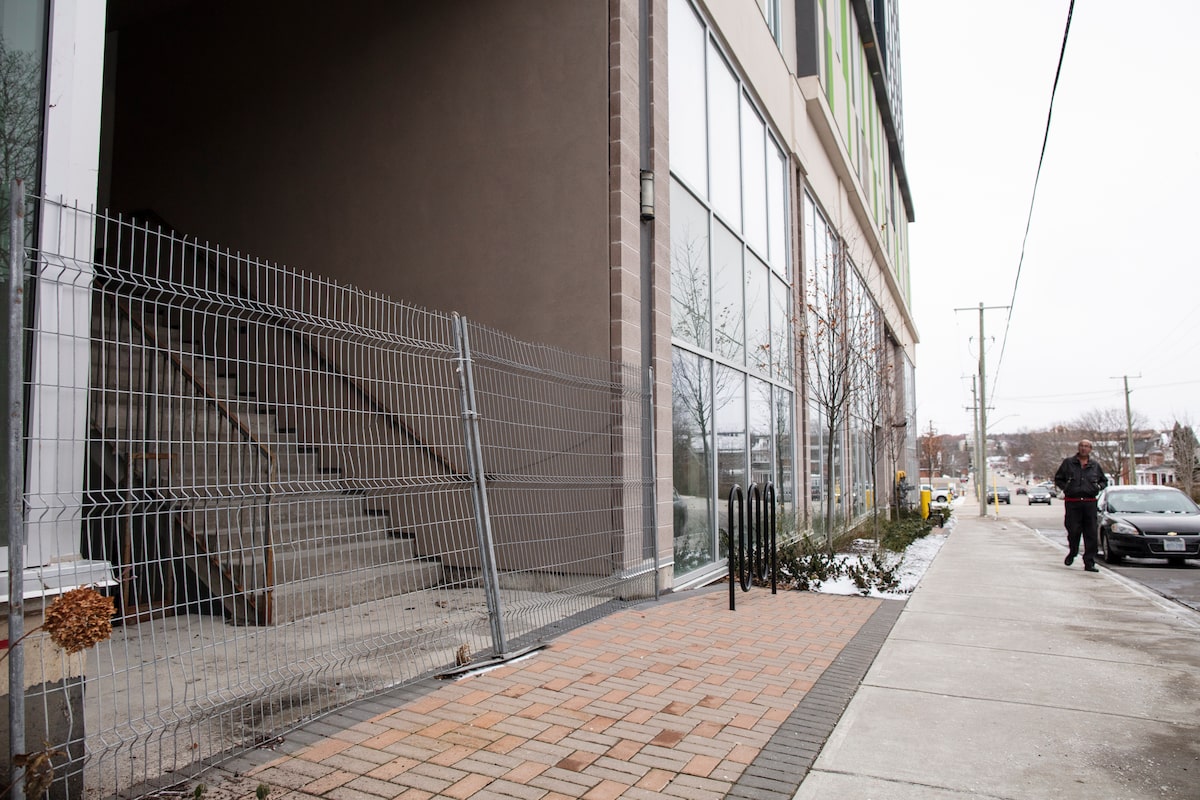
Fencing blocks an entrance to the Collier Centre in Barrie, Ont., in 2018. The mixed-use development was one of two projects at the heart of the criminal case against Fortress Real Developments’ co-founders.Globe and Mail
The co-founders of now-defunct syndicated mortgage company Fortress Real Developments Inc. have been sentenced to five years in prison and ordered to pay $12.2-million each for committing fraud.
Jawad Rathore, Fortress’s former chief executive officer, and Vince Petrozza, its former chief operating officer, were found guilty of fraud last year after a lengthy criminal trial.
Lawyers for Mr. Rathore and Mr. Petrozza said they have appealed the Ontario Court of Justice verdict and are seeking bail pending appeal.
The sentence handed down by Justice Daniel Moore on Monday includes five years of additional imprisonment if Mr. Rathore or Mr. Petrozza fail to pay the fine in lieu of forfeiture within 10 years of being released from custody.
“Obviously, no sentence that I impose is going to get the investors their money back or undo the significant financial and psychological harms caused,” Justice Moore told a Toronto courtroom.
Mr. Rathore and Mr. Petrozza founded Fortress in 2008. The company helped to popularize the concept of bringing syndicated mortgages to the masses by allowing mom-and-pop investors to pool their funds and participate in financing early-stage real estate projects. This type of investment was previously available primarily to wealthy and institutional investors.
More than 14,000 retail investors provided $920-million in financing to Fortress for 80 construction projects in cities across the country. Some of the projects were completed while others failed.
From the archives: Inside the fall of Fortress
The criminal case focused on two specific projects: the Collier Centre in Barrie, Ont., and a proposed 45-storey tower in Winnipeg called SkyCity.
Justice Moore found that Fortress had deceived investors with respect to the amount of security they were getting in its syndicated mortgage loans.
Prosecutors had been seeking 10 years of jail time and the forfeiture of $26-million.
In addition to the forfeiture, which amounts to $13-million for each of the two men, the Crown was also seeking a fine in case that money is unavailable to be forfeited, and additional jail time if that fine is not paid.
Defence counsel were seeking a conditional sentence of two years less a day. A conditional sentence is one that can be served outside of prison, for instance under house arrest or curfew.
The defence had argued that the 10-year sentence requested by the Crown was disproportionate.
Justice Moore said the Crown’s arguments for a 10-year sentence were based on sentences imposed on offenders who had committed Ponzi schemes or other outright scams.
“This was not a pure scam or Ponzi-type scheme where the investment does not even truly exist. That said, the fraud did allow the projects to proceed on an overleveraged basis, meaning that the losses suffered were directly attributable to the fraud,” Justice Moore said in his reasons.
He noted several aggravating factors, including the magnitude of the fraud, the fact that it involved a high degree of planning and complexity, that it went on for nearly four-and-a-half years and that almost 800 investors were defrauded.
The fraud targeted mom-and-pop investors, for whom the impact of the losses was, in some instances, “financially catastrophic,” Justice Moore said. He noted that most victims suffered some degree of psychological harm, with some suffering “extremely serious deteriorations of their mental health which in turn also impacted on their physical health.”
Justice Moore said the fact that neither offender has a prior criminal record and both have strong potential for rehabilitation were mitigating factors.