
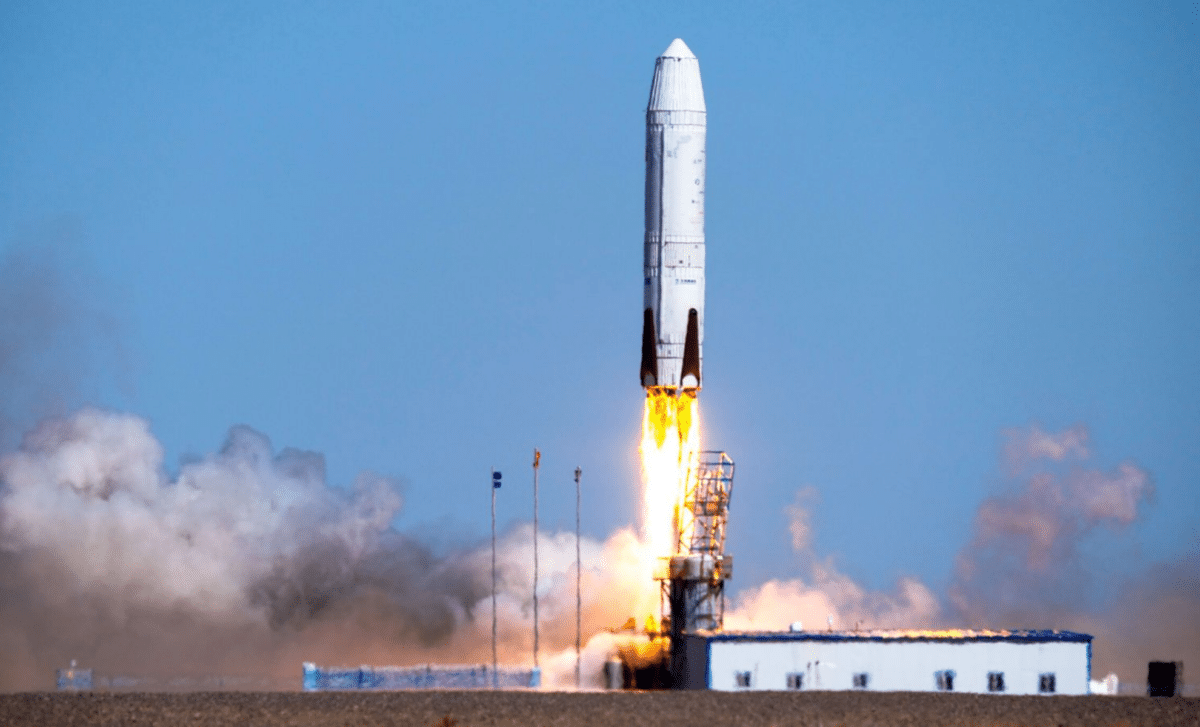
China’s fast-growing commercial space sector is setting its sights on human space tourism, as a Beijing-based startup lays out plans to fly paying passengers on suborbital missions by 2028. The project reflects a broader shift in China’s private space industry, which is increasingly moving beyond satellites and launch services toward crewed experiences once reserved for government programs.
A New Player Enters The Global Space Tourism Race
China is steadily expanding its ambitions in commercial human spaceflight, and space tourism is now emerging as a visible next step. Beijing-based startup InterstellOr has announced its intention to conduct its first crewed suborbital mission in 2028, a move that would place it among a small group of companies worldwide offering private access to space. The company recently revealed a full-scale experimental version of its CYZ1 crew capsule, signaling tangible progress beyond conceptual designs.
The CYZ1 capsule is engineered to carry passengers on a brief journey above the Kármán Line, the commonly recognized boundary of space located about 62 miles above Earth’s surface. During the flight, occupants would experience several minutes of microgravity before returning via a controlled descent. InterstellOr has already completed a landing buffer test, an early but meaningful step in validating systems intended to protect passengers during touchdown.
While the company has emphasized that its schedule depends on continued testing and certification, it has begun accepting reservations. This decision reflects a growing confidence within China’s private space sector, which is increasingly willing to operate with business models similar to those pioneered in the United States over the past decade.
Celebrity Bookings Signal A Marketing Strategy With Global Parallels
One of the most notable aspects of InterstellOr’s announcement is its early commitment to high-profile passengers. Chinese actor Johnny Huang Jingyu has reportedly signed on for a future flight, becoming the company’s first celebrity space tourist and receiving the designation of passenger 009. This strategy closely resembles approaches used by Western companies, where celebrity involvement helped draw public attention and legitimize early space tourism efforts.
As reported by Space.com, ticket prices for InterstellOr’s suborbital flights are set at approximately 3 million Chinese yuan, or about $430,000, with a 10% deposit required to secure a seat. The company has also announced that Lin Xiaoyan, a Chinese-American poet, is expected to become the first overseas Chinese female astronaut on one of its missions, adding symbolic weight to the program.
These early passenger commitments play multiple roles. They help finance development during a capital-intensive phase, while also shaping public perception of who space tourism is for. In a market where no Chinese commercial company has yet flown civilians to space, visibility and credibility remain valuable assets.
Technology Roots And Ambitions Beyond A Single Company
InterstellOr was founded in January 2023 and has quickly drawn attention due to the background of its technical team. Reports indicate that several core members have experience within China’s state-led human spaceflight programs, a connection that may offer advantages in areas such as safety standards, spacecraft design, and operational discipline.
The company’s ambitions are part of a broader trend. China’s commercial space landscape is becoming increasingly competitive, with multiple firms exploring suborbital tourism concepts. CAS Space, a commercial offshoot of the Chinese Academy of Sciences, has already carried out an uncrewed capsule launch to test microgravity experiments. Another company, Deep Blue Aerospace, is pursuing reusable rocket technology aimed at supporting similar short-duration human flights.
This growing ecosystem suggests that space tourism in China is not an isolated effort but part of a wider push to commercialize access to space. As several companies advance in parallel, competition could influence pricing, safety benchmarks, and the pace of technological development.
A New Chapter For Commercial Human Spaceflight In China
If InterstellOr succeeds in launching paying passengers by 2028, it would represent a notable milestone for China’s private space industry. Such a mission would mark the first time a Chinese commercial company carries civilians on a dedicated space tourism flight, expanding the country’s footprint in a field largely shaped by U.S. operators.
Significant hurdles remain, including rigorous testing, certification, and the establishment of regulatory frameworks suited to commercial human spaceflight. Even so, the combination of early hardware demonstrations, celebrity participation, and rising domestic competition points to sustained momentum. Space tourism, once a distant concept in China, is now taking form as a concrete commercial objective.