
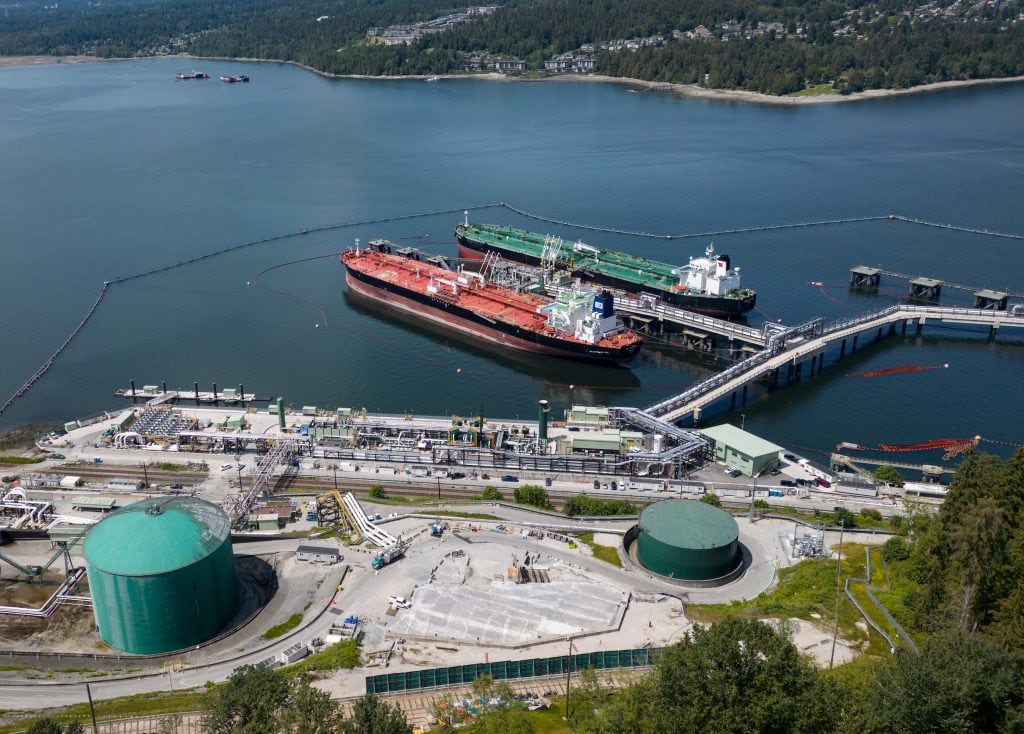
If you’re in Western Canada — heck if you’re anywhere in Canada — you’ve probably heard about pipelines lately (or for the past seemingly million years). It’s particularly true since late last year when Prime Minister Mark Carney signed an agreement with Alberta meant to incentivize a new oil pipeline to the West Coast.
The last time Canada was so into talking about pipelines was about 10 years ago, a national back and forth that ended with the cancellation of the Northern Gateway pipeline proposal and the federal government buying and building what turned out to be a very expensive Trans Mountain expansion.
Since then, oil has started to flow through the government-owned project, drastically increasing shipments to the coast and expanding market access to other countries (somewhat, more on that later). That has helped put more money into the very large pockets of oil companies, but hasn’t been enough to satisfy the patch or the Alberta government.
Trans Mountain is still front and centre in the new national debate — a debate that includes whether or not the country’s oil industry actually needs a new pipeline. That’s not helped by a lack of clarity around how much oil is actually flowing through that pipe, how much could flow through that pipe, how much oil Canada actually has to move to international markets and how much of that oil other countries actually want.
There’s also the fact that no company has indicated it wants to actually build a new pipeline.
Here, we break down where we are, where we could go and why it all matters.
Quick recap: TMX, KXL, Northern Gateway, Energy East … what’s what?
For a quick refresher, since the 1950s the Trans Mountain pipeline has been taking oil from Alberta down to the Lower Mainland of B.C. where it is shipped to overseas markets as well as the west coast of the U.S.
In 2012, a private company, Kinder Morgan, announced it wanted to greatly expand that network by building a new pipeline (referred to as the Trans Mountain Expansion, or TMX) alongside the existing one. In 2018 it suspended non-essential spending on the project and warned it could ditch it entirely amidst mounting opposition and costs.
In 2016, as Kinder Morgan was struggling, the government under Justin Trudeau scuttled the proposal to cut the Northern Gateway pipeline project through the great rainforests of northern B.C. It purchased the troubled Trans Mountain from Kinder Morgan two years later to ensure oil flowed to the coast.
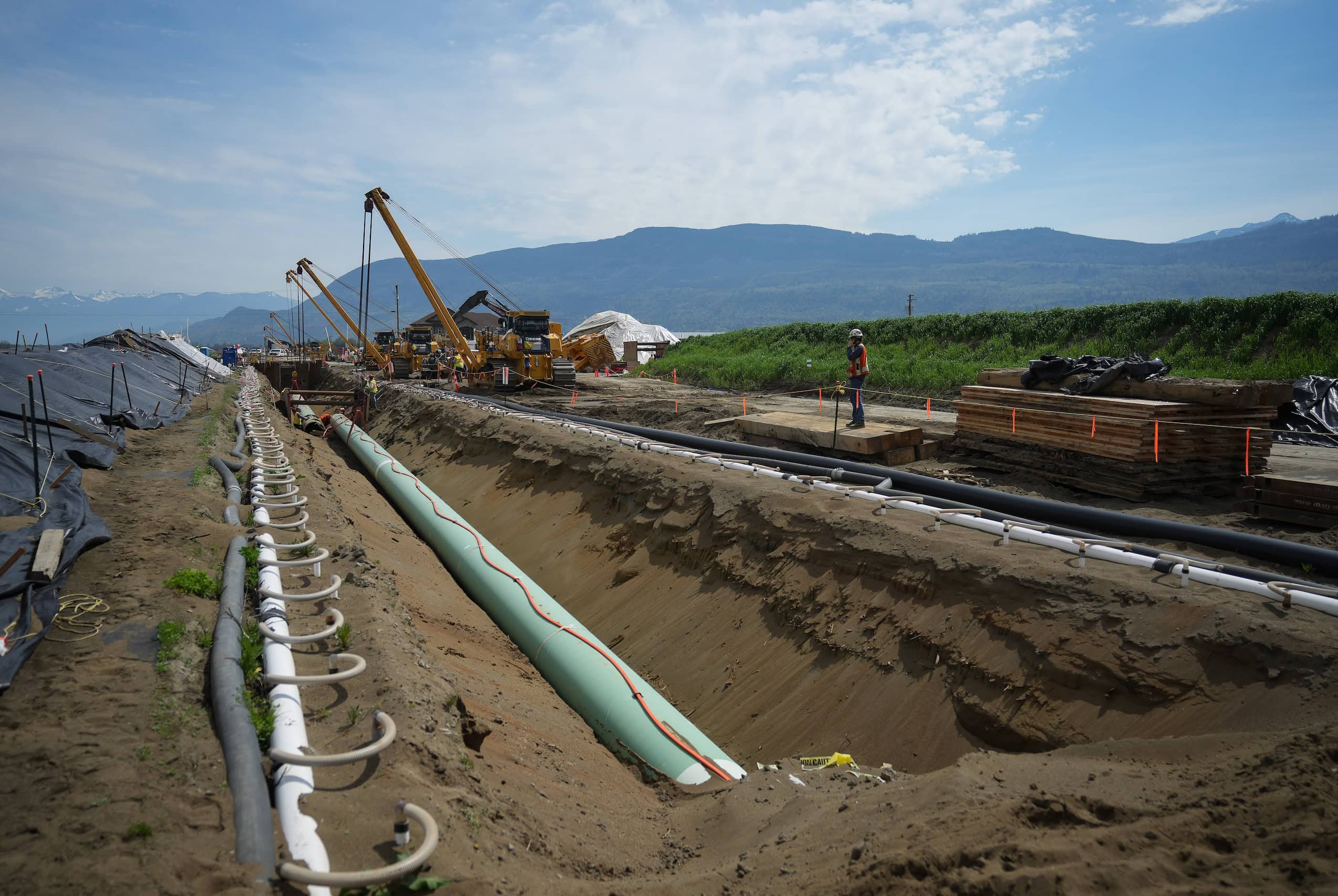 The expanded Trans Mountain pipeline, seen here under construction in 2023, began transporting oil from Alberta to the West Coast in May 2024. On average, it operated at about 82 per cent of its capacity between June 2024 and June 2025 — significantly less than its forecasts of 96 per cent utilization between 2025 and 2027. Photo: Darryl Dyck / The Canadian Press
That expansion project ultimately cost taxpayers a whopping $34 billion — almost $30 billion more than initial estimates. Oil started flowing along the expanded network in May 2024.
Between the scuttling and the purchasing, TC Energy announced it would kill its Energy East pipeline proposal that would have carried oil across Canada to the East Coast in 2017. Later, former U.S. president Joe Biden cancelled TC Energy’s Keystone XL expansion, backstopped by Alberta taxpayers to the tune of $1.5 billion. Proving that no pipeline proposal is ever truly over, just undead, Keystone XL could make a comeback.
But after all that, Trans Mountain remains “Canada’s only pipeline system transporting oil products to the West Coast.” The company says it operates a nearly 1,200-kilometre pipeline network with room for 890,000 barrels of petroleum products to be shipped each and every day. That translates to approximately 141 million litres, or nearly 60 Olympic-sized swimming pools.
Okay, so do we have enough pipeline capacity or not?
There’s a lot of talk about how much oil is flowing through Trans Mountain and whether there’s even enough extra to warrant the new pipeline endorsed by Alberta Premier Danielle Smith (which still doesn’t have a company that wants to build it).
In short, no.
Trans Mountain, which increased its capacity to 890,000 barrels per day from 300,000 barrels per day, is not full and hasn’t been since it opened. But that’s only part of the story.
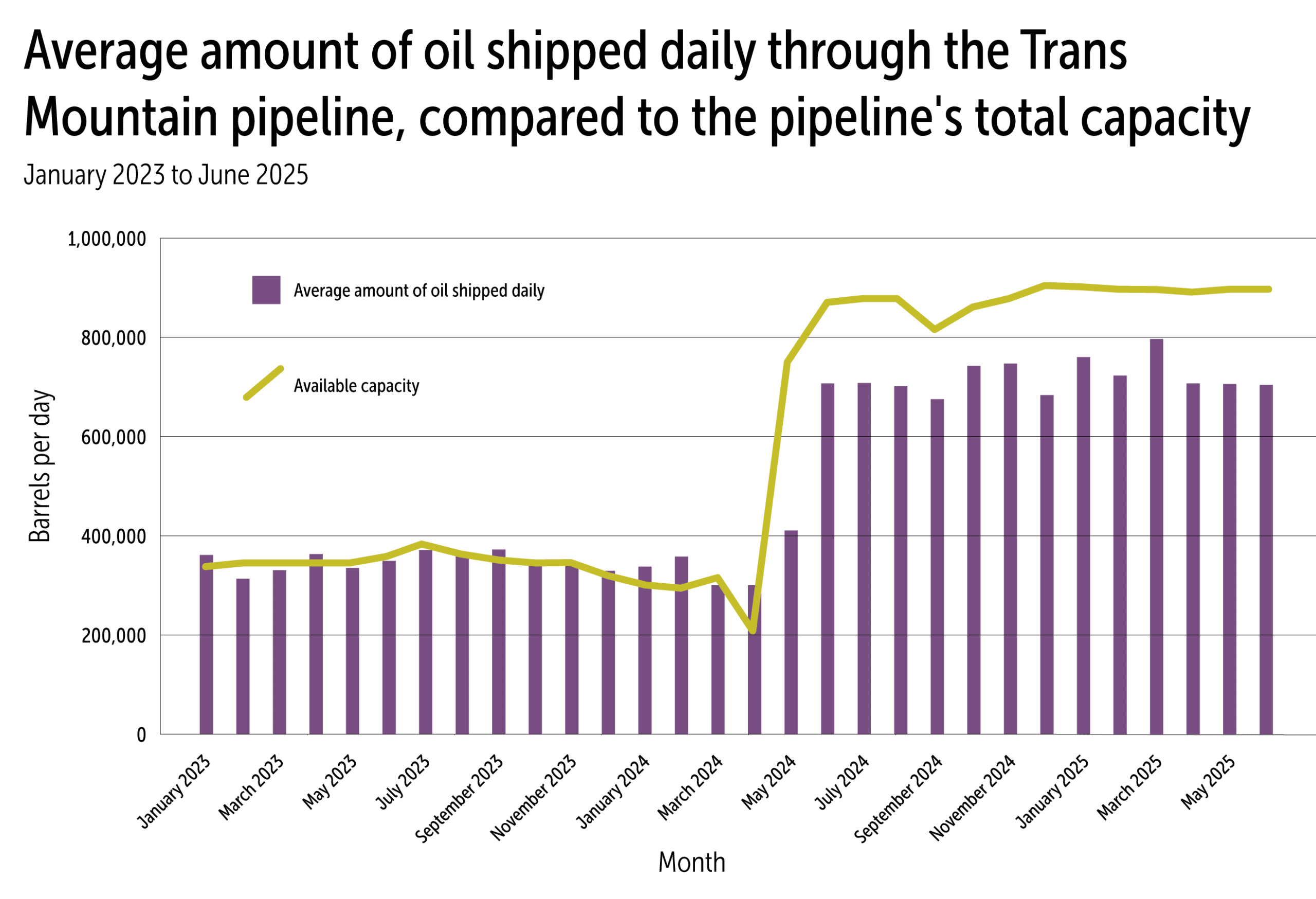 The Trans Mountain pipeline’s capacity more than doubled in spring 2024, when its expansion became operational. Since then, the pipeline has never been used to its full capacity. Source: Canada Energy Regulator. Graph: Shawn Parkinson / The Narwhal
On average, between June 2024 and June 2025, the pipeline was 82 per cent full, with a low point of 76 per cent and a maximum of 89 per cent, according to the Canada Energy Regulator.
That is far below Trans Mountain’s forecasts of 96 per cent utilization between 2025 and 2027.
The actual numbers do go up and down and vary from season to season. Trans Mountain CEO Mark Maki told Global News in November that the pipeline was at 90 per cent or higher, though he expected that to dip in the months to come due to seasonal maintenance in the oilsands.
Most of the room in the pipeline, 80 per cent, is set aside for regular customers, including Cenovus, Canadian Natural Resources and ConocoPhillips, on long-term contracts, while the remainder is set aside for clients looking for shorter spot contracts.
The regular shippers are using the pipeline, essentially filling their quotas, but there is little apparent appetite for spot shippers to book passage. Nonetheless, Maki has speculated the pipeline will be full by next year.
Why is the Trans Mountain pipeline not full yet?
The answer to this is a bit complicated, and depends on individual producers and contracts. But one factor is the cost of shipping on Trans Mountain.
On average, Alberta produces more than four million barrels of oil per day. That’s enough to fill Trans Mountain, but there are already several other pipeline systems in use, too, and according to the Alberta Energy Regulator, all of them together could carry 5.4 million barrels per day.
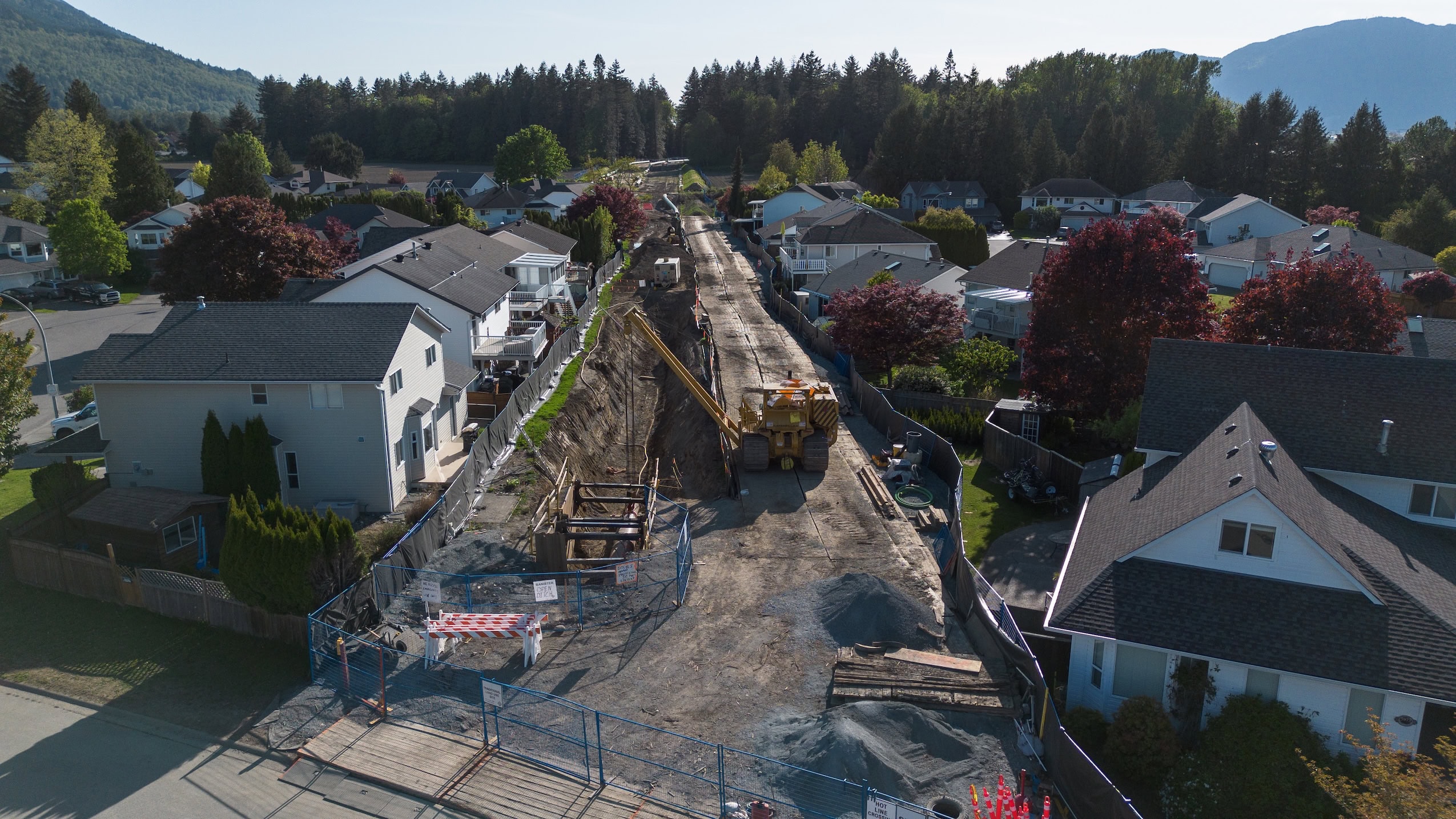 The Trans Mountain pipeline cuts through a residential neighbourhood in Chilliwack, B.C., on its way to Burnaby. The pipeline expansion was so over budget that the tolls it charges customers to move oil are much higher than other pipelines. Photo: Jesse Winter / The Narwhal
But it’s not just the amount of oil that impacts pipeline usage. Pipelines are owned by companies — or governments — which charge fees for companies to move their products.
The Trans Mountain expansion ended up costing so much that the tolls it charges customers to move oil are much higher than other pipelines, according to credit rating agency DBRS Morningstar. At least one of those other pipelines, Enbridge’s mainline system into the U.S., also has excess capacity.
Essentially, competition is limiting uptake on shorter Trans Mountain contracts.
On the flip side, the pipeline has opened new markets — think, Asia — where producers can sell their oil for more money per barrel.
Back up, what’s actually flowing through the pipeline, and … how?
Let’s back up for a minute. What exactly flows through the pipeline? And how do different companies pay for space?
The Trans Mountain pipeline carries oil, obviously, but it also carries refined products including jet fuel and sometimes those products will be in the pipeline at the same time.
Those products will all move in segments, a batch of heavy oil, for example, followed by a batch of refined fuel so that it doesn’t all get mixed up — although some mixing does occur where one segment meets the other.
Those with long-term contracts will pay to reserve a certain amount of space — think, volume of product to be shipped — on the pipeline, while spot shippers will pay to book short-term space based on how much they have to ship.
All of it is pumped through the pipelines with the help of pumping stations that push the product to terminals on the West Coast.
If there’s so much extra pipeline space, why is there a push for another pipeline?
To recap, right now, there’s enough pipeline space for all the oil Alberta produces. And that space could increase without introducing a new pipeline into the mix. Enbridge plans to expand its existing mainline network into the U.S. Meanwhile, Trans Mountain is planning to increase its capacity by essentially making the oil move faster using an additive and adding more pumping stations. (Though, it notes some plans are “subject to confirmation of commercial interest including shipper agreements for additional volumes.”) But the gist is: the faster oil or other products can flow through the pipeline, the more it can ship.
Those projects alone — on existing pipelines and routes — could add another one million barrels per day in transport in coming years. The zombie of Keystone XL? Room for another 800,000 barrels.
Oil production is not expected to increase dramatically in Alberta in the coming year, with depressed prices chilling major investments and most companies focused on reducing costs and waiting for improved returns, according to a state of the industry report published by Enserva, the industry group which represents the service side of the oilpatch (think drillers).
Enserva also estimates plateaued production in the oilsands in 2026, as well as reduced drilling in both Alberta and Saskatchewan for conventional wells.
A glut of oil on the market, and planned increases in production from Organization of the Petroleum Exporting Countries (OPEC) members, isn’t expected to improve pricing, according to the report.
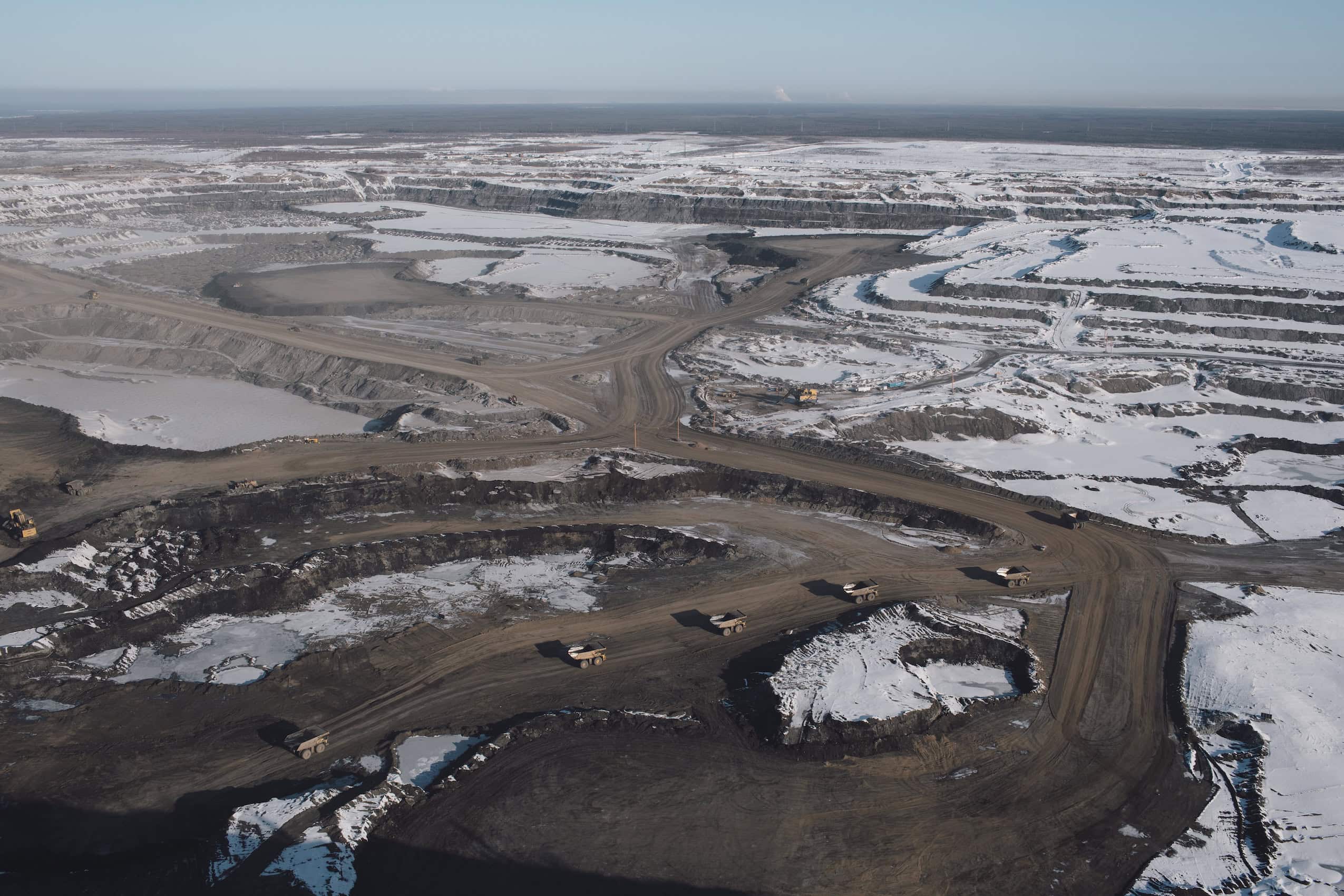 An open-pit oilsands mine near Fort McMurray, Alta. The Alberta government under Premier Danielle Smith wants to double oilsands production — but it’s not clear companies want to invest in expansion. Photo: Amber Bracken / The Narwhal
There’s also the lingering question of how much oil could be produced in Venezuela, following the recent attack from the U.S., which happened shortly after the report was released.
But that hasn’t stopped the Alberta government from pushing for a doubling of production — and a new West Coast pipeline that could add capacity for another one million barrels. Its latest argument is that the prospect of Venezuelan oil flooding U.S. Gulf refineries is an added reason to increase shipping capacity to Asia.
Of course, that could all change over the coming months — and years.
Where are we selling our oil?
Prior to the Trans Mountain expansion, virtually all Canadian oil was going to the U.S. and that meant selling at a discount. In 2024, the year the expansion opened, over 90 per cent of Canada’s oil went south.
Since the expansion opened, more oil has flowed onto tankers and shipped to Asia, mostly China, but it’s still a relative drop in the bucket, according to the Asia Pacific Foundation of Canada.
China is the biggest Asian customer, but there are questions about its long-term demand as it aggressively pursues clean energy alternatives, as well as concerns about how easily it canpivot to other suppliers as it seeks the lowest prices on the international market.
Won’t anyone think about the emissions? Is the plan to capture them?
In 2024, the Alberta oilsands emitted 92 megatonnes of heat-trapping greenhouse gases. As a whole, Canada’s oil and gas sector emitted 212 megatonnes. For comparison, the next largest emitter was transportation, at 156 megatonnes — that’s all cars, trucks, planes and trains put together.
The pipeline deal inked by Carney and Smith requires construction of a carbon capture and storage project led by the Pathways Alliance of Canada’s five biggest oilsands producers. The multi-billion-dollar plan would include a pipeline of its own, transporting carbon to deep reservoirs in Alberta.
It’s a project the proponents say they won’t build without significant public dollars in the mix and the governments of Alberta and Canada have pledged billions in tax credits and more.
The project, even if it lived up to expectations, would eventually achieve a net reduction of just 10 to 12 megatonnes of emissions per year.
Carbon capture and utilization projects have a long history of overpromising and underdelivering on emissions reductions. Modelling from the Pembina Institute warns that while there could be a marginal drop in overall emissions with a new pipeline and the Pathways project, those projections are likely “optimistic.”
We’re going to pay for this, aren’t we?
That seems likely, yeah.
Alberta has already budgeted $14 million to act as the proponent for the hypothetical pipeline to the coast, despite no company offering to build it. It has also pledged tax incentives and financing for Indigenous participation.
Sonya Savage, the former energy minister under former premier Jason Kenney, said there’s almost no chance a private company would build the pipeline without financial backstops from the government.
That’s in addition to the public dollars that would pour in the Pathways capture project.
Oh, and a new pipeline would compete with the Trans Mountain system that is struggling to pay back taxpayers for the multi-billion-dollar cost of building it, one reason its tolls are so high.