
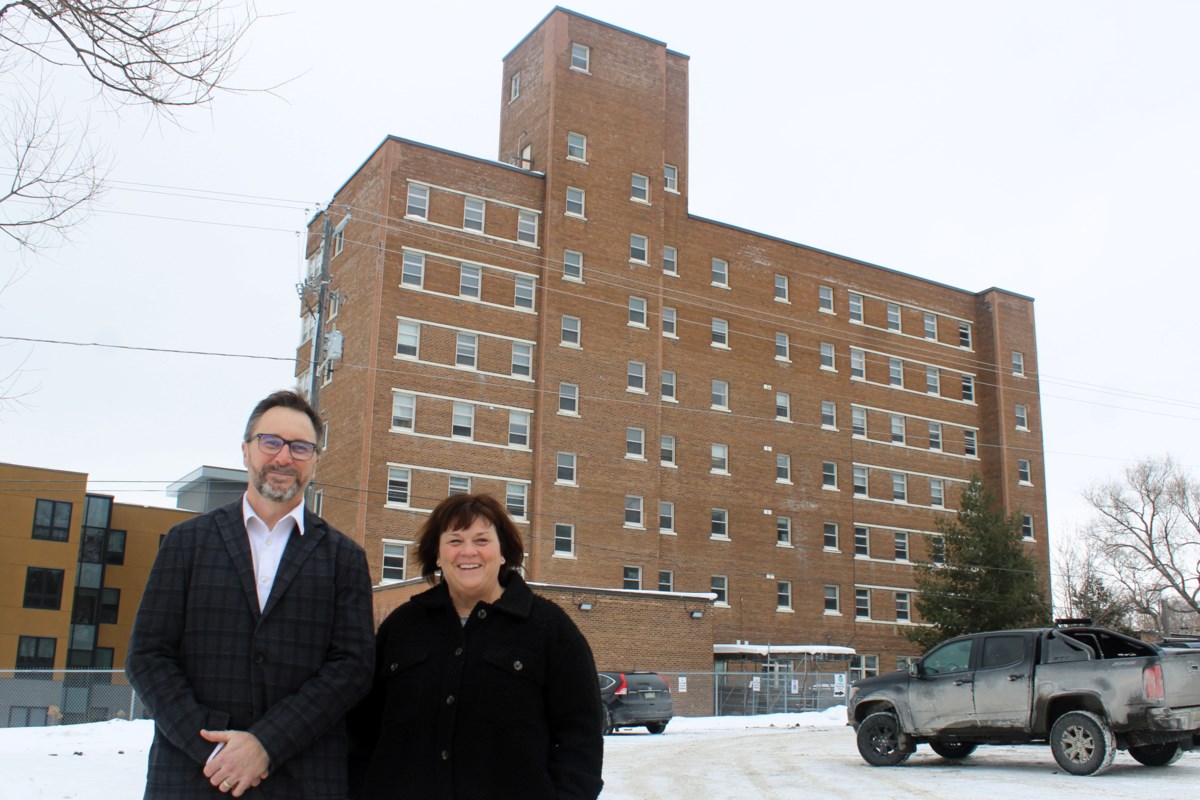
Ward 5 Coun. Mike Parent and Ward 4 Coun. Pauline Fortin are championing the effort, which they described as years in the works and aiding in their goal to end homelessness
A group of private investors have asked for municipal support in converting the nine-storey building at 30 Ste. Anne Rd. in downtown Sudbury into 135 units of supportive housing.
For at least two city council members, the answer is a resounding yes.
“To some degree, this is like finding a unicorn,” Ward 5 Coun. Mike Parent said of the building, which he credits as carrying the potential to put a significant dent in local homelessness.
Parent said he’s been working with the group for the past couple of years alongside Ward 4 Coun. Pauline Fortin to get a project like this rolling.
“It’s been a long time, so to see it finally come to council … It’s exciting,” Fortin said. “This is a game changer, I’m very excited about it, to see something come to a head.”
In a municipal report city council is scheduled to vote on during their Feb. 10 meeting, city senior planner Ed Landry recommends council approve $1,526,720 in municipal support via Community Improvement Plan incentives to help get the $5.6-million renovation project off the ground.
This comes at zero impact to the tax levy, Parent clarified, noting that $1,086,720 of the cost will be covered by a portion of the $16-million federal Housing Accelerator Fund the city received last year, which has been earmarked for affordable housing incentives.
The $440,000 balance would come via a tax-increment equivalent grant spread out over the course of 10 years. Under a tax increment equivalent grant, the difference between taxes levied using a property’s assessed value both pre- and post-development are rebated to the owner for a set number of years.
In this case, the pre-renovation annual tax levy is approximately $80,000 and the post-renovation tax levy is estimated to hit $135,000, representing a difference of $55,000. If approved, 100 per cent of this difference will be rebated to the property owner during years one through six, and 50 per cent of the difference will be rebated during years seven through 10.
Mandy Branham represents what she describes as a small group of Northern Ontario investors behind the project at 30 Ste. Anne Rd. Branham resides in Midland.
They finalized their purchase of 30 Ste. Ann Rd. last year, and Branham said they considered various options for the building, including high-end apartments and seniors housing, before settling on supportive housing.
“It’s the easiest transition,” she said, adding that limited renovations would be required to open the building up for geared-to-income supportive housing units subsidized by the province.
A big push toward its supportive housing use came when the city released its Roadmap to End Homelessness by 2030 in May 2024, she said.
Within this report, which cites an immediate need for supportive and deeply affordable housing, Branham said the investors determined that 30 Ste. Anne Rd. could easily apply. The investors connected with Parent, who tabled the motion which led to the roadmap, which Branham said resulted in the project as currently proposed.
“The building is so solid,” she said. “They don’t build them like they used to, so this has three to five decades of use, as is.”
There are currently three tenants in the building, including the Sudbury District Nurse Practitioner Clinics, which the building’s owners are working with to open up more space for residential units. If everything goes to plan, Branham said they’d open one floor by the end of March.
The property-owning investors are providing the infrastructure, while the non-profit Sudbury Supportive Housing is providing the support necessary to help residents maintain success in permanent community housing.
Supportive housing is considered to be the next step from the more heavily regimented transitional housing, such as is in place at the 40-unit municipal transitional housing complex on Lorraine Street.
This is the group of investors’ biggest project to date, Branham said, but they’ve tackled smaller residential conversion projects up to 20 units in the past.
Parent said the 30 St. Anne Rd. project is what happens when hard work pays off.
“The easiest thing we could have done is something like tiny homes, grab a whole bunch of taxpayer money and build it, and we’re not even sure it would be a feasible option,” he said. “It would be very costly upfront and very costly in operation and maintenance moving forward.”
Instead, he said, by working with the private sector, they’re securing 135 units in an existing building at no hit to the tax levy.
“I believe that with early engagement of not-for-profits providing services, there will be a lot of wraparound care for those who agree that they want to move into this place and transition into a better life,” he said.
“This was not the easy solution, this took a bit more work. I’m extremely proud of the developers, they’re the ones who are putting a bit on the line for this, and I’m very pleased and grateful for them. … It’s not always about doing the easiest thing, it’s about doing the right thing for the community.”
The Feb. 10 city council meeting at which members will vote on whether to approve municipal supports is scheduled to begin at 6 p.m. The meeting can be viewed in-person at the Lionel E. Lalonde Centre in Azilda or livestreamed by clicking here.
The meeting will also include a staff-recommended approval for $237,500 in municipal incentives toward renovating 1545 Gary Ave. Like 30 Ste. Anne Rd., this funding would come from the federal Housing Accelerator Fund with no impact on the tax levy.
The project at 1545 Gary Ave. is proposed to transform an old school into a child and youth mental health campus, including an eight-bed live-in treatment centre.
Tyler Clarke covers city hall and political affairs for Sudbury.com.