
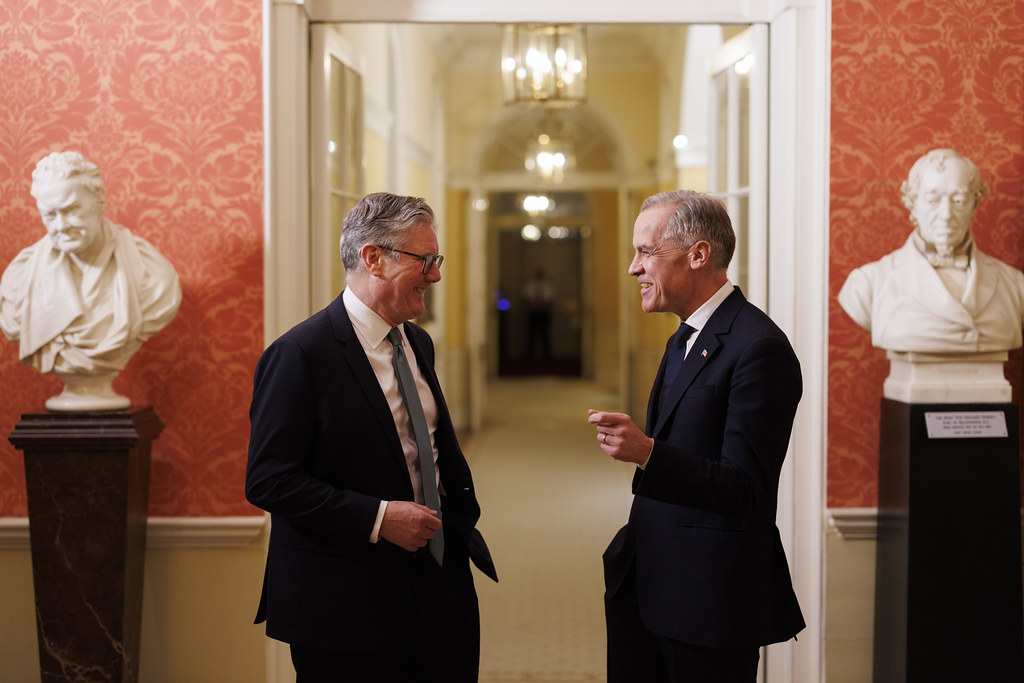
Prime Minister and banker Mark Carney’s speech at Davos has generated admiration in many sectors of Canadian society and beyond. It was celebrated as a bold call to defend “democratic values” and sovereignty in the face of a world in crisis. However, it also invites an uncomfortable reflection: what happens when the mirror we use to point out the flaws in the global system reflects our own contradictions first?
Canada presents itself as a defender of a fair order, but its history of interference in Latin America, its complicit silence in the face of genocide in Palestine, and its double standards when legitimizing governments according to its economic interests reveal a gap between Canada’s discourse and its actions.
If we truly aspire to build a more equitable world, we must begin by looking at ourselves without historical makeup, recognizing that no country, not even one that proclaims itself “peaceful” and “multilateralist,” is exempt from questioning its role in colonial power structures. Genuine change can only emerge through this type of raw honesty, not as a moral exception, but as collective reparations.
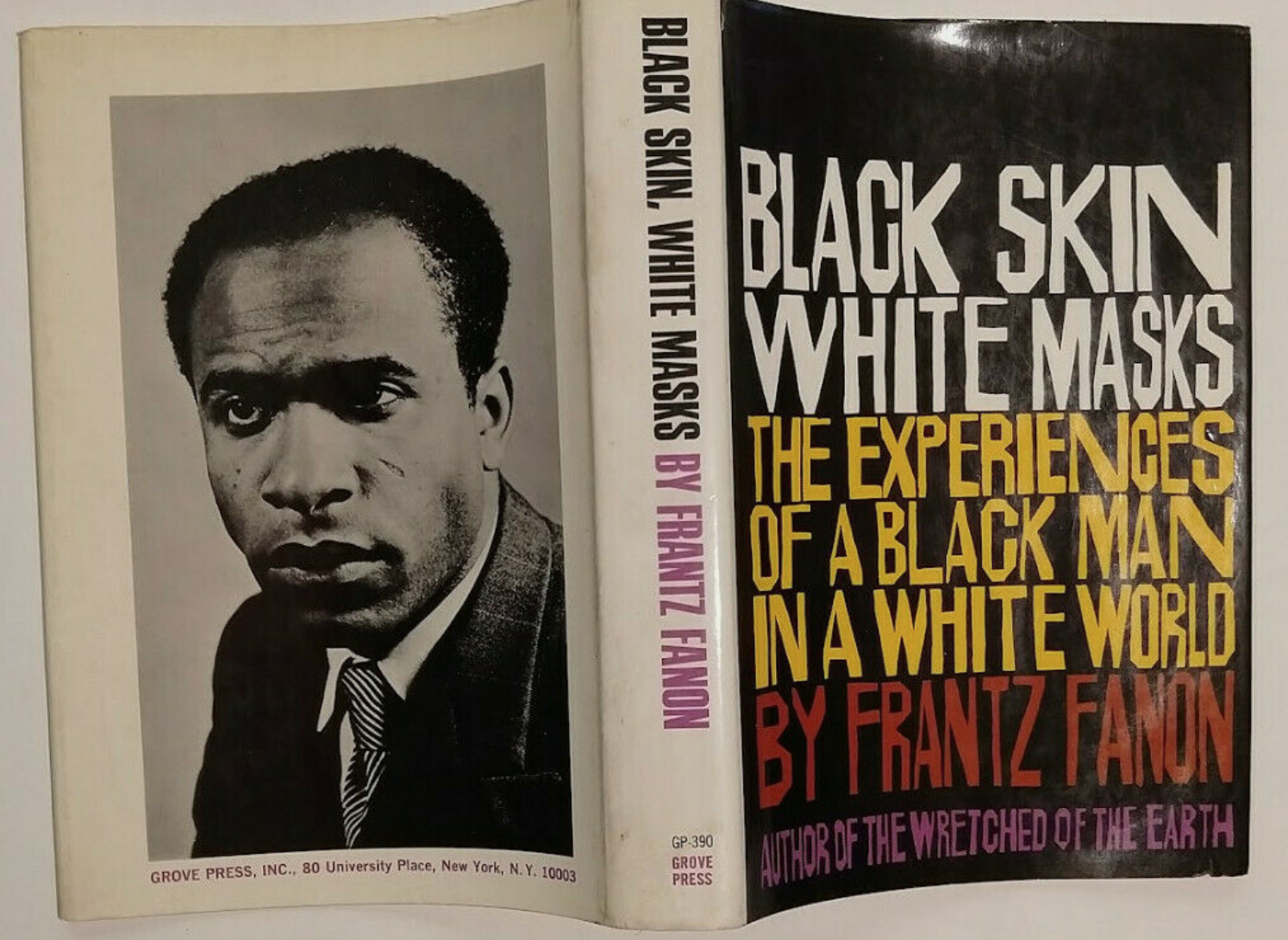 The title for Martínez’s commentary was inspired by the title of renowned author Frantz Fanon’s study, Black Skin, White Masks, first published in French in 1952. Photo: Ebay.
The Prime Minister’s speech, though wrapped in rhetoric of “rupture” and “values,” reproduces the colonial hierarchies that uphold the global order. By quoting Vaclav Havel to criticize authoritarian systems, Carney deliberately ignores how capitalism, a system Canada defends, has failed to guarantee dignity and the common good to billions in the Global South, the Global Majority.
We must not forget our own Canadian Global South, where many Indigenous communities still lack access to the basics needed to live with dignity: safe drinking water, adequate housing, timely healthcare, and quality education. While communism is pointed out as an oppressive fiction, the speech is silent about countries like Cuba or Vietnam that, with socialist models, have achieved advances in health and education that capitalist nations have not achieved. Cuba accomplished this while under a criminal embargo since the 1960s.
This selectivity is not casual: it is part of the so-called “coloniality of knowledge,” where only the Global North boasts the right to define what is considered “democracy” or “progress.” Even worse, Canada has applied contradictory standards. While preaching sovereignty and human rights, it supported Juan Guaidó in Venezuela as president in exile: an unelected leader, but one aligned with Canada’s interests. Meanwhile, today, it defends the “right of Greenland to decide its future,” but is silent in the face of Israeli apartheid in Palestine. Do the people of the South only deserve self-determination if they obey the intentions of the North?
The “coloniality of power” is manifested in the North’s proposal of “values-based realism,” which, in practice, translates into alliances with authoritarian regimes in the Gulf, such as Qatar, with whom Canada signed agreements days before the speech. Meanwhile, elected governments in Latin America are punished.
Carney’s call to “not build forts” clashes with his participation in NATO, an alliance that has invaded countries of the Global South, and with his militarization of the Arctic, where he supports Denmark to control strategic resources. While criticizing the “economic coercion” of other powers, Canada has imposed unilateral sanctions on Venezuela and Nicaragua, measures that starve civilians and violate international law. This hypocrisy reveals that “values” are not universal, but tools to legitimize domination; human rights only apply fully to those who belong to the club of the “civilized,” like Canada and the self-proclaimed “international community” club.
On the other hand, the “coloniality of being” exposes the arrogance of believing that Canada knows better what suits the peoples of the Global South, and how they should behave. The Prime Minister’s speech in Davos neglected to mention the active participation of Canadian mines in the plunder of Latin America’s resources, from lithium in Chile, to nickel, silver and gold in Guatemala, to oil in Ecuador. It avoided recognizing that the “rules-based order” was designed to perpetuate the peripheries’ dependence. While preaching “resilience” and “strategic autonomy,” Carney promotes trade treaties that will tie economies like Mercosur to neo-colonial value chains. How can we talk about sovereignty when Canada, with the US. and Europe, has funded coups in Bolivia (2019) and Haiti (2004) to protect Canadian investments?
The Prime Minister is right about one point: the world can no longer “live in a lie,” that was imposed to plunder the Global South’s natural and cultural resources. That “lie” that was for others, not for White folks. Those lies have been denounced for decades and have been silenced, literally, with fire and blood, through coups, genocides, disappearances (plus a long etcetera), under the guise of “democracy” and “peace.”
This would require that Canada stop being complicit in that fiction, created for servitude. It requires acknowledging that Canada’s historical prosperity was built on the exploitation of territories and racialized bodies, that the “multilateralism” which is often boasted about, is a smokescreen to perpetuate hierarchies. It is a White mask.
In Latin America, everyone knows that, as long as the Global North continues to impose its agenda under the guise of “democracy,” the one it has the right to veto if it is not “ours,” we will continue to be trapped in a cycle of dependence and interventions.
The alternative is not in Davos —a private club underwritten by international companies who decide who can speak, but in listening to those who have resisted centuries of colonialism: those silenced, massacred, those demanding reparations, not charity; self-determination, not guardianship; and climate justice, not green extractivism disguised as progress.
Canada could be a bridge to a fairer world, but only if it first stops seeing itself as an exception and accepts that it is part of the problem, historically, a large part. We must now face the mirror but will we have the courage to look? Or, the other crucial question is: how long is this discourse going to last before the empire returns to the fold?
Juan Carlos Martínez is a poet and professor of Modern Languages and Literatures at Mount Allison University in Sackville, New Brunswick. This piece was published on the author’s social media on Jan 23, 2026 in Spanish.