
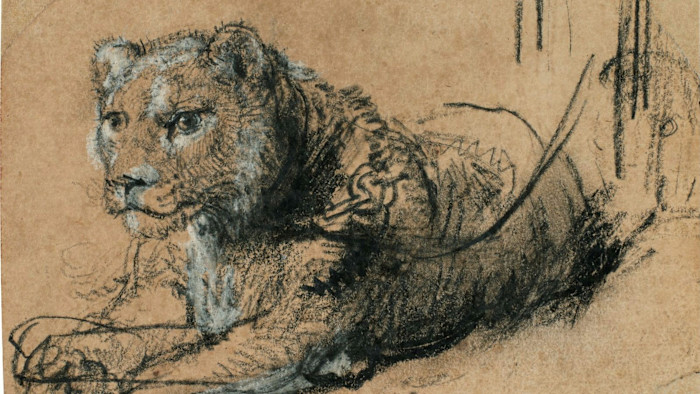
Nearly 400 years ago, Rembrandt van Rijn rushed to see the rare appearance of a young lion in the Netherlands. This week the artist’s deft, arresting sketch is set to make at least $15mn for a charity whose mission is to protect the world’s 40 species of wild cats.
“Young Lion Resting” (c1638-42) is co-owned by the Franco-American collector and metals billionaire Thomas Kaplan and by Jon Ayers, a former animal healthcare industry leader. They are selling their Rembrandt to mark the 20th anniversary of the charity Panthera, co-founded by Kaplan in 2006 and of which Ayers has been chair since 2021.
Kaplan describes wildcats as “the linchpin of most ecosystems, the umbrella species . . . for the flora and fauna to stay in balance, they need an apex predator to survive”. Threats include not having enough land to roam — fragmented by human activity including road building and agriculture — while poaching for their skins and meat is one of the biggest risks to the species.
His powers of persuasion are evident in Panthera’s “Conservation Council” of advocates, founded in 2017 and originally co-chaired by the actors Glenn Close and Jane Alexander. Today, its members include the actor Jeremy Irons, musician Shania Twain, former CIA director-general David Petraeus, and investor Wendi Deng Murdoch.
Kaplan describes himself as “completely unembarrassed” to pull favours from them. “There are things I wouldn’t ask for personally or professionally, but I have zero inhibition when it comes to [Panthera],” he says.
Irons, who voiced Scar in the The Lion King (1994), has turned those velvety, villainous tones to narrate some of Panthera’s videos, including a promotional piece for Sotheby’s sale of the Rembrandt.
 Jeremy Irons: ‘Fame doesn’t really have any value, but it can help raise awareness of certain causes’ © Carolina Porsche
The actor confesses to me that he is “a dog person” domestically, but says he has grown “increasingly passionate” about Panthera’s missions. “Seeing those large cats in the wild, how they protect their young is extraordinary. I have learnt [through Kaplan] how under threat they are . . . Fame doesn’t really have any value, but it can help raise awareness of certain causes.”
He talks too about the long fascination with lions throughout the world. “There are ancient cave markings of lions [including at Chauvet and Lascaux], lions guarded Nebuchadnezzar’s gates of Babylon, in Egypt you have the Sphinx of Giza, and stone lions were the guardians of imperial tombs in China.” In Europe, he says, “the lion was a symbol of strength, in tapestries and flags.”
This leads us to Rembrandt’s young lion, which Irons acknowledges is not a Scar-like king of the savannah — “he is on a lead for a start” — but has, he says “a depth of feeling and dignity, particularly around the eyes.”
Gregory Rubinstein, Sotheby’s head of Old Master drawings, explains the artist’s technical skills that created such a mix. “Where there’s movement, particularly in the left paw where he’s sketched two different positions, Rembrandt uses long, rapid, fluid strokes. For the face, these are smaller and more precise, which gives a sense of fixed stillness.” The overall effect, he says, is “a feeling that even this young lion could pounce with real menace.”
Clearly drawn from life, Rubinstein notes how rare it was to have seen a lion in 17th-century Europe. The best guess from Sotheby’s research is that Rembrandt saw such animals (as well as the elephants he also drew and painted) at one of the continent’s touring fairs. Records show that these were kept in tents or mobile cages, to be viewed by paying customers.
“Rembrandt surely would have grasped such opportunity with great enthusiasm,” Sotheby’s says. And Rubinstein adds that the artist had good cause. “There are lions in some of his earlier works that didn’t look like they were painted by someone who had seen them. Later on, they really, really work,” he says, citing the etching “Saint Jerome in an Italianate Landscape” (c1653), which features a turning, maned lion behind the reading saint.
 Rembrandt’s ‘Saint Jerome in an Italianate Landscape’ (c1653) © Alamy
“Young Lion Resting” is one of six drawings Rembrandt made of the wildcats, including two lioness sketches in London’s British Museum. Rubinstein confirms that the Sotheby’s work has been requested as a loan to a forthcoming exhibition at The Morgan Library & Museum in New York, which takes Rembrandt’s lions as a launch pad to explore stories of migration and Dutch identity in Amsterdam.
Estimated at $15mn-$20mn, “Young Lion Resting” could also make art market history this week. The auction record for a Rembrandt drawing was set in 2000, when a landscape, “The Bulwark De Rose and the Windmill De Smeerpot”, Amsterdam (c1649-52), sold for $3.7mn (now in the Morgan Library & Museum collection). And if the young lion sells within its estimate, it would rank among the top five Old Master drawings ever at auction, topped (in dollar terms) by Raphael’s sublime “Head of a Muse” (c1510-11), which sold for $48mn in 2009.
For Panthera, which Kaplan says now has an annual budget of $30mn, the small drawing would make a big difference. Ongoing projects include buying private land between national parks in Africa, Kaplan says. Other initiatives, such as the Jaguar Corridor, which involves scientists partnering with governments and corporations to create safe passages through Central and South America for wildcats, require long-term investment in areas such as community education, rancher training and the building of predator-proof enclosures.
“Young Lion Resting” was the first Rembrandt that Kaplan and his wife Daphne bought, in 2005, for their Leiden collection, which now includes 17 of the artist’s paintings (Ayers bought into the drawing when he became Panthera chair). Kaplan recalls seeing the drawing at the high-end dealership of brothers John and Paul Herring, and while he won’t reveal the price paid, he says that at the time “it was the most expensive work we had ever acquired”.
Now is not the time for seller’s remorse, though. As Kaplan puts it: “Wildlife conservation is the one passion I have which surpasses Rembrandt.”
February 4, sothebys.com