
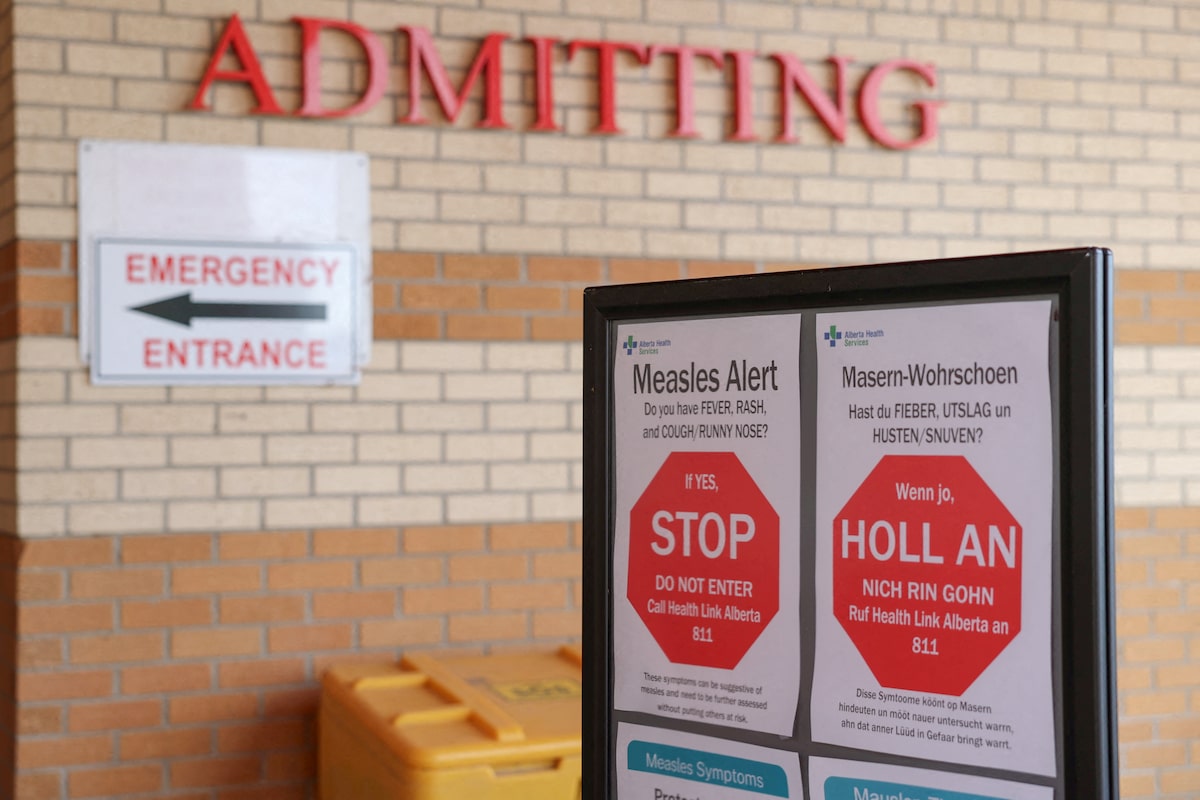
The highest number of confirmed measles cases in a single week – 147 – occurred in mid-July, the month of the baby’s death. By the time it was reported publicly in October, the spread had significantly slowed.Ahmed Zakot/Reuters
A premature baby in Alberta who contracted measles in utero – the province’s only death linked to the current outbreak – died last July, but health officials did not make the public aware until October, documents obtained by The Globe and Mail show.
Internal e-mails between senior officials in the Ministry of Primary and Preventative Health Services (PPHS), obtained through a freedom of information request, detail months of discussion on the definition of congenital measles and whether certain cases fit within it, leading to the three-month delay.
On Oct. 2, the death of the premature baby was made public on the provincial measles dashboard. The province declined at that time to provide any additional details, including the date of death.
Alberta has the highest rate of cases per capita of any province or territory, and has been under scrutiny for its measles response and approach to public transparency. Canada’s measles outbreak began in November, 2024, and continues to simmer, resulting in the country losing its long-held measles elimination status last November.
The Globe previously reported that Alberta rejected expert advice to include probable measles cases in public reporting and has delayed efforts by public-health officials to stifle the transmission of measles.
Internal documents show how Alberta’s measles outbreak began to spiral out of control
It is now known that the Alberta baby died at the “end of July” and was severely premature with no other complications related to the pregnancy, according to an Oct. 2 e-mail from Kristin Klein, then Alberta’s interim deputy chief medical officer of health.
“We have been trying to detangle how to capture and report on adverse pregnancy outcomes and finalize our congenital measles case definition. Once that was done, we went back and reviewed the cases previously reported to us,” Dr. Klein wrote to Eleni Galanis, then acting chief public health officer with the Public Health Agency of Canada.
Dr. Galanis had asked for additional details on the death so that PHAC could better understand risk and the burden of illness. She said Alberta and PHAC should “ideally be on the same page” because of interest from the media and international partners.
“It would be helpful if you could let us know how this info will be used as we have been hesitant to provide much clinical detail even within our own province,” Dr. Klein wrote.
An e-mail sent earlier from Dr. Galanis gives another glimpse into the debate among Alberta officials. She said she was aware of questions Dr. Klein had about “gestational age and whether measles deaths in utero or shortly after birth should be considered fetal deaths or congenital measles infection in an infant.”
Alberta government rejected expert advice to report probable measles cases, documents show
On Aug. 23, Sunil Sookram, then Alberta’s interim chief medical officer of health, told his colleagues that they were waiting on PHAC and Alberta Communicable Disease Control to define congenital measles before classifying the death.
But Anna Maddison, a spokesperson for PHAC, said in a statement that the national working case definitions for congenital measles, which were developed with provincial partners, were finalized in July, 2025. She said the agency was first made aware of the Alberta fatality in October.
Newborns who demonstrate laboratory evidence of measles within the first 10 days of life, whose parent was a confirmed or probable case, or who had no other suspected source of exposure are considered a confirmed case. A probable case follows much of the same criteria but does not have a laboratory confirmation.
The documents indicate Alberta updated its own case definition by Sept. 16, still more than two weeks before the death was reported.
In early June, Ontario reported the death of a baby infected with measles in utero. The provincial government declined to provide the exact date of death because of privacy laws. PHAC said it was alerted to that death in late May.
‘If the numbers are right, we’re in trouble’: Behind the comeback of measles in Canada
Andrew Livingstone, director of communications with PPHS, said in a statement on Monday that additional time was required to review the death because congenital measles was an “extremely rare outcome that had not been seen in Canada for decades.” He said Alberta assessed the case against evolving criteria before reporting it publicly and to PHAC.
He said PHAC used a “working, interim definition” in July that was intended to “support short-term classification and information sharing.” Mr. Livingstone also said that “Alberta aligned its criteria with PHAC’s key elements while adding the operational detail needed to apply the definition consistently at the provincial level.”
Lynora Saxinger, an infectious-diseases specialist at the University of Alberta Hospital, said there are factors that could legitimately cause reporting delays, but a classification is not necessarily required to alert people.
“Timeliness is important when there’s people at risk whose actions might be changed by knowing this information,” Dr. Saxinger said.
Measles cases were surging in Alberta during the month of the baby’s death. The highest number of confirmed measles cases in a single week – 147 – occurred in mid-July. By the time the death was reported publicly in October, the spread had significantly slowed.
Canadian Medical Association head calls for review of measles processes
The document also includes conversations about adverse outcomes in other cases involving an infection during pregnancy. Alberta does not detail outcomes, such as stillbirth or low birth weight, on its public dashboard.
In early July, internal e-mails show the office of Adriana LaGrange, Minister of Primary and Preventative Health Services, did want an op-ed column written about pregnancy and measles, highlighting the risks of infection. But the op-ed was not published until Aug. 14, roughly six weeks later, under Dr. Sookram’s name.
Karen Diaper, an assistant communication director with PPHS, wrote in an e-mail on July 7 that the minister’s office also wanted the op-ed to highlight that it was “off-base” to suggest events such as the Calgary Stampede weren’t safe, and to point out “how misguided it was to emphasize that our rates were higher” if cases are also rising in the United States.
Starri Sewlal with PPHS, in an e-mail on July 30 to Dr. Klein and Vivien Suttorp, then medical officer of health for southern Alberta, said his team prepared a draft that incorporated the requested points “indirectly yet factually” to fit with the intended tone.
Dr. Suttorp wrote on Aug. 12 that she was “intrigued with the many times this document has surfaced, and in fact how many individuals provide feedback,” but pleased that some adverse outcomes for newborns were included.
The published version focused on the danger of measles in pregnancy, Alberta’s vaccination efforts and “encouraging” case numbers.