
When Katy Steding was young, professional basketball was always her dream.
She wasn’t able to see that dream on the TV growing up in Lake Oswego in the 1970s. But Steding turned into a hometown hero for many during her time playing for the Portland Power.
“Pro basketball in Portland was really a life dream,” Steding said. “So the fruition of that with Portland Power was pretty incredible.”
When the Portland Fire return to the WNBA in 2026, Steding said a new generation of kids in Oregon will likely be inspired to chase a basketball future.
“There’s a huge gain for young women that find players to look up to and model themselves after,” said Steding, currently an assistant coach at Stanford.
Steding is an alumnus of Lake Oswego High School, scoring 1,405 points for the Lakers in the early ‘80s. She was the Lakers’ all-time leading scorer when she graduated (her total has since been eclipsed by Kelsey Lavender (1,517 from 2001-2004).
Steding led Stanford to the NCAA Championship in 1990 and was named to the All Pac-10 team three times. She was also a member of Team USA, winning the 1996 Olympic gold medal in Atlanta.
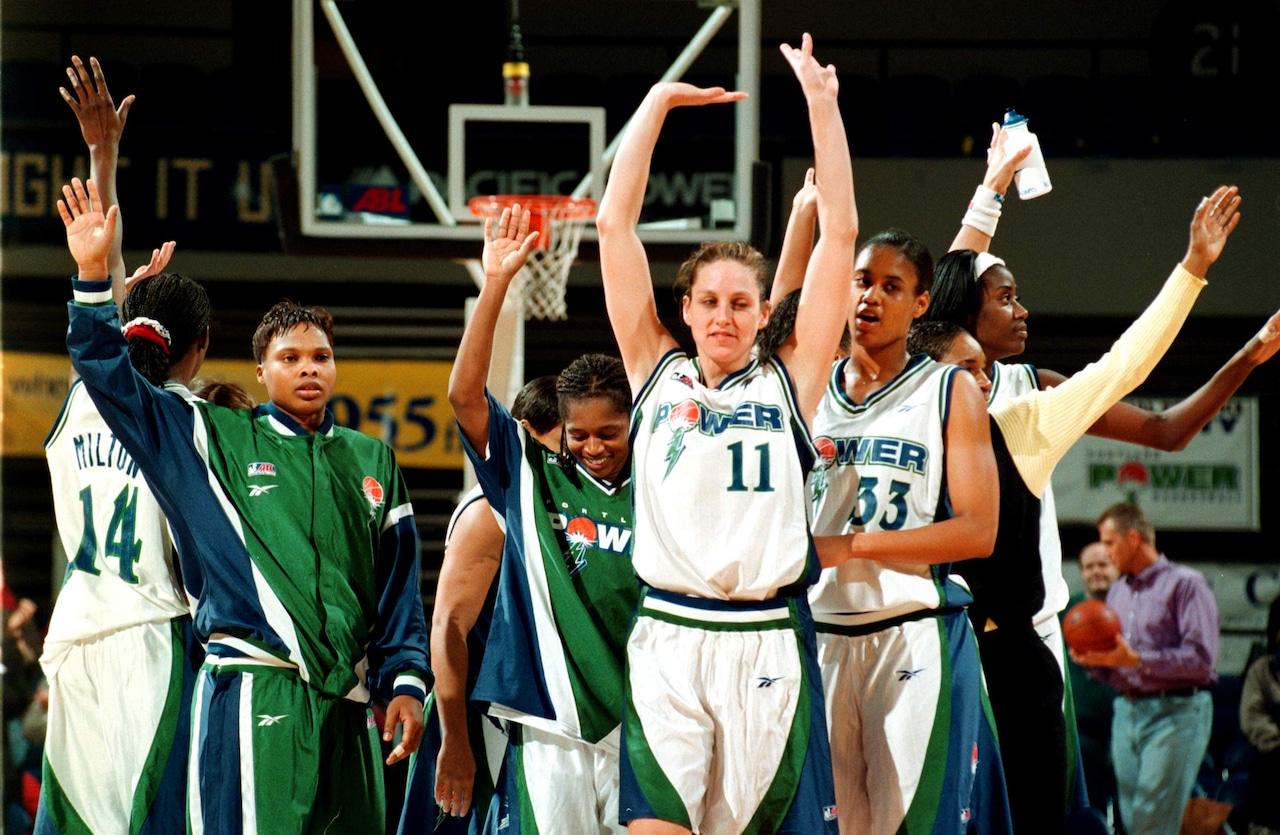
After the Olympics, Steding started her American professional career in 1996 with the Portland Power. She was a part of the team for its entire run from 1996 through 1998.
“I was always so proud to be from Oregon. So proud to be from Portland and the area and having all those connections and being able to help start basketball,” Steding said.
 Power forward Katy Steding celebrates a season-opening victory over the Seattle Reign in 1997.THE OREGONIAN
Steding said the thing that made her time as professional basketball player in Portland extra special was how the community embraced the Power.
“We had the best fans, I promise you,” she said. “We had the best fans in the whole country. Very loyal, super supportive, engaged in the game. They were knowledgeable, but they were always on our side.”
As a local, Steding was on the team’s rolodex of players to send out to community events regularly, especially speaking in Portland schools. Steding said those interactions were what made the team so beloved in the community.
“We were always doing stuff in the community,” she said. “It was very much not a hands-off thing. So it was really wonderful. It was one of the highlights of my life.”
Despite a rocky opening in 1996, going 14-26 and missing the playoffs, the Portland Power had the second highest attendance in the ABL. Steding said it helped that Ducks and Beavers games require a commute down Interstate-5 to attend, coupled with the city’s love of women’s sports.
“It was a time where we could kind of own Portland women’s basketball and thusly in women’s sports at the time,” Steding said. “The Portland community is hungry for professional women’s sports. So the more teams and the more opportunities you have to see women in those kinds of positions, the better it is.”
As an Oregonian herself, Steding knows how having access to women’s basketball can help elevate the game at the youth level.
An assistant coach at Stanford, her alma mater, Steding worked closely with fellow Oregonian Cameron Brink — who played at Mountainside and Southridge and led multiple teams to the Class 6A state championship game — and was part of the staff when Brink helped lead the Cardinal to the 2020 NCAA Championship.
“There’s so many players that have come along and been part of the Oregon sports community, whether they were born and raised in Oregon or kind of transplanted or gone and come back.”
After the ABL folded in late 1998, Steding spent a year with the Sacramento Monarchs and a year with the Seattle Storm before transitioning to coaching. She spent seven years coaching in her home city at Warner Pacific and since has been mostly an assistant coach at San Francisco, the Atlanta Dream, Columbia and has been at Stanford since 2020.
But despite being away from Oregon, Steding said she still considers Oregon her home. Most of her family still lives in the metro area.
“It’s my favorite place to be,” she said.