
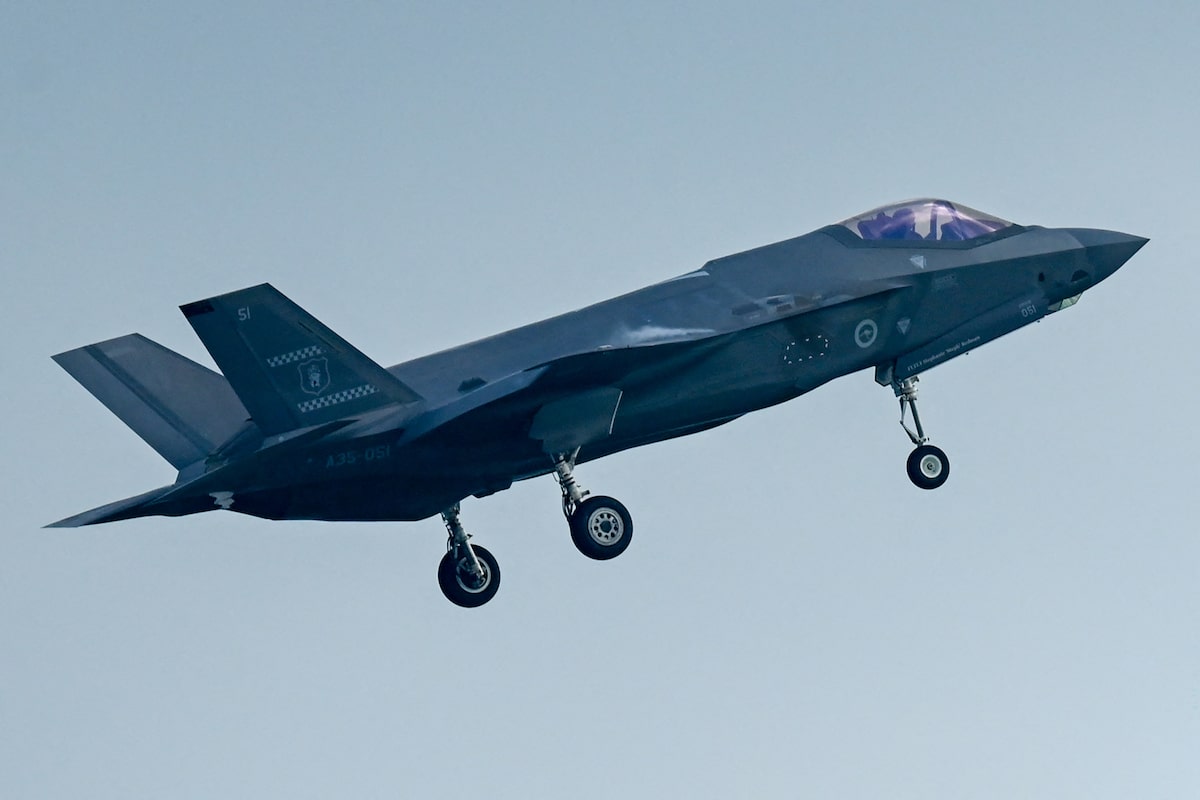
Ottawa should downsize its plan to buy F-35 fighter jets from the U.S. in response to Trump’s threats against Canada.ROSLAN RAHMAN/AFP/Getty Images
For the first time in generations, Canada’s only neighbour is a threat.
The threat exists on two levels.
There are barriers to Canadian exports to the United States, and the possibility of more to come. That economic threat is reversing decades of continental trade and integration.
Then there’s the threat to Canada’s sovereignty – U.S. President Donald Trump’s social-media posts with the Stars and Stripes over Canada; his taunts about the “governor” of his 51st state; his Treasury Secretary musing that perhaps Alberta could be that state.
As I wrote last week, the economic threat – tariffs and the like – is real but also survivable.
But the threat to our sovereignty is existential.
Opinion: Trump and Ottawa’s take on TACO will determine Canada’s fighter-jet strategy
In response to these twin threats, I believe that Ottawa should downsize its plan to buy F-35 fighter jets from the U.S., replacing them with a large order of Gripen jets from Sweden’s Saab – which has promised to include a substantial amount of assembly and subcontracting in Canada.
Such a move would be a big change in Canadian defence and industrial policy. But big change is what the Trump administration is imposing on Canada.
In human affairs as in physics, every action provokes an equal and opposite reaction. That Mr. Trump does not understand this does not make it less true.
Insist that we export less to the U.S.? We will have no choice but to trade more with others.
Threaten integrated North American supply chains? We will have no choice but to integrate into supply chains elsewhere.
Tell us that our long-time military partner and protector is now a potential predator, and that we are the table d’hôte? We will have no choice but to protect ourselves against predation.
Purchasing the Gripen furthers each of these goals.
Joly says Canada ‘didn’t get enough’ industrial benefits out of F-35 procurement deal
To deal with current trade barriers, and Mr. Trump’s constant threats of more – in just the past week or so, he has threatened a 100-per-cent tariff if Canada gets too close with China, and separately promised a 50-per-cent tariff on Canadian-made aircraft – a logical response is to increase trade and economic partnerships with other countries. That diversification is one of Prime Minister Mark Carney’s aims.
Another logical response is a Canadian industrial strategy, to prevent U.S. trade barriers from hollowing out Canadian industries such as automobiles. That industry was built on the assumption of free movement of parts and vehicles between the U.S. and Canada.
To the extent that continental manufacturing is at risk of being roadblocked, we need partnerships beyond the U.S. Hence last week’s memorandum of understanding on industrial co-operation with South Korea. It is intended to be a first step toward Korean automakers manufacturing here.
And if the U.S. has moved from rock-solid ally to potential threat, then we need to recalibrate our long-standing defence policy. We must continue to co-operate closely with what is still, for now, a NATO and NORAD ally, while preparing for a different future, and keeping a wary eye over our shoulder.
That means strengthening strategic partnerships with other NATO allies. It also means being careful about how dependent we are on U.S. weapons, given that the Trump administration has shown it is willing to use what was mutually beneficial interdependence to harm Canadian industries, and to threaten allies.
Put it all together, and purchasing the Saab Gripen makes sense. Canada has already agreed to buy 16 F-35s from Lockheed Martin, the first of which is to be delivered to the Royal Canadian Air Force later this year. The option for another 72 F-35s is in limbo. It should be terminated.
Instead, the RCAF’s main fighter aircraft should be the Gripen. Saab has offered to set up a production line in Canada.
There’s also an opportunity for that production line to make Gripens for Ukraine. That would strengthen Canada’s industrial base through an approach that we used during the Second World War: We donated massive amounts of military equipment to our allies, above all the British, who paid with money we gave them – allowing for the manufacture in Canada of thousands of tanks, aircraft, trucks, machine guns and radar sets.
Mr. Trump may dislike global supply chains, but they remain widespread, particularly in sectors such as aerospace.
For example, Mr. Trump’s threat to tariff Canadian aircraft was aimed at Bombardier, for the benefit of U.S.-based Gulfstream Aerospace. However, many of Gulfstream’s executive jets are powered by engines made by Pratt & Whitney Canada.
And the most modern version of the Gripen is powered by an engine from U.S.-based General Electric. That engine is manufactured in the U.S., South Korea and India, with components from other countries.
Would buying the Gripen anger the White House? Surely. But Mr. Trump has made it clear that the only thing he respects is strength. He may try to steamroll us if we fight back; he is definitely going to steamroll us if we lie down.
In any case, Canada is only following Mr. Trump’s lead. You want less trade with Canada? You want less co-operation? You want us to fear you as a threat instead of trusting you as a friend?
Message received, bud.