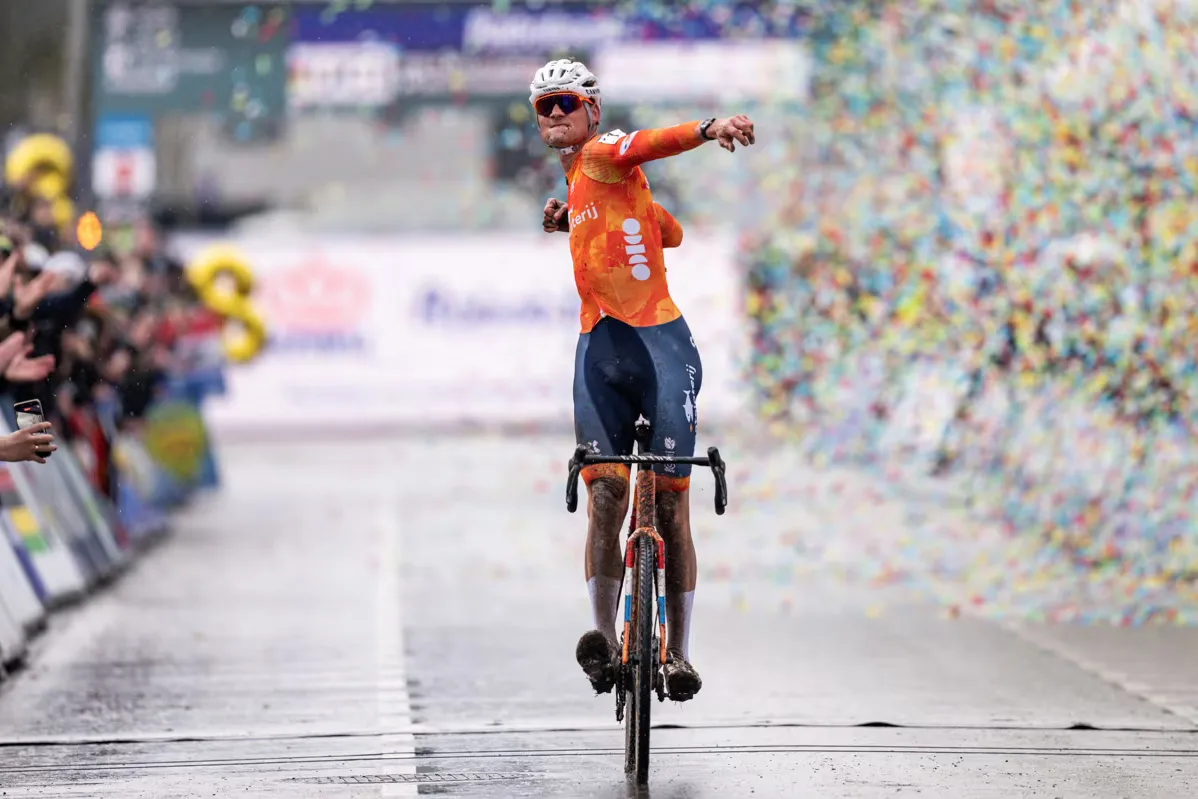
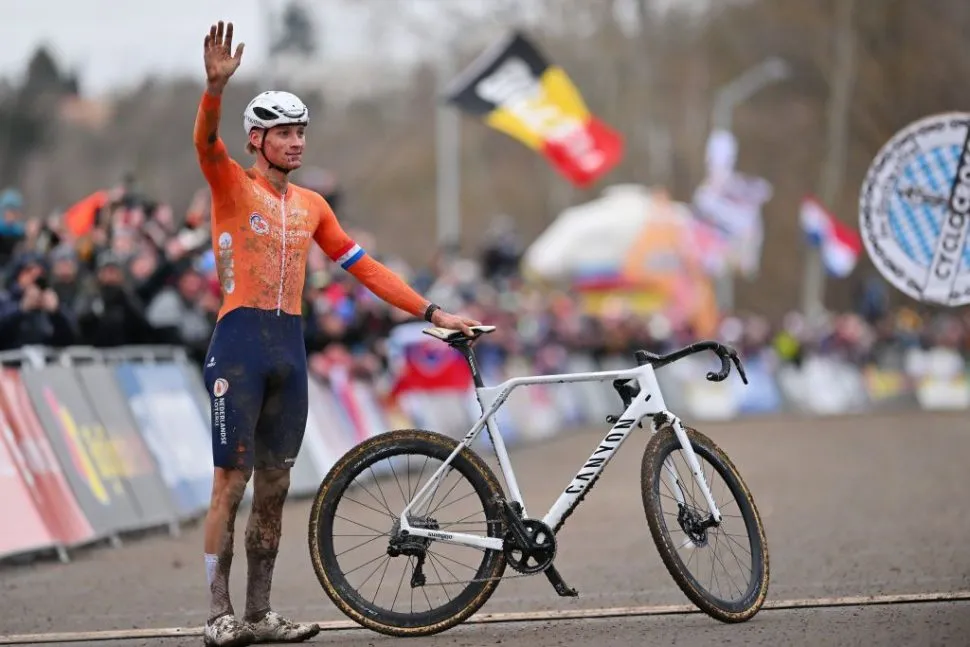
After a record-breaking eighth UCI Cyclocross World Championship victory over the weekend, Mathieu van der Poel has become the most successful rider in the event’s history.
Now with 183 cyclocross victories under his belt, a record 51 UCI World Cup race victories and this eighth world title, Van der Poel is undoubtedly the greatest cyclocross rider to ever grace the muddy fields of northern Europe. However, after having supposedly ‘completed cyclocross’ this season, the Dutchman is hinting at hanging up his mud-caked bike in the coming years.
Without its 31-year-old talisman, the sport will be forced to navigate a new era, one that could either burn bright or see the discipline fall back into its niche category. So, as Van der Poel takes some time to rethink his options, let’s take a step back and envision the sport post-MVDP.
The prospect of closer racing
 UCI
UCI
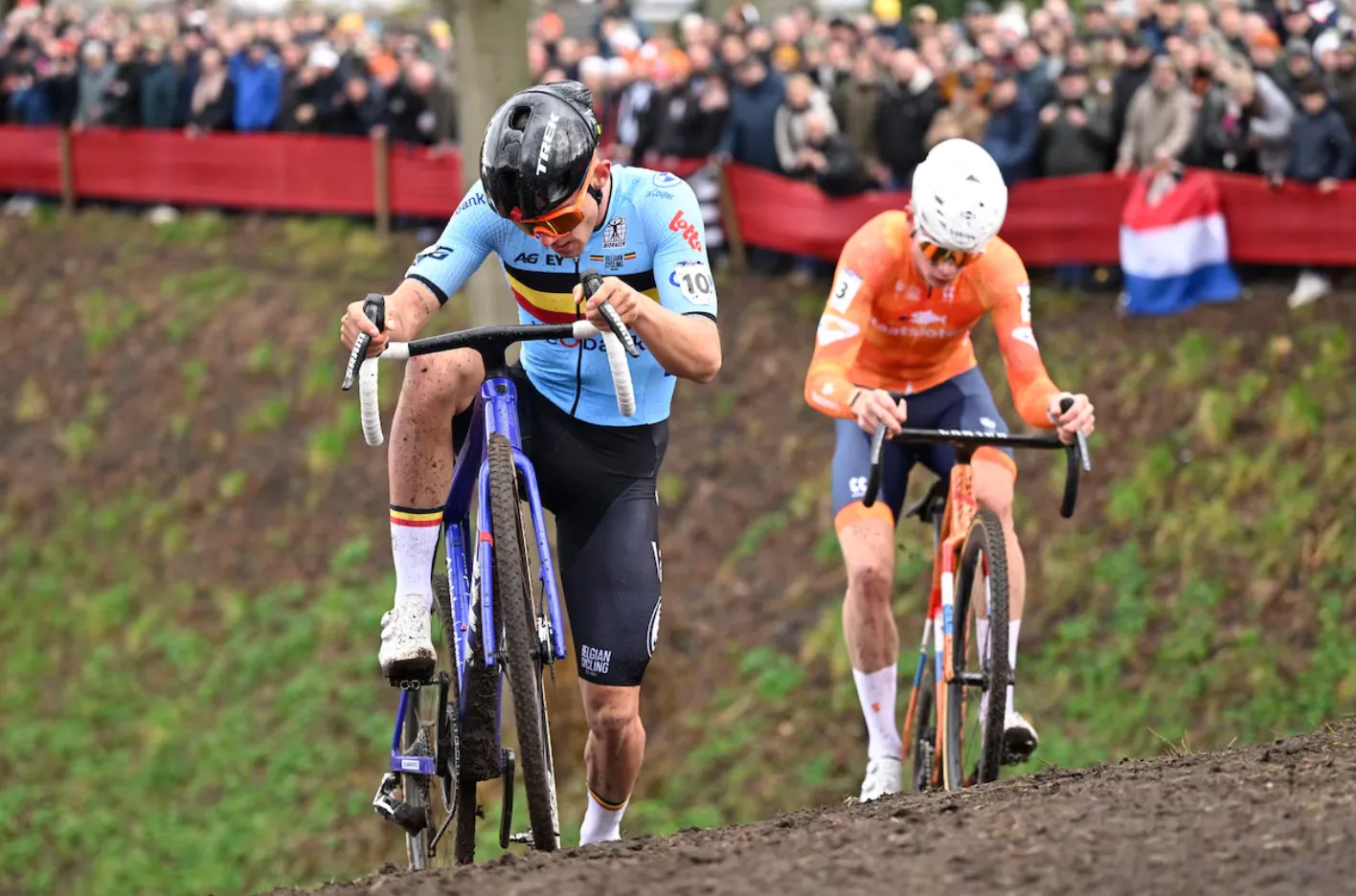
While Van der Poel’s mitre and dominance in cyclocross has been nothing short of spectacular in recent years, it has verged on being boring at times. In fact, he has only lost one race during the past three seasons, and that was down to a crash. His winning formula is now tried and tested, often seeing him spending an hour on his own off the front after going clear during the first lap.
If you’re sitting down to watch a cyclocross race with the hope of seeing some close competition throughout, you’ve largely been out of luck when a rainbow jersey is on the start line. Since the demise of close rival Wout van Aert’s own cyclocross career in the past three years, the season has felt like a series of exhibition races once Van der Poel sails away to an insurmountable lead.
Without him, the hierarchy opens up. The competition between the likes of Tibor del Grosso, Thibau Nys, Michael Vantourenhout, Niels Vandeputte and Toon Aerts creates the prospect of far more entertaining and volatile battles in the future. It means we can look forward to more classic cat-and-mouse moments, final lap blitzes and overall intrigue throughout the race.
As a bonus, the World Cup could reclaim its relevance without riders needing to worry about an impending Van der Poel hammering. That psychological blow must have weighed heavily on the bunch since his dominance began, so a Van der Poel-less bunch could see riders regain some confidence.

The man making the sport global
 Gaetan Flamme
While the watchability of cyclocross races may increase without Van der Poel, there is a flip-side to his dominance.
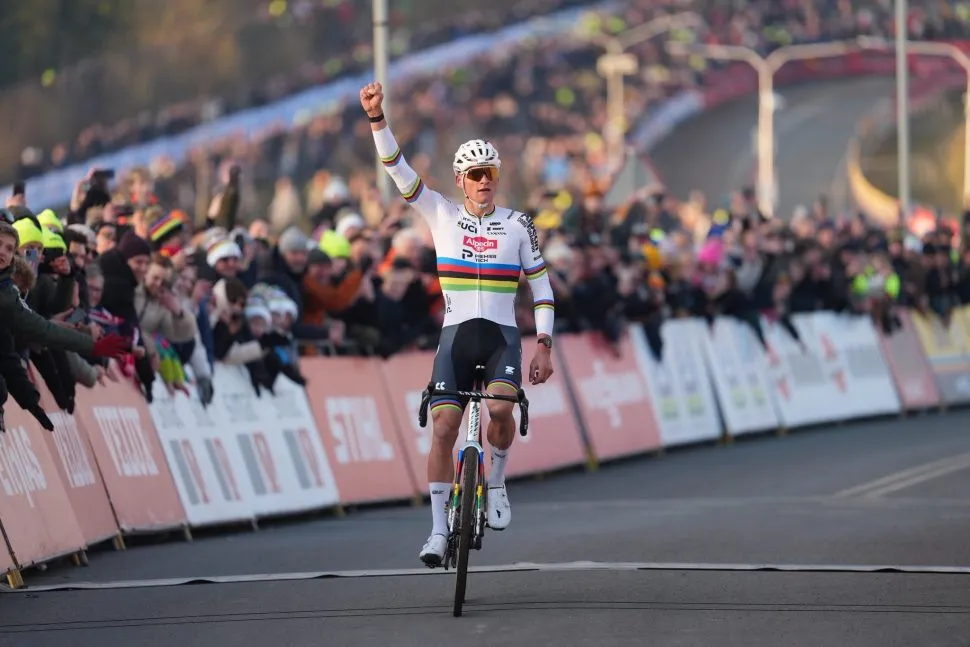
The Dutchman has an unparalleled star power in the sport. I’d even say he has almost grown bigger than cyclocross itself, particularly on an international level outside of the traditional Benelux market. Clips featuring the Alpecin-Premier Tech rider go viral each weekend and headlines featuring his name are bound to get far more traction than those of any other cyclocross racer. As a result, his fame has transcended cycling’s traditional realm.
The Dutchman has wrangled in new viewers to the sport, whether they know his name from the road or mountain biking. The proof of this is evident in YouTube views and social media impressions. For example, on TNT Sports’ YouTube channel – which accrued the highest view counts for any highlights packages on the site – races featuring Van der Poel this season received an average of 158,000 views in comparison to the Van der Poel-less figure of 57,000. In other words, views almost tripled when the Dutch superstar was racing.
In an age of clippable moments and social media virality, losing a star like Van der Poel could certainly damage cyclocross’ reach, both online and on TV. Not only that, but ticket sales at races may also suffer if fewer people find the sport or connect a star like Van der Poel to its very existence, particularly at races outside of Benelux.
I can testify to this with my own experience, having attended the World Cup in Benidorm last month. Van der Poel received an unprecedented amount of attention on the side of the course, with some spectators only deciding to turn up thanks to the promise of a Van der Poel cameo. In fact, ticket sales at the Benidorm World Cup round increased in 2026 in comparison to 2025 when Van der Poel decided to skip the Spanish event.
The kids are alright
 UCI CX
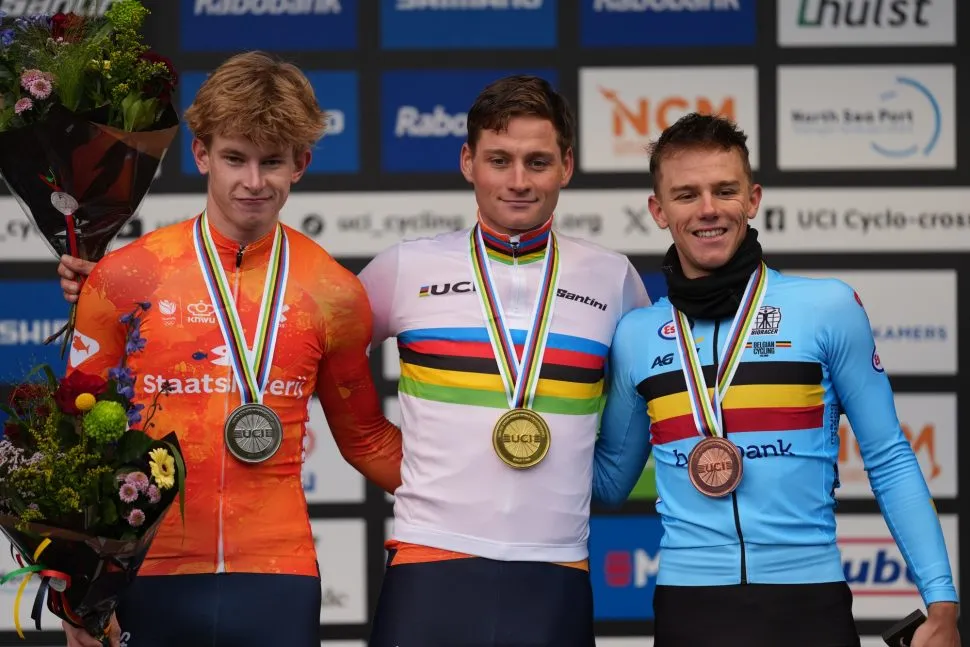
If the current vacuum of stars in cyclocross is a worry, feel reassured by the prospects of Del Grosso and Nys. Like a carbon copy of the Van der Poel/Van Aert duo entering the sport a decade ago, the pair are exciting talents with both personality and star power. Nys, of course, has a poetic connection to his father Sven, while Del Grosso posts videos on his YouTube channel and offers Gen Z quips over on social media. Together, they are the perfect torchbearers for cyclocross going forward.
Like Van der Poel – and, in fairness, Van Aert and Tom Pidcock – the pair have also crosspollenated onto the road, helping them to build a bigger name than many of their cyclocross-exclusive contemporaries. Nys has already picked up WorldTour wins, for example, while Del Grosso, as the heir to Van de Poel’s Dutch throne, has targetted a big Classics programme in 2026. We await his ascendancy on the tarmac, but let’s not forget that it took Van der Poel four years to claim his first WorldTour win despite picking up a first rainbow jersey in cyclocross back in 2015.
Perhaps their success on the road could bring extra eyes to cyclocross once they switch focus in the winter. After the era of Van der Poel and Van Aert, it would be good to keep up this synergy between the two disciplines, particularly in terms of international reach.
Where does the sport go forward?
 Billy Ceusters/Getty Images
Let’s get one thing clear. Van der Poel hasn’t fully made up his mind on retirement. He told the press the other day that he ‘still has time’, while also hinting that ‘it would not be a bad idea to skip a winter’. Of course, there are financial considerations, with each World Cup appearance offering at least €5,000 in cash. Throw in a potential tenth world title in 2028 on home roads in Hoogerheide, the hometown of his father, and we could be premature to think that Van der Poel is ready to bow out.
To be honest, the sport probably needs him to stay in the loop for now. His star power is vital for cyclocross’s growth, and it’s obvious just how much attention he brings to the sport, which has historically been dominated by Belgians. He keeps the sport relevant, and he elevates its appeal to a broader audience, who are not guaranteed to stay on board if he were to retire.
That said, the seeds have already been sewn for cyclocross’s next phase through the emergence of captivating characters in Del Grosso and Nys. Their youthful energy is engaging online audiences and seeing their personal appeal expand internationally. As a duo, they offer a new rivalry for cyclocross to build on in the years to come, which is exactly what the sport needs.
For most long-time cyclocross fans, names like Sven Nys, Niels Albert and Mathieu van der Poel are the legends of the sport that we remember. If either Tibor del Grosso or Thibau Nys can join those ranks, cyclocross is in safe hands.