
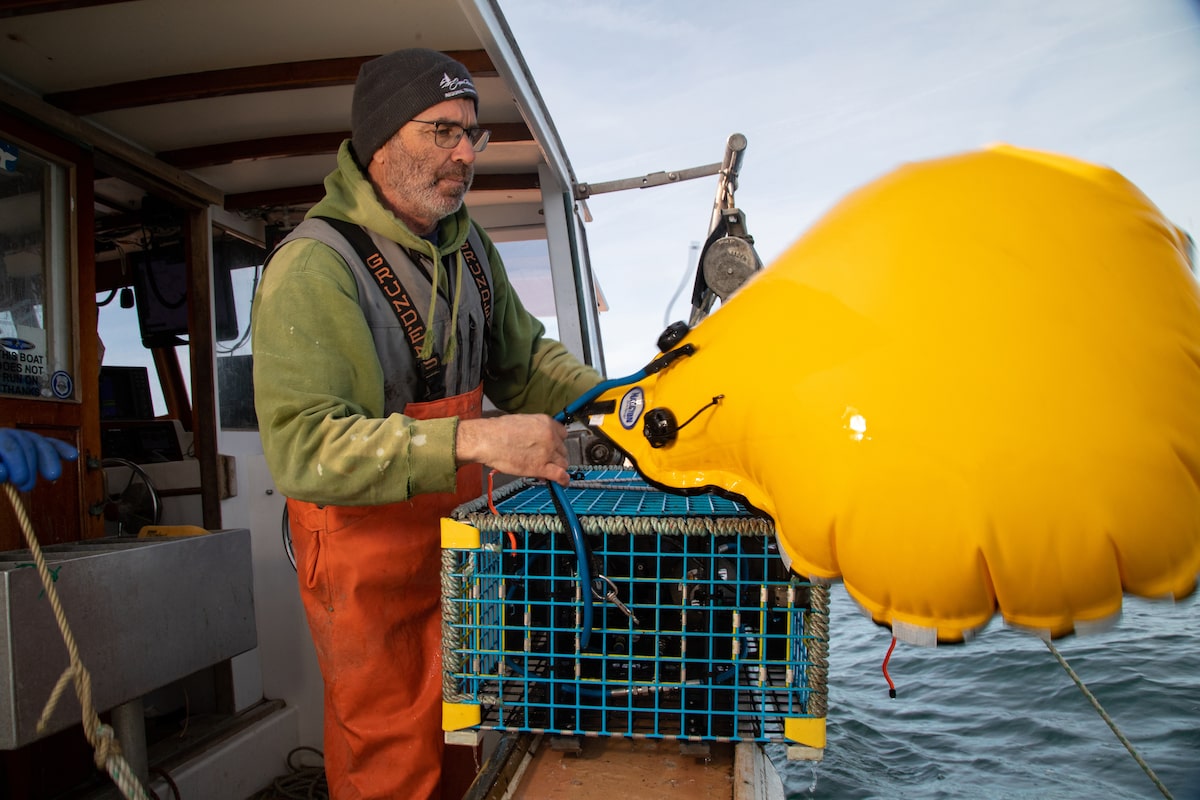
Lobsterman Mike Lane uses on-demand fishing gear off the coast of Massachusetts in 2025. A new government strategy proposes using specialized gear as standard practice in some zones to protect endangered whales.LAUREN OWENS LAMBERT/The Globe and Mail
A new federal strategy will allow Canadian harvesters to fish sustainably even when endangered whales are present.
The Whalesafe Fishing Gear Strategy aims to reduce entanglements in vertical buoy lines – the ropes connecting surface markers to traps or trawls on the ocean floor – and lessen the harm when entanglements occur.
The strategy, promised last year and released Tuesday by Fisheries and Oceans Canada, commits to designated management areas open to on-demand “ropeless” gear – which eliminates vertical lines – in areas where entanglement risk is highest.
“This isn’t something you want to rush,” said Brett Gilchrist, director of national programs at DFO, noting extensive consultations with harvesters and Indigenous groups delayed the release. “Getting it right was critical – making sure we didn’t launch something that would immediately lead to resistance from harvesters.”
Entangled: The tides of change for endangered whales
Currently, harvesters can use on-demand gear under scientific permits, but they typically only do so after right whale detections trigger closures. The strategy would flip that approach, proactively designating fishing areas where the gear is standard practice, not a last resort.
The priority is Canada’s east coast, where critically endangered North Atlantic right whales overlap with fishing seasons. DFO will establish pilot areas in 2027, management areas by 2028, and expand to all high-risk fisheries nationwide by 2030.
SMELTS on-demand acoustic technology was tested in Massachusetts last year.LAUREN OWENS LAMBERT/The Globe and Mail
“The long-term is not more closures, it’s finding ways for fish harvesters to fish sustainability and properly in a way that’s safe for whales,” says Mr. Gilchrist.
As The Globe reported last fall, entanglement is a primary cause of death and decline for right whales – 86 per cent have been entangled at least once, some as many as nine times. Other whales also face entanglement risks. In fact, according to DFO, the whales most often reported entangled in fishing gear are humpback whales on both the east and west coasts, fin whales on the east coast, and grey whales on the west coast.
Alden Gaudet, a PEI snow crab fisher, was resistant to using on-demand gear – until it saved his season. In 2022, when right whale closures hit the island’s fishery for the first time, he found himself pushed 90 nautical miles from his home port, burning double the fuel, with most of his quota still in the water.
“I cursed this out and I made fun of it,” says Mr. Gaudet, referring to the on-demand gear.
He switched to the ropeless gear borrowed from the CanFISH Gear Lending Program – the first lending program for adaptive fishing gear in Canada – landing his full quota. He’s depended on it ever since whenever right whale presence cues closures.
“Now I see things in a different light,” he says. “Without this gear, I’m nothing.”
An endangered North Atlantic right whale entangled in fishing gear is seen in the Gulf of St. Lawrence, northeast of New Brunswick’s Acadian Peninsula.Robert F. Bukaty/The Canadian Press
Snow crab harvesters in the Gulf of St. Lawrence have collectively landed roughly one million pounds using on-demand gear in areas otherwise closed to conventional fishing. Last year, for the first time, lobster harvesters in the Bay of Fundy landed catch using the technology.
“This strategy is a game changer,” says Sean Brillant, senior conservation biologist at Canadian Wildlife Federation, which hosts the CanFISH library. While harvesters say whalesafe gear requires on-boarding that initially slows down fishing effort, extensive gear trials in Canada and the U.S. show whalesafe gear works, says Dr. Brillant.
“This isn’t a fringe tool. This is an effective tool. Harvesters feel they can use this stuff to continue to make a living. And that’s a very encouraging result,” says Dr. Brillant, adding that he hopes the strategy’s launch will encourage greater harvester uptake.
Six ways to show humanity to endangered right whales
The Globe reported last fall that fewer than 10 Canadian harvesters currently use ropeless gear in regular operations, though that number grows to about 200 when including those who borrow equipment or are preparing for potential closures.
The strategy identifies two main categories of whalesafe gear: on-demand or systems that eliminate vertical buoy lines entirely, and low breaking-strength rope designed to break at 1,700 pounds of force, allowing whales to free themselves.
“I consider 1700-pound rope whale safer but not necessarily whale safe, as entanglements would still occur,” says Amy Knowlton, senior scientist at the New England Aquarium.
Ms. Knowlton also urges DFO to develop clear metrics for success in undertaking risk assessments, a process that DFO plans to define with stakeholders, starting with right whales, then expanding to other whale species and areas in Canada.
“Determining the level of risk posed by any given fishery to whales should not just be based on whether gear from the given fishery has been found on a whale as obtaining this detailed information can be challenging and only tells a small part of the entanglement story,” says Ms. Knowlton.
Using ropeless gear, crab fishers affix multiple traps to an on-demand device that deploys a buoy or balloon when they’re ready to haul in the traps.Alden Gaudet/Supplied
Mr. Gilchrist says the fundamental question for assessing entanglement risk is asking, “Do you have a fishery that co-occurs with whales?”
The strategy pledges that DFO “will not impose on-demand gear on fish harvesters where viable alternative options exist,” language that signals flexibility for industry.
“Fisheries that don’t necessarily have a regular interaction or co-occurrence with whales need alternative tools,” says Mr. Gilchrist.
The strategy will also give whalesafe gear manufacturers the predictability they need to invest, which should bring down the price point – a key barrier to adoption.
“Once it becomes a normal application in fisheries, the cost is going to come down quite a bit,” he says.
The strategy arrives as entanglements continue to threaten the species’ survival. Last month, a four-year-old North Atlantic right whale named Division (#5217 in the catalogue maintained by the New England Aquarium) was found dead off North Carolina, his mouth and blowhole cut by embedded fishing line. First spotted tangled in December, he had been entangled three times before. Division is the first detected right whale death since May, 2024.
Another whale, male #5132 born in 2021, became entangled in Canadian lobster gear from the Bay of Fundy in December, 2024, and remained so when last sighted in June, 2025. Athena (#5312, born in 2023) was entangled in Canadian snow crab gear in the Gulf of St. Lawrence in June, 2024, requiring rescue by the Campobello Whale Rescue Team. An additional eight entanglement cases with attached gear occurred in 2024, though country of origin has not been determined.
“Each case adds to the urgency,” Mr. Gilchrist said. “But that urgency is already there. That’s why the strategy is moving along.”
There are currently an estimated 384 North Atlantic right whales. The species has been under an Unusual Mortality Event declaration since 2017. This year’s calving season has brought hopeful news – 22 new calves spotted so far – but entanglement and vessel strikes remain leading causes of death and injury.
“It’s really about getting harvesters out safely and allowing them to succeed on the water while protecting these important species,” says Mr. Gilchrist.
This story is produced in partnership with the Pulitzer Center’s Ocean Reporting Network.