

Prime Tire Newsletter | This is The Athletic’s F1 newsletter. Sign up here to receive Prime Tire directly in your inbox twice a week during the season and weekly in the offseason.
Welcome back to Prime Tire, where today I’m reveling in the Formula 1 engine technology feud that has been brewing behind the scenes for over a month, then boiled over in a new Toto Wolff rant yesterday.
I’m Alex, and Luke Smith will be along later.
Angry Toto Returns: Mercedes boss calls out engine rivals
Many F1 paddock personnel had long tagged Mercedes as the favorite to succeed as the championship’s new car design rules era kicked off in 2026.
I can remember watching cars under the glowing lights of Bahrain’s preseason nighttime testing in 2024, while discussing Mercedes’ then-hiring spree of engineers to staff its new engine project with a rival team’s official photographer.
Everyone expected a lot of Mercedes in 2026, even back then.
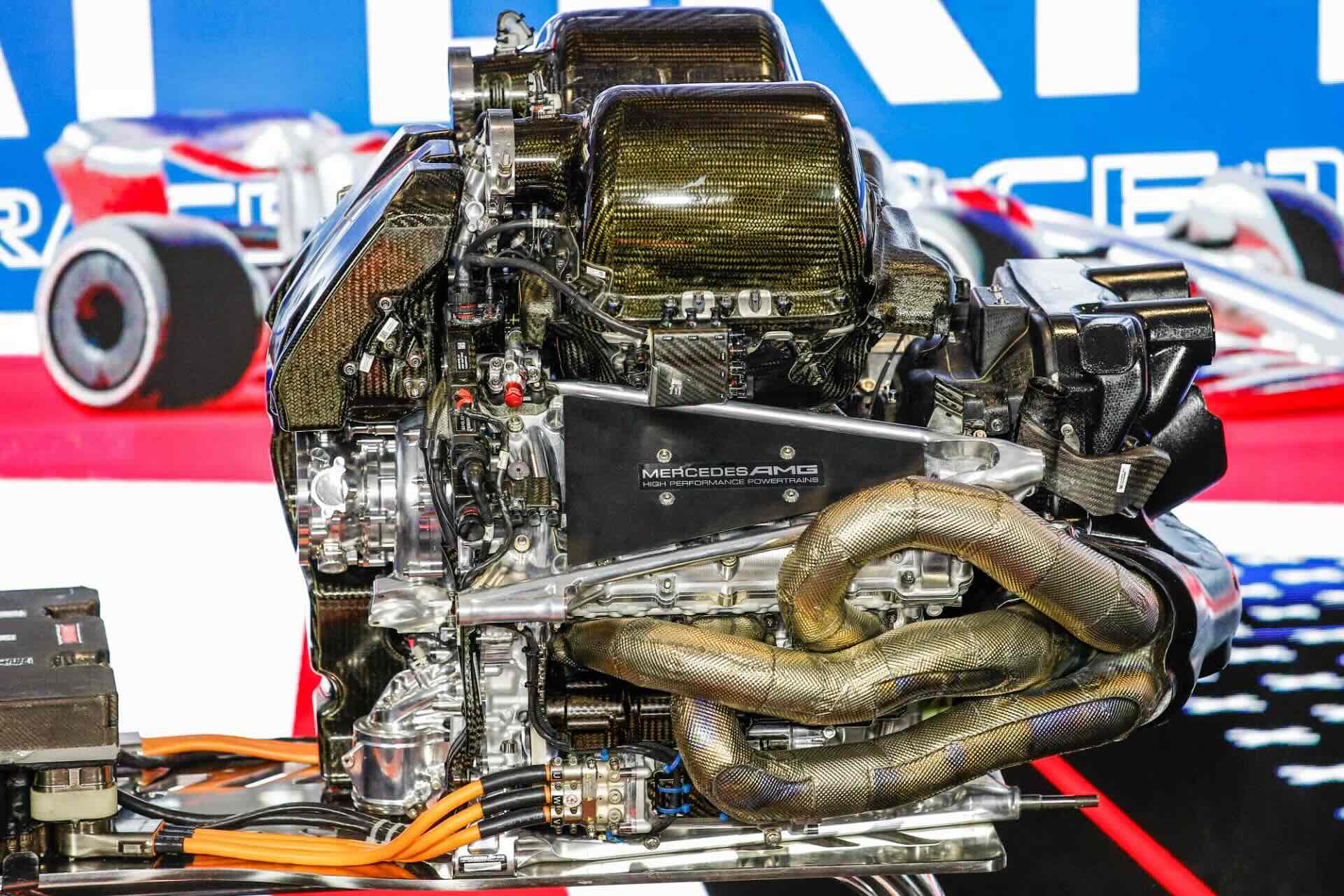
Plenty of that centered on how it first nailed F1’s initial switch to hybrid engines back in 2014 (example of this tech pictured below, from 2023) and its years of dominance to 2021 that followed. But there was something telling in the fact that Mercedes was well advanced in resourcing and staffing its new engine project, years out from the full 2026 reset even being signed off by the FIA.
By 2024’s end, Mercedes’ communications staff was briefing about McLaren’s resurgence and Williams’ early shoots of proper revival.
The subtext was that these teams, as Mercedes engine customers, could provide competition to the works squad that just wasn’t there in 2014, when Lewis Hamilton and Nico Rosberg scrapped for that world title and those that followed.
It all bred a sense of confidence through the end of the 2022-2025 rules era that wasn’t flowing from F1’s other engine builders.
Ferrari is … Ferrari, closing on 18 years without a title of any sort. Renault doesn’t make F1 engines any more. Honda is now starting fresh with Aston Martin and made a truly awful mess of the first F1 hybrids. Audi and Red Bull/Ford are entirely new projects.
And so, there was a sense of inevitability when, as The Race website reported just before Christmas, two teams found a clever way to boost power in their new engines in a way others couldn’t match — one was Mercedes.
The other was Red Bull. And its new engines division features many ex-Mercedes engine staff — including project head, Ben Hodgkinson.
Anyway, the important part is what they’re doing and how the other three engine builders (Ferrari, Audi and Honda) reacted, which led to Wolff’s comments this week.
This was to complain, in writing, to the FIA about how Mercedes and Red Bull are thought to be gaining power by cleverly expanding their engine cylinder volume beyond a new limit when out on track.
A cylinder with a larger compression limit will deliver more power than a smaller one, although too much expansion can cause an engine to malfunction.
Gongora / NurPhoto via Getty Images
The nub of the issue is that this can currently only be measured when the engines are cold, when cars are in the garages.
The FIA can’t stop or measure the parts involved in expanding when they heat up on track, and therefore delivering a power boost. But there is a rule that technically forbids such an approach.
Other engine builders argue this rule applies at all times, on or off track. When engines are hot or cold.
And they aren’t happy because to achieve the same improved results — potentially as much as 0.4 seconds faster per lap, huge in F1 terms — they would have to significantly redesign their engines. That might take a year or more.
Talks between all the teams and engine manufacturers took place through January, with more planned for Thursday. But any motion to ban the practice may be hard given the teams vote on the issue — and the six Mercedes/Red Bull powered teams form a majority block within the 11 squads competing in 2026.
Hodgkinson downplayed the saga during Red Bull’s season launch last month, as you would if you were a team gaining from such an approach. Then yesterday, as Mercedes formally presented the car that racked up 500 laps in Barcelona in the first private test of 2026 last week, team boss Wolff came out swinging.
“Just get your s— together,” he said of the aggrieved engine manufacturers. “Doing secret meetings and sending secret letters, and keep trying to invent ways of testing that just don’t exist … I can just say, at least from us here, we are trying to minimize distractions.
“But maybe we are all different. Maybe they want to find excuses for why things are not good before they have even started.”
He later added: “The power unit is legal.”
Luke was on the call with Toto and wrote our piece covering his explosive comments.
But the reaction in the comments section of that article got me thinking about how fans are taking in this saga, and also how it compares to tech feuds of recent years.
Piranha Club Politics: Nothing new to F1

Here, readers Paulius and Drake are referring to Wolff’s lobbying efforts over rule changes, specifically to reduce the porpoising aerodynamic disturbance in 2022. The Mercedes car that year was suffering badly around this.
Welcome to F1’s often hypocritical political arena. Teams have to win in the long and short term, so Wolff can’t be blamed for shifting his approach to reflect his now much stronger position.
He is, as Paulius states, ex-Red Bull boss Christian Horner insisting his rivals “change your f—ing car” — immortalized in season five of Netflix’s “Drive to Survive” docuseries, as team bosses clashed at a filmed meeting on porpoising at the 2022 Canadian GP.
F1 is so often politics. And political people thrive in the paddock.
As a handy aside here, the F1 organization employs several PR staff that used to work in British government communications of late the 2010s and early 2020s.

A recent F1 political argument, and again where Wolff was a major player, as Ben highlights above, concerned Ferrari’s engine in the 2018 and 2019 seasons.
Ferrari’s rivals were suspicious it was illegally gaining power — especially as it dominated in qualifying at Spa in 2019, but then only barely beat Mercedes to pole a week later in Monza.
It was suspected — but never proven, given the team entered into a secret “settlement” deal with the FIA that meant it dropped its old engine tech and had to bounce back with a newer, initially slower one in 2020-2021 — that Ferrari was illegally getting around F1’s strict fuel flow restrictions.
Essentially, this involved firing in extra fuel in the exact split second the mandated fuel flow meter wasn’t taking a measurement. This would theoretically give a massive burst of acceleration out of corners.
But where this differs from the current saga is that this approach would’ve actively gamed a compliance device. You can disagree, but to me that’s a very different sort of bad compared to exploiting the gray area of rule wording, as it appears Mercedes and Red Bull are doing now.
A better tech feud comparison is the flex-wing saga that has erupted on many occasions over the years.
In 2025, the FIA beefed up tests on front and rear wings to ensure they weren’t flexing too much when cars were out on track.
These could be measured as static in the pit lane but flex considerably under load when cars were at speed and still remain legal. This is what Mercedes and Red Bull will be arguing about their new engines right now.
Innovation in gray areas is what F1 car design is all about. It’s just much harder to do in the modern era as rules are so prescriptive on cost grounds.
So, you can slice this saga either way depending on your perspective. And it will likely rumble on through the opening phase of the new era if the teams continue disagreeing. A rival could even protest the results of the season opener in Australia.
FWIW, I think Mercedes and Red Bull should be applauded for their innovation. In this instance, poor rule wording and a lack of alternative testing has created the loophole at play.
But, as works teams are expected to lead their customer squads as the new era begins, I don’t want to see one team running away with it. Again.
If the FIA has to step in again, the political fighting will only increase.
Love it or loathe it, you can’t blame Wolff for fighting his corner. Or anyone else, for that matter.
Now over to Luke for an update on Williams.
Inside the Paddock with Luke Smith: James Vowles and Williams’ new livery
I wrote last week after the Barcelona test that, despite the reasons to skip the private running, for Williams to be hundreds of laps behind many of its rivals could only be a bad thing.
Ahead of the team’s 2026 livery reveal today, team principal James Vowles provided further updates, expanding on why he wasn’t overly concerned about missing the test.
“You’re not starting from square one,” said Vowles, pointing to a “strong” Virtual Track Testing program the team completed at its factory with a car on a rig simulator instead.
He also highlighted the knowledge gathered by those at Barcelona running Mercedes engines (the works team, Alpine and McLaren) would help Williams, compared to, say, Aston Martin. As the only Honda-powered team, it can’t rely on data gathered elsewhere.
Carlos Sainz and Alex Albon have been working hard in Williams’ simulator to try and learn how the vastly different 2026 cars function. Williams will also hold a season preparation filming day in Bahrain ahead of the next preseason test.
“Is it perfect? No, you learn a lot more on track,” Vowles said.
There’s faith in Williams’ systems to ensure it is not chasing too much ground. But only the Bahrain running will show if it’s truly off course or not.
There is definitely a deficit to make up, regardless of the work being virtually.
Outside the points
🇬🇧 Madeline Coleman exclusively interviewed 2009 F1 world champion Jenson Button about his decision to finally retire from racing.
🏎 And Madeline heard from George Russell about his big chance to win the 2026 world title, if the new Mercedes is as good as many people think it is.
🇦🇺 Finally, ex-Alpine racer Jack Doohan has joined Haas as the team’s 2026 reserve driver.
📫 Love Prime Tire? Check out The Athletic’s other newsletters.