
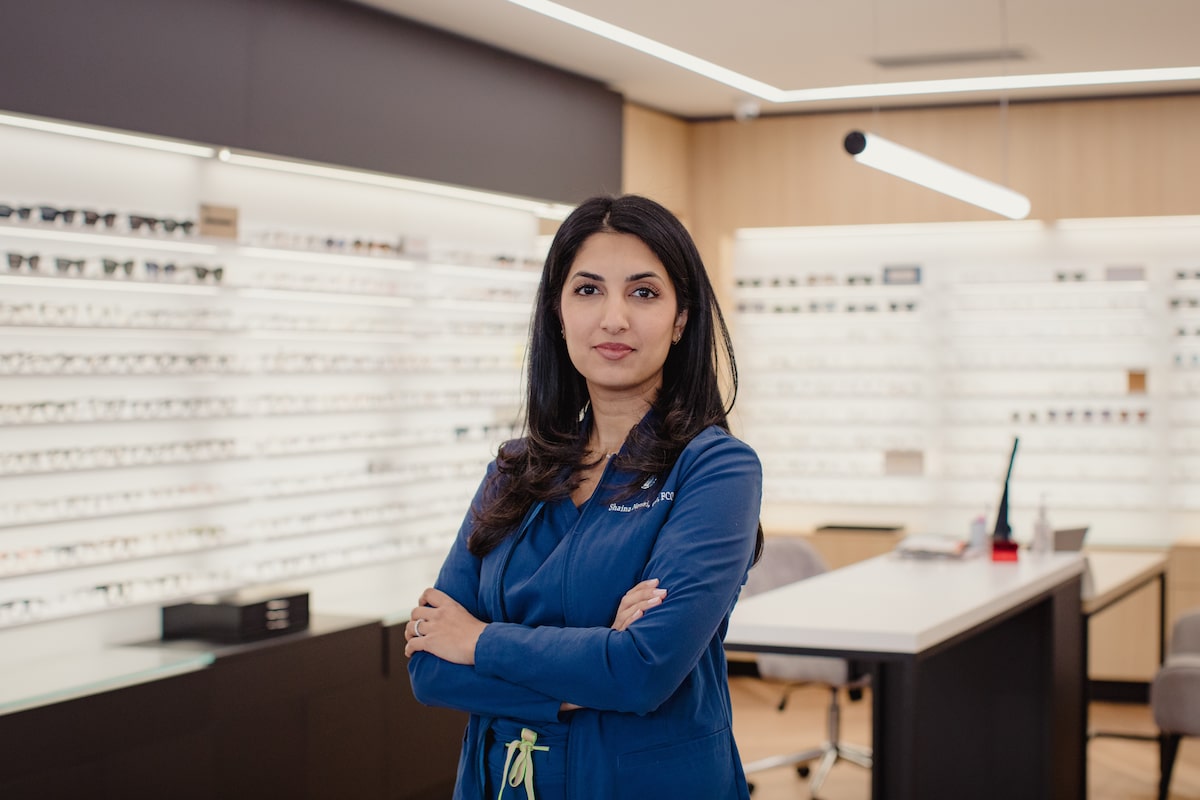
Ontario Association of Optometrists president Shaina Nensi in Toronto on Tuesday. Ontario is considering a proposal to expand the procedures that optometrists can perform.Chloe Ellingson/The Globe and Mail
When someone walks into Toronto optometrist Shaina Nensi’s office with something in their cornea – say, a construction worker who wasn’t wearing their safety glasses and has a microscopic shard of metal in their eye – she needs to take a careful measurement of how deep the object is.
If the foreign body is any deeper than the thousandths-of-a-millimetre-thin outermost layer of the cornea, called the epithelium, she has to send the patient to the emergency room.
But if Dr. Nensi practised anywhere else in Canada, outside of Ontario, she would be allowed to remove the object and give the patient quicker relief.
“Ontario is the only province that restricts optometrists to a certain layer of the cornea, and we can’t go deeper than that,” said Dr. Nensi, president of the Ontario Association of Optometrists. “It sounds a little silly, because we’re talking about the difference of microns.”
A Toronto hospital’s mass-casualty war game puts Canada’s health care system to the test
Removal of tiny objects from the cornea is just one of eight procedures that optometrists are urging the Ontario government to allow them to do, to expand their practice and take pressure off other parts of the health care system.
The OAO, which represents more than 2,000 optometrists, first submitted its proposals to the Ontario government in February, 2024, along with an endorsement from University of Waterloo’s School of Optometry and Vision Science and the College of Optometrists of Ontario, which is the profession’s self-regulatory body.
In November, the province wrapped up a public consultation on the proposals, similar to ones conducted for other health care professions, such as pharmacists who are now able to prescribe medication for some minor ailments.
But the Ontario government has not yet announced whether or how it will expand optometrists’ scope, and it is getting pressure from the province’s doctors not to act.
Dr. Nensi says Ontario is the only province that restricts optometrists to a particular layer of the cornea.Chloe Ellingson/The Globe and Mail
Optometry is one of three health care professions that deal with vision. Opticians, who have a college diploma, can dispense and fit visual aids such as glasses; optometrists, who earn a four-year doctorate after an undergrad degree, can prescribe and generally provide services on or outside the surface of the eye; and ophthalmologists, who have gone through medical school and further specialization, generally provide surgical procedures such as cataract removal.
The other new powers that optometrists in Ontario are seeking include ordering diagnostic tests such as blood tests or CT scans; using a laser treatment for a common form of glaucoma; and providing samples of topical medication.
Stanley Woo, a professor at University of Waterloo’s School of Optometry and Vision Science, said most optometry students are trained to do the procedures, which fall under their remit in other jurisdictions.
Waterloo and the University of Montreal are the only two optometry schools in Canada.
“The fundamentals of all the things that are being requested have been covered in the curriculum for a long, long time,” Dr. Woo said.
The Ontario Ministry of Health said it was still weighing the submissions it received in last year’s consultation.
“No decision has been made to date as the ministry considers this feedback and determines next steps, if any,” ministry spokesperson Ria Yadav said.
But while optometrists say the increased scope of practice would take pressure off emergency rooms and family doctors, the group that represents the province’s physicians says they don’t think it would help.
Opinion: An urgent prescription for our ailing Canadian health care system
Zainab Abdurrahman, president of the Ontario Medical Association, which represents about 31,000 practising physicians, said her group has opposed the increased scope because, in some cases such as allowing Botox injections for blepharospasm (involuntary spasm of the eye lid), the procedure is done so rarely as to not have a meaningful impact on wait times in hospitals or doctors’ offices. On the other hand, she said, allowing optometrists to order more tests could increase the volume of tests and lead to delays for those services.
“They used an access argument, but it didn’t really line up with the procedures that were being proposed,” Dr. Abdurrahman said.
In general, she said, the OMA believes only medical doctors have the training to perform these procedures in Ontario. The response they sent to the government in November rejected all the proposals.
Dr. Nensi said there is no data from other jurisdictions to suggest that allowing optometrists to perform these services would increase risk to patients. “We have the training, tools and education to be able to do it,” she said.