
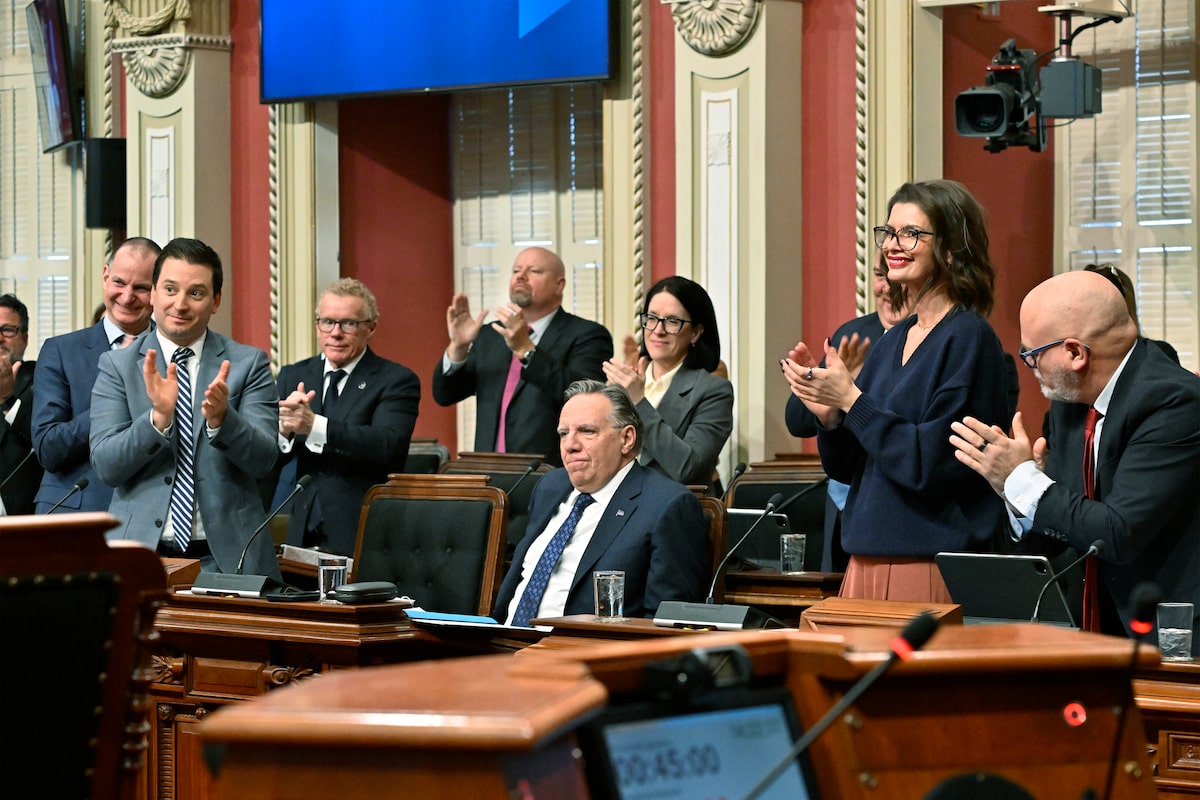
Quebec Premier François Legault is applauded by members of the National Assembly before question period at the legislature in Quebec City, on Tuesday.Jacques Boissinot/The Canadian Press
A strange scene unfolded at the opening of the Quebec legislature on Tuesday, when an outgoing Opposition Leader faced off against a lame-duck Premier.
Ahead of Question Period, interim Liberal leader Marc Tanguay rose to thank Premier François Legault for his years of public service, prompting an extended standing ovation from the members of the National Assembly. Mr. Legault announced last month he would resign once his party selects a new leader.
Having thus dispensed with the niceties, Mr. Tanguay rose again to question the Premier, this time striking a rather different tone. “At the end of the CAQ’s regime, does he acknowledge his mistakes?” Mr. Tanguay asked. “He will have been the Premier of decline and debt.”
Though Question Period is always theatrical, there was an element of absurdity in Quebec’s Salon Rouge on Tuesday. Within a matter of months, neither Mr. Legault nor Mr. Tanguay will be at the helm of their respective parties. Not long after that, Quebec’s political landscape may be entirely transformed.
The Sunday Editorial: The conflicting signs from François Legault’s departure
The leader of the steadiest ship in Quebec politics – the Parti Québécois – remained silent during Question Period. But earlier in the day, Paul St-Pierre Plamondon had summed up the situation to reporters. “It’s a session that promises to be different,” he said. “But interesting.”
In a province known for dramatic political realignments, this year is shaping up to be an especially bumpy ride. With just months to go before the next election, set for October, the governing party and the Official Opposition are both in search of new leaders. The Coalition Avenir Québec is looking to reverse more than two years of waning popularity. The Liberals are hoping to shed the taint of scandal after former leader Pablo Rodriguez was caught up in allegations of vote-buying last year.
With a leadership race underway, Mr. Legault’s two potential successors have begun to cast doubt on his record, though both sat alongside him in the legislature on Tuesday. Christine Fréchette, the former economy minister, recently told La Presse that some elements of Quebec’s proposed constitution, one of Mr. Legault’s signature bills, could be “reoriented.”
Opinion: François Legault set out to bridge Quebec’s divides. He ended up widening them
Over the weekend, former environment minister Bernard Drainville launched his campaign to lead the CAQ with a long speech in which he said his own government had “lost the trust of Quebeckers.”
“It’s chaotic,” Mr. Tanguay told reporters in Quebec City. Under Mr. Legault, the CAQ had “no rudder or captain,” he said, but now there are “three sailors” pulling in different directions. “Who’s at the helm?”
In contrast, Mr. St-Pierre Plamondon looks something like an elder statesman. The 48-year-old sovereigntist, who took the reins of his party in 2020, survived the PQ’s worst-ever election result in 2022, when it was reduced to just three seats. The party is now leading in the polls, and a majority government seems within his grasp.
On Tuesday, Mr. St-Pierre Plamondon pitched himself to reporters as a steady hand at the wheel in a time of upheaval. But if he is to maintain momentum, he will have to find a way to sell a skeptical public on his promise of a third referendum on independence.
“At some point, it’s going to turn against him,” said political analyst Raphaël Melançon in an interview.
A recent Léger poll showed the Liberals have narrowed the gap with the PQ since the departure of Mr. Rodriguez. It also suggested that Ms. Fréchette could substantially improve the fortunes of the governing party, which has been polling so badly under Mr. Legault’s leadership that it’s at risk of losing most or all of its seats.
Despite his boyish looks, Mr. St-Pierre Plamondon is “no longer a fresh face in politics,” Mr. Melançon said.
PQ Leader says ‘battle of ideas’ has begun, garnering support for independence
But there are major hurdles ahead for those hoping to reverse the PQ’s ascendancy. The Liberals’ next leader will almost certainly be Charles Milliard, the former head of the federation of Quebec chambers of commerce. A political newcomer in his forties, Mr. Milliard is relatively unknown and untested. He does not currently hold a seat in the legislature.
Mr. Milliard would offer a fresh start to a party that needs to clean up its image, Mr. Melançon said. But the early days of his leadership risk being overshadowed by the ongoing fallout of the campaign-financing scandal that cost Mr. Rodriguez his job.
In an interview, Mr. Drainville said he believes the CAQ still has a “reasonably good chance to rebound” if the new leader admits to Quebeckers that the government “did screw up on a few things.”
But after more than seven years in power, most members of the government are “realistic” about their chances in the next election, Mr. Melançon said. “They’re looking for someone who’s going to be able to save what’s left of the party.”