
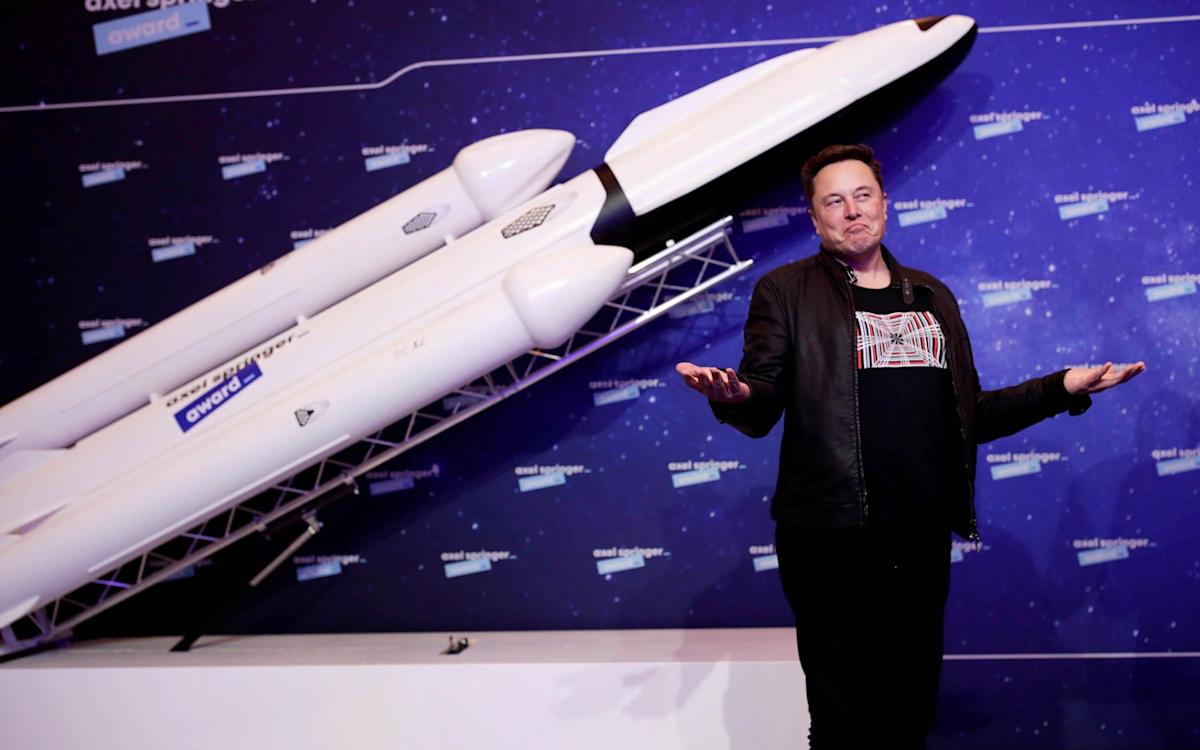
 Elon Musk’s SpaceX has acquired his social media and artificial intelligence business xAI in a deal that unites much of his business empire – Hannibal Hanschke-Pool / Getty Images
When Elon Musk declared his intention to buy Twitter, his friends and allies were quick to rally behind his $44bn (£32bn) bid.
“A billion or whatever you recommend,” Larry Ellison, the billionaire Oracle founder, messaged Musk at the time.
“I’d recommend maybe $2bn or more,” Musk replied.
Other notable investors included Marc Andreessen’s Andreessen Horowitz, Qatar, Saudi Arabia’s Kingdom Holdings and hedge fund billionaire Bill Ackman.
Yet once the deal was completed in 2022, it didn’t take long for Musk’s social media gamble to unravel.
By reinstating controversial accounts and hailing a new era of free speech, Twitter – later renamed X by Musk – saw its valuation plunge as advertisers fled and revenues fell.
However, the tech billionaire’s allies are now about to have their loyalty repaid following a series of deals and a planned $1.5tn stock market listing.
It was last year that Musk combined Twitter with xAI, the business behind his Grok AI chatbot, valuing the social media site at $30bn.
The world’s richest man then revealed plans on Monday to merge his emboldened xAI business with his rocket company, SpaceX.
The merger, already dubbed the biggest in history, will pave the way for a proposed float that is expected to value the businesses at $1.5 trillion. And investors in xAI will receive a slice of that pie.
“This marks not just the next chapter, but the next book in SpaceX and xAI’s mission,” Musk said on Monday. “Scaling to make a sentient sun to understand the universe and extend the light of consciousness to the stars.”
According to Musk, the venture will ultimately launch a fleet of up to one million data centre satellites aboard his SpaceX rockets.
These satellites will be boosted by solar power, with Musk claiming he could ultimately launch one terawatt of computing power into space.
In a blog post, he said that within three years, space would be the cheapest way to generate AI computing power – helping to train a future AI superintelligence and allowing his businesses to overtake rivals such as OpenAI.
“This cost-efficiency alone will enable innovative companies to forge ahead in training their AI models and processing data at unprecedented speeds and scales,” Musk wrote, “accelerating breakthroughs in our understanding of physics and invention of technologies to benefit humanity.”
Story Continues
Musk is expected to list his combined SpaceX business later this year, potentially as early as June, raising around $50bn from investors in the process.
That is good news for those who backed his Twitter deal in 2022 and for others who have ploughed billions of dollars into xAI, which burnt through an estimated $7.8bn last year.
However, the scale of Musk’s expenditure on its large language model has since raised concerns over the rationale for Musk’s SpaceX merger.
“The rationale for this deal is simply that xAI needs more money,” says Tim Farrar, a Silicon Valley-based analyst at TMF Associates.
“He gets to monetise his accidental purchase of Twitter and takes an AI share hype lift,” another industry source says. “Still, I wouldn’t bet against him.”
SpaceX and Starlink have so far been kept separate from Musk’s turbulent leadership of X – which he has used to amplify his own political views.
This has included promoting support for Donald Trump and backing a string of far-Right candidates across Europe.
Closer to home, he also claimed that Britain is on the brink of civil war.
Most recently, X and its Grok chatbot were accused of generating tens of thousands of non-consensual sexualised images of women – prompting a global backlash that triggered a series of regulatory investigations.
On Tuesday, it emerged that prosecutors in Paris had also raided X’s offices with the assistance of Europol.
Therefore, SpaceX’s plans to absorb X will undoubtedly expose the company to the threat of negative publicity and billions of dollars in regulatory fines.
Given the nature of Musk’s Space venture – which includes customers such as Nasa – this may well prove to be a problem.
SpaceX, and its Starlink satellite network in particular, is increasingly trusted by governments and military customers around the world. Tying it together with X’s volatile Grok chatbot could complicate those sensitive arrangements.
Rather than boosting SpaceX, Farrar, of TMF Associates, says the proposed stock market listing will allow Musk to funnel money straight into xAI’s coffers.
SpaceX was reportedly cash flow positive in 2025, according to tech news site The Information, and its supply of rockets currently far outstrips demand.
This will make it a potentially attractive target for Musk if he wants to draw down funds to keep bankrolling his xAI adventure.
It would not be the first time Musk has used cash from one successful venture to bankroll another. In 2016, he used Tesla stock to bail out SolarCity, a solar storage business, in a $2.6bn deal. Musk was the business’s largest shareholder.
Craig Moffet, a MoffettNathanson analyst, says: “Without making any judgments about SpaceX’s proposed valuation, there is at least a clear path to profitability.
“By contrast, xAI is a market laggard in a hugely concentrated market that’s burning through cash with no end in sight.”
As Farrar puts it: “Musk is going to do whatever he can to keep xAI funded.”