

A doctoral researcher in Australia has successfully recreated cosmic dust inside a laboratory, offering a new way to study how the chemical foundations of life may have formed long before Earth existed. The study, published in The Astrophysical Journal, demonstrates that complex organic material can arise under plasma conditions similar to those found around aging stars and in star-forming regions, supporting the idea that life’s ingredients were assembled in space and later delivered to the early Earth.
Recreating the Conditions of Deep Space Inside a Laboratory
The experiment was designed to replicate environments that exist far beyond Earth, where matter is exposed to intense energy, radiation, and particle bombardment. Using evacuated glass tubes to simulate the near-vacuum of space, the researchers introduced a controlled mixture of nitrogen, carbon dioxide, and acetylene, gases commonly found in astrophysical environments. These gases were then subjected to electrical potentials reaching roughly 10,000 volts, generating a glow-discharge plasma capable of breaking molecular bonds and driving rapid chemical recombination. Over the course of the experiment, fragmented molecules reorganized into increasingly complex structures, eventually settling onto silicon substrates as a thin layer of dust whose physical and chemical properties closely resemble those observed in interstellar and cometary material.
“We no longer have to wait for an asteroid or comet to come to Earth to understand their histories,” Losurdo said. “You can build analog environments in the laboratory and reverse engineer their structure using infrared fingerprints. This can give us huge insight into how ‘carbonaceous cosmic dust’ can form in the plasma puffed out by giant, old stars or in cosmic nurseries where stars are being born and distribute these fascinating molecules that could be vital for life. It’s like we have recreated a little bit of the universe in a bottle in our lab.”
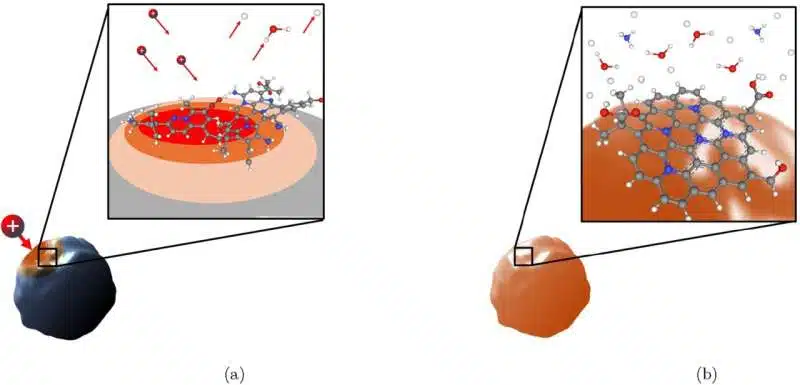 Schematic diagrams contrasting the structural changes induced in amorphous CHON networks arising from the nonequilibrium, transient thermal spike effect of ion bombardment and the equilibrium thermal effect of postsynthesis annealing. Credit: The Astrophysical Journal (2026). DOI: 10.3847/1538-4357/ae2bfe
Why Cosmic Dust Is Central to the Origins of Life
Cosmic dust plays a fundamental role in astrophysical chemistry, acting as both a catalyst and a reservoir for complex organic compounds. These microscopic grains drift through interstellar space, where they are constantly exposed to energetic ions and electrons that trigger chemical reactions not easily replicated on planetary surfaces. The laboratory-produced dust contained a rich mixture of carbon, hydrogen, oxygen, and nitrogen, collectively known as CHON elements, which form the backbone of biological molecules such as amino acids, nucleobases, and sugars. Their presence in the synthesized material reinforces the idea that much of life’s chemistry originated in space rather than exclusively on Earth.
“Covalently bonded carbon and hydrogen in comet and asteroid material are believed to have formed in the outer envelopes of stars, in high-energy events like supernovae, and in interstellar environments,” Losurdo said. “What we’re trying to understand are the specific chemical pathways and conditions that incorporate all of the CHON elements into the complex organic structures we see in cosmic dust and meteorites.”
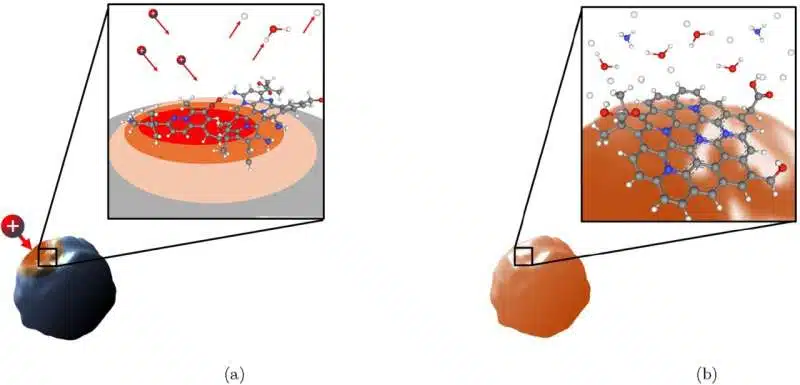 Schematic diagrams contrasting the structural changes induced in amorphous CHON networks arising from the nonequilibrium, transient thermal spike effect of ion bombardment and the equilibrium thermal effect of postsynthesis annealing. Credit: The Astrophysical Journal (2026). DOI: 10.3847/1538-4357/ae2bfe
Matching Laboratory Dust With Astronomical Observations
One of the strongest validations of the experiment came from infrared spectroscopy, a technique widely used by astronomers to study distant dust clouds. Every molecular structure absorbs and emits infrared radiation in a characteristic way, creating a spectral signature that reveals its composition. The dust produced in the laboratory displayed infrared fingerprints that closely match those detected in interstellar space, confirming that the plasma-driven process accurately reproduces natural cosmic chemistry. This correspondence allows scientists to directly link experimental results to telescope observations, strengthening confidence in laboratory simulations as reliable tools for studying environments that are otherwise unreachable.
The findings, reported in The Astrophysical Journal, also provide a reference framework for interpreting infrared data collected from stellar nurseries, supernova remnants, and protoplanetary disks, where organic chemistry is believed to be especially active.
Reading the Chemical History of Meteorites and Asteroids
Beyond explaining how organic molecules form, the research helps scientists decode the physical histories of meteorites and asteroids that reach Earth. Microscopic features such as surface smoothing, aggregation, and compaction record the cumulative effects of ion bombardment and thermal processing experienced over millions or billions of years. By reproducing these effects under controlled conditions, researchers can estimate the temperatures, radiation levels, and energetic impacts that shaped these materials during their journey through space, offering a clearer picture of the environments they once inhabited.
“By making cosmic dust in the lab, we can explore the intensity of ion impacts and temperatures involved when dust forms in space,” Professor McKenzie said. “That’s important if you want to understand the environments inside cosmic dust clouds, where life-relevant chemistry is thought to be happening. This also helps us interpret what a meteorite or asteroid fragment has been through over its lifetime. Its chemical signature holds a record of its journey, and experiments like this help us learn how to read that record.”
Tracing Life’s Chemical Pathway Across the Universe
The broader ambition of this work is to establish a comprehensive library of infrared signatures derived from laboratory-made cosmic dust, allowing astronomers to identify and compare organic-rich regions throughout the galaxy. By matching observations to known experimental conditions, scientists can infer how and where complex chemistry emerges, linking stellar evolution to planetary formation and, ultimately, to the origins of life. This approach supports the growing view that the fundamental ingredients for biology are widespread in the universe and that Earth inherited much of its organic material from processes that began long before the planet itself formed.