

This groundbreaking discovery could reshape the future of electronics, including supercomputers and sensors. By revealing this “quantum metric,” researchers have confirmed that the fabric of space inside these materials is curved, offering a new understanding of the quantum world.
Previously, scientists had speculated that electrons might behave in a way governed by a hidden geometry, but until recently, this idea remained theoretical. A team from the University of Geneva (UNIGE), the University of Salerno, and the CNR-SPIN Institute has now demonstrated this effect in common materials. Their findings challenge previous assumptions about electron behavior and open up new possibilities for future technological advances.
Revealing the Hidden Quantum Geometry
For years, physicists had suspected that electrons might not follow simple, predictable paths in quantum materials. Instead of moving in straight lines, electrons could follow curved trajectories due to a hidden geometry. This idea, known as the “quantum metric,” has now been confirmed by a team of researchers. According to ZME Science, the discovery is a significant breakthrough in the study of quantum mechanics, as the quantum metric was once considered a purely mathematical concept rather than something that could be experimentally observed.
In their experiment, the team studied a material composed of two insulating layers, strontium titanate (SrTiO3) and lanthanum aluminate (LaAlO3). When these materials were combined, a two-dimensional electron gas formed between them, offering the perfect environment to study the behavior of electrons. The team’s observations revealed that the electrons’ paths were distorted, confirming the presence of the quantum metric.
The Unexpected Truth: Quantum Geometry Is Real
Before this discovery, the quantum metric was regarded as an abstract concept, something that could explain certain theoretical phenomena, but not something that could be measured in real materials. However, as explained by Andrea Caviglia, a professor at UNIGE, recent experiments have shattered this assumption. “For a long time, it was regarded purely as a theoretical construct,” Caviglia stated, highlighting how this idea was considered speculative for decades.
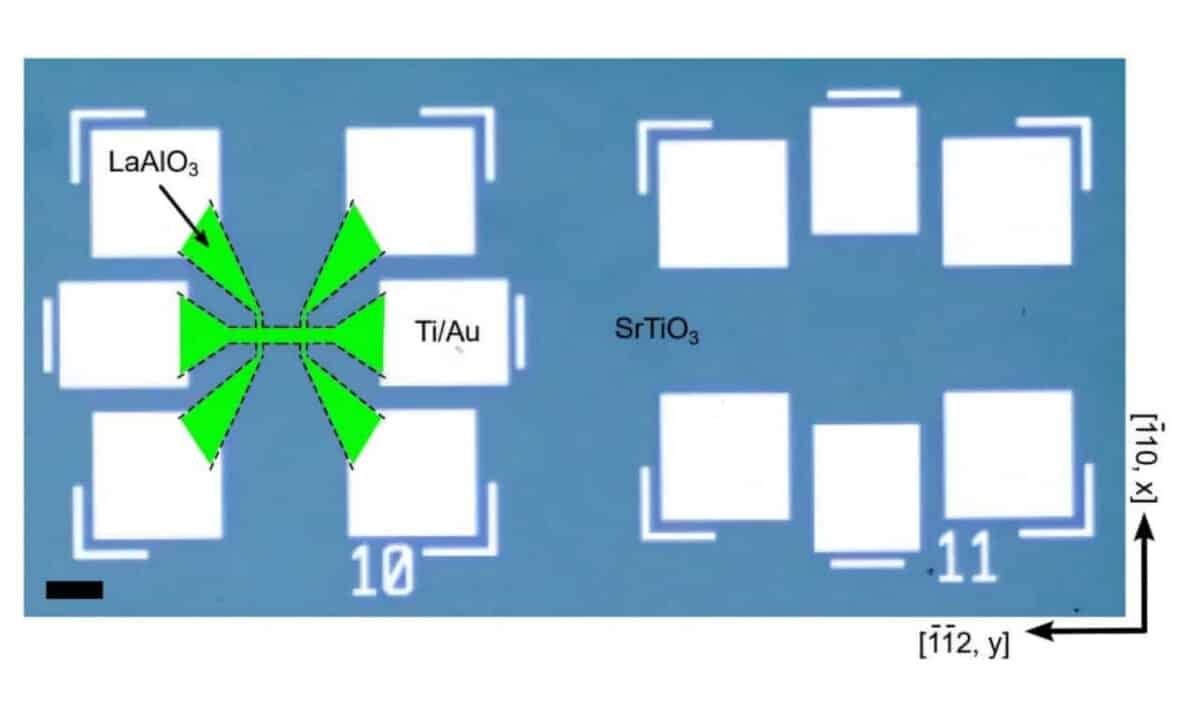 Optical image of two patterned Hall bar devices oriented along orthogonal directions on the SrTiO3 surface. The green area indicates the position and shape of the devices. Note that the LaAlO3 layer cannot be distinguished by eye from the substrate. The black scale bar corresponds to 60 µm – © Science.
The research team’s findings indicate that this quantum geometry is not just a rare anomaly but rather a general characteristic of surfaces and interfaces where “spin-momentum locking” occurs. This phenomenon, where an electron’s spin is tied to its motion, is seen in many materials, meaning that the implications of this discovery extend far beyond just one specific class of materials.
How Magnetic Fields Expose the Quantum Metric
To confirm the existence of the quantum metric, the researchers applied a magnetic field to their material and observed how the electrons reacted. What they found was quantum metric magnetoresistance, a specific type of resistance that only appears due to the quantum metric’s influence on the electron’s wavefunctions. This phenomenon caused the electrons to behave non-linearly, revealing the hidden geometry that had previously been impossible to detect.
Giacomo Sala, a research associate at UNIGE and lead author of the study, explained that this “geometric drag” on the electrons was key to observing the quantum metric. By studying how the electrons’ trajectories were distorted under the combined influence of the quantum metric and magnetic fields, the team was able to directly measure this previously elusive property.
A New Era for Electronics and Technology
The discovery of the quantum metric is poised to have far-reaching effects on electronics. By understanding and manipulating this hidden geometry, scientists may be able to develop materials that operate at terahertz frequencies, trillions of cycles per second. This would bridge the gap between existing microwave technologies and infrared light, opening new doors for high-speed computing, communications, and advanced sensors.
Andrea Caviglia noted that this research could pave the way for groundbreaking applications in superconductivity and light-matter interactions. By unlocking the hidden curves in the atomic landscape, scientists are now able to envision technologies that are faster, more efficient, and capable of functioning at unprecedented speeds.