
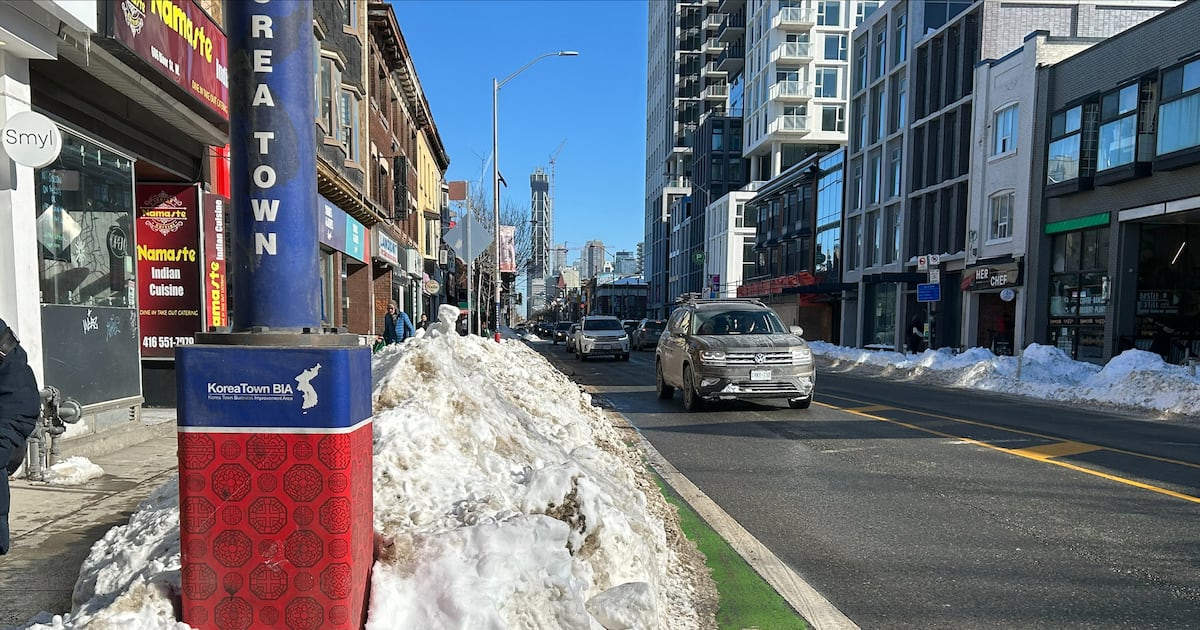
Russell Baker, director of media relations with the City of Toronto shares the city’s plans to respond to the storm and why snow clearing operations take time.
Toronto Mayor Olivia Chow says she called the province for help to clear the snow left behind from last month’s record storm so city crews can prioritize residential streets and intersections.
“Here’s something new. I phoned up the province, the Ministry of Transportation, and said, ‘Hey, you signed a contract that will shovel snow and remove snow in 2021…the city wasn’t as smart,“ Chow said at an unrelated news conference earlier this week.”
“We are only clearing the snow and not removing the snow.”
City crews began plowing the snow off main streets and highways as soon as it started falling on Jan. 25. Some parts of the city saw nearly 60 centimetres of accumulation by day’s end.
Snow removal efforts, including physically moving it to dump sites and melting it, began last week, but some arterial streets and sidewalks are still covered.
The city says the crews from the province are focusing on the residual snow banks left on the Gardiner and DVP to help free up its own workers to prioritize residential streets and intersections with reduced visibility.
“Crews started working Saturday night and will work continuously overnight until snow is removed from the shoulders of the Gardiner and DVP. As of early this (Tuesday) morning, the provincial contractors have removed 200 loads of snow,” a spokesperson for the city said in an email.
It’s unclear how much the ad-hoc contract will cost the city, but the mayor’s office said the maximum spend is up to $950,000.
311 calls for service continuing to decline
Last week, City Manager Paul Johnson said Toronto’s 311 line was inundated with requests for service, primarily for sidewalk clearing.
“Clearly, there’s a gap in our performance around sidewalks,” Johnson said at the time.
Since then, the city says it has removed 150,000 tonnes of snow and 311 call volumes are continuing to decline.
The city said that crews are working around the clock to haul away the remaining snow and that inspectors will be flagging sidewalks and bike lanes that need additional plowing or salting. Residents are asked to report problem areas to 311.
The city declared a Major Snowstorm Condition and Significant Weather Event on Jan. 25, which remains in effect. Parking on streets marked as snow routes remains prohibited.
Residents can track the city’s snow plows here.
Snow clearance vs. snow removal
Matti Siemiatycki, director of the Infrastructure Institute at the University of Toronto, told CTV’s Your Morning on Wednesday that a lack of resources is at the heart of the snow-clearing issue.
“Snow clearance obviously costs money and cities sometimes try to avoid those costs (because) some winters are not as snowy as others.”
Under the city’s current winter contracts, which were signed under former mayor John Tory and will expire in 2029, there is no formal provision for snow removal. As such, the city treats snow removal operations as an “exceptional activity,” rather than an integrated part of storm response and uses its existing resources (both contracted and in-house) to get rid of accumulation on the ground.
Last year, a review of the city’s winter maintenance found that improving snow removal operations could cost up to $130 million. However, Johnson did not recommend the adoption of the models laid out in the report due to budget constraints and the fact that major snowstorms do not occur in the city every year.
“Cities like Toronto, for example, have snow clearance contracts, but not snow removal contracts. Clearance is when they come by with the plow, but the plow just pushes it to the side of the road. You then have these big snow piles on the sides of the street, and they get really messy and ugly as they get dirty,” Siemiatycki explained. He added that while global warming has led to generally warmer weather, it’s also producing “wilder” weather events, like last month’s snowstorm and the back-to-back wallops the city saw in February 2025.
“If there’s enough snow, that then needs to be taken away and that’s a different process, and often the contracts haven’t necessarily been in place to actually remove that snow and that’s causing problems as you get these bigger snowstorms that are just leaving a lot more snow on the ground that needs to be taken away.”
The city told CTV News Toronto that it is working on a cost-sharing arrangement with the province and that the total cost will be shared at a later date.