
Bad Bunny accepts the Album of the Year award for Debí Tirar Más Fotos onstage during the 68th GRAMMY Awards at Crypto.com Arena on Feb. 1 in Los Angeles.Emma McIntyre/Getty Images
Though he did not perform at this year’s Grammy Awards or win the most awards, Bad Bunny was easily the star tuxedoed attraction.
Host Trevor Noah interviewed the Puerto Rican megastar not once but twice. And when he accepted his two trophies, the singer did not hesitate to address U.S. immigration policies.
Bad Bunny’s ‘ICE out’ comment received a standing ovation at the Grammy Awards.
Reuters
“We’re not savage, we’re not animals, we’re not aliens,” he said while collecting the award for best música urbana album. “We are humans and we are Americans.”
He also took home album of the year for Debí Tirar Más Fotos, the first all-Spanish album to win in the category.
How to watch the 2026 Super Bowl in Canada, which teams are playing and who’s performing at halftime
“I want to dedicate this award to all the people that had to leave their homeland, their country, to follow their dreams,” he said in English, in a speech otherwise in Spanish.
But as important a platform the Grammys are, Sunday’s Super Bowl LX halftime showcase at Levi’s Stadium in Santa Clara, Calif., is next level. The rap-reggaeton colossus will take pop culture’s biggest stage – more than 120 million viewers are expected to tune in – and, as his Grammy moments showed, he is more than ready for his close-up.
Bad Bunny, 31, is outrageously popular. Debí Tirar Más Fotos (I Should Have Taken More Photos) was his fourth chart-topping album. From 2020 to 2022, he was the most streamed artist in the world. His 31-concert residency last summer at José Miguel Agrelot Coliseum in San Juan pumped more than US$200-million into Puerto Rico’s economy.
But he is also Benito Antonio Martínez Ocasio, a former grocery-store bag boy born in Puerto Rico, the self-governing island organized as an unincorporated territory of the United States. In the years since, he has become a socially conscious Latin-music icon. Debí Tirar Más Fotos is a danceable hit – and an expression of resistance against, among other things, U.S. colonialism.
The Super Bowl halftime show is the five-time Grammy winner’s lone U.S. appearance on his current tour. At a time of heightened political and cultural tension, it is almost unthinkable that he’ll squander such an opportunity on song, dance and salsa music alone. Even his fashion decisions, including a pink dress in the past, are statements.
“Bad Bunny’s presence on the stage is itself political,” Vanessa Díaz, associate professor of Chicana/o and Latina/o Studies at Loyola Marymount University in Los Angeles, said in an interview. “He is a proud Puerto Rican who will be performing in Spanish at a time when Latinos, the Spanish language and migrants more broadly are being criminalized and targeted by ICE.”
Grammys 2026: The best, worst and weirdest moments of the night
Díaz is the co-author, with Petra R. Rivera-Rideau, of P FKN R: How Bad Bunny Became the Global Voice of Puerto Rican Resistance, a just-released book that looks at Puerto Rico’s history and culture through the lens of its most well-known advocate.
“He has made it very clear what he stands for,” Díaz said. “So, I can’t imagine these values would all vanish at the Super Bowl.”
The announcement of Bad Bunny as the halftime headliner was not embraced by the U.S. administration and conservative commentators. Homeland Security adviser Corey Lewandowski told right-wing podcaster Benny Johnson that the choice was “so shameful,” and that the megastar was “somebody who seems to hate America.”
President Donald Trump is also not a fan. “I think it’s a terrible choice,” he said. “All it does is sow hatred.”
Super Bowl halftime shows have been typically apolitical. In the tiniest of political gestures in 2017, Lady Gaga followed Irving Berlin’s God Bless America with Woody Guthrie’s folk song counterpoint, This Land is Your Land.
Last year’s entertainment was deeply satirical, however, starting with actor Samuel L. Jackson garbed as Uncle Sam as he introduced hip-hop giant Kendrick Lamar. The groundbreaking performance featured a living American flag – formed by dancers in red, white and blue – splitting in half, an allusion to a racially divided country.
Kendrick Lamar performs during halftime of the NFL Super Bowl 59 game in New Orleans on Feb. 9, 2025.Matt Slocum/The Associated Press
“The revolution ‘bout to be televised,” the Not Like Us rapper said. “You picked the right time but the wrong guy.”
This year the NFL and NBC have seemingly doubled down on edgy content. Brandi Carlile, a gay artist and outspoken advocate for LGBTQ+ rights, will sing America the Beautiful. San Francisco Bay Area punk-pop legends Green Day, who have a history of publicly criticizing Trump, are also part of the opening ceremony.
These are odd choices for the historically conservative NFL.
Still, the NFL is bullish on Bunny. The league is determined to grow its international audience, and the Puerto Rican’s global reach is massive.
“Sports leagues don’t want to offend people,” said Mark Hebscher, veteran sports broadcaster and author of Madness: The Rise and Ruin of Sports Media. “But that kind of traditional thinking may be old-fashioned. Now, any form of protest at an event like the Super Bowl is not only acceptable, it’s expected.”
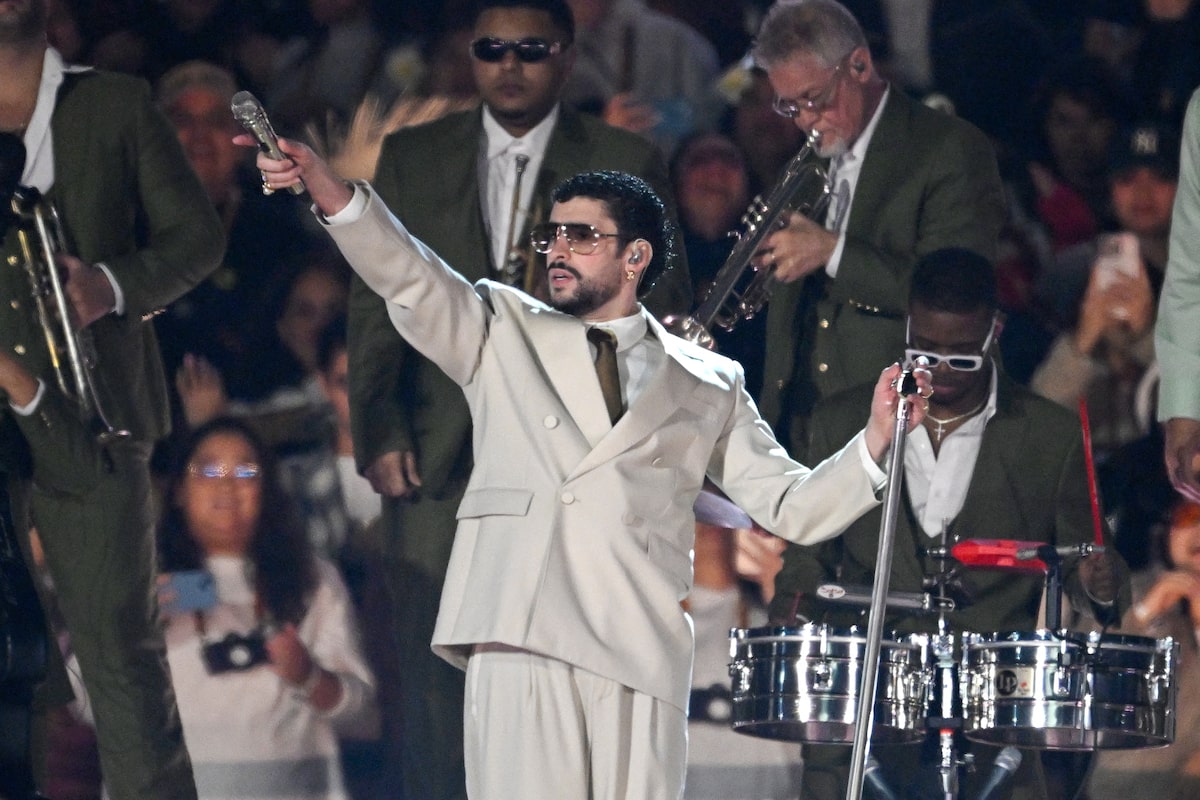
Bad Bunny performs on stage during his Debí Tirar Más Fotos world tour in Mexico City on Dec. 10, 2025.ALFREDO ESTRELLA/AFP/Getty Images
Given how the Super Bowl transcends sports – even commercials aired during the game become the topic of water-cooler discussions – any clear criticism of Trump during Sunday’s broadcast will resonate profoundly.
“It’s very possible that when Bad Bunny exits the stage after his performance, it becomes the most historic halftime show in history,” Díaz said.
“I think the political moment we’re in, and the kind of artist he is, makes it very possible. Regardless, we will be witnessing an event that we will be analyzing forever. I have no doubt about that.”