
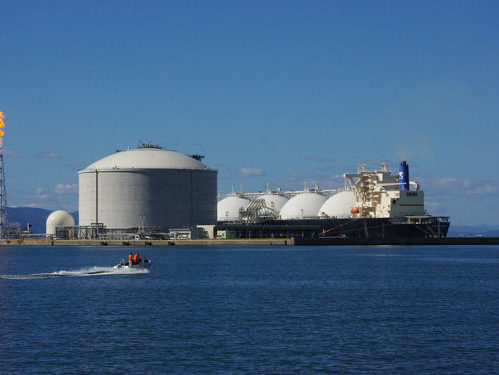
After warnings that it has become over-reliant on the United States for liquefied natural gas (LNG), the European Union is looking to diversify its suppliers.
That dependence emerged as the EU began shifting away from Russian energy imports following Russia’s invasion of Ukraine, while the U.S. pushed LNG exports into the global market.
But now, Europe is experiencing what Bloomberg calls “déjà vu,” as concerns grow over Donald Trump’s aggressive bids to acquire Greenland.
“Geopolitical turmoil in the wake of the crisis in Greenland has been a wake-up call,” EU energy commissioner Dan Jørgensen told reporters in Brussels Jan. 28. “There is a growing concern, which I share, that we risk replacing one dependency with another.”
The continent is eyeing Canada, Qatar, and North African countries as alternatives, Bloomberg adds. That option would serve Canada as it seeks new LNG buyers to reduce export reliance on the U.S.
“We will never use our energy for coercion,” Canadian Natural Resources Minister Tim Hodgson recently said at a conference in India. “Canada used to provide 98% of its energy exports to a single country. We are committed to diversifying.”
The EU has been on a years-long campaign to improve energy security, with mixed success. The bloc cut gas demand by 20% between 2021 and 2024 and reduced imports of Russian gas by 75% since the Ukraine war started in 2022, though Russia remains one of its largest gas suppliers.
But the EU now sources more than half of its LNG from the U.S., creating a new high-risk geopolitical dependency, says the Institute for Energy Economics and Financial Analysis (IEEFA). The shift may have moved the bloc out of the proverbial frying pan and into the fire. [Author’s note: Except that with declining gas demand, frying pans are increasingly being used on electric stoves and induction cooktops.]
The EU’s reliance on the U.S. could deepen further, the Institute adds. After a trade deal announced last July, the EU agreed to buy US$750 billion of U.S. energy by 2028, which “effectively ties the EU’s energy supply to one seller, risking energy security and jeopardizing gas reduction plans.”
At the time, however, the trade deal was written off as a “delusional” attempt to mollify Trump. But a series of long-term contracts announced at the Gastech conference in Milan last September could further entrench LNG’s role in that trade. In a scenario where all the deals come through and the EU does not reduce gas demand, the U.S. could become the source of 75% to 80% of the continent’s total gas imports by 2030.
EU countries could instead spend that $750 billion to install roughly 546 gigawatts of combined solar and wind capacity, the Institute calculated. “This would boost energy security and could bring down electricity prices.
But not all experts see a risk in heavy reliance on U.S. LNG. Some say the U.S. is itself becoming reliant on selling gas to the EU after trade tensions blocked its sales to China, writes industry newsletter Rigzone.
“The idea that the U.S. could stop exporting to Europe seems quite dangerous,” Anne-Sophie Corbeau, a global research scholar at Columbia University’s Center on Global Energy Policy, wrote in a LinkedIn post. “U.S. LNG dearly needs Europe in the current geopolitical environment.”