

Political analyst Sharan Kaur says CPC Leader Pierre Poilievre is likely to pass his leadership review, but there could be more MPs crossing the floor in 2026.
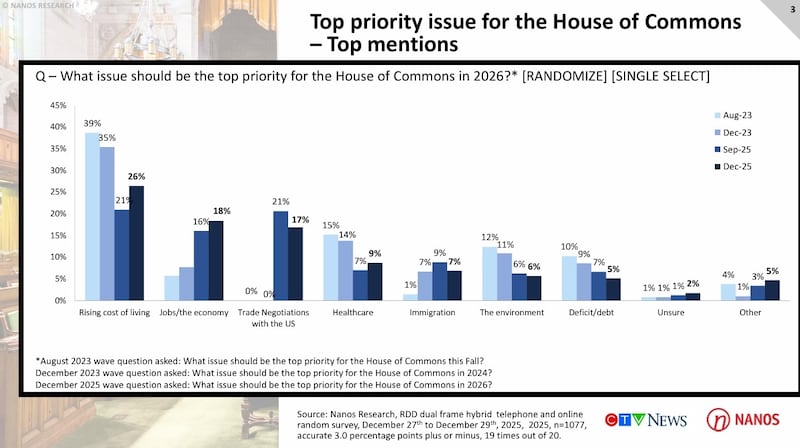
New data from Nanos Research shows the rising cost of living remains one of the top issues of concern for Canadians, and as their top priority for the Parliamentary agenda.
The other top priorities are jobs and the economy, and trade negotiations with the United States, according to a survey commissioned by CTV News to gauge the opinion of Canadians on priorities for the federal government.
The rising cost of living is up, from 21 per cent in September to 26 per cent in December, while trade negotiations with the United States is down, from 21 per cent in September to 17 per cent in December.
In an interview on CTV Power Play with Vassy Kapelos on Tuesday, Nanos Research founder and chief data scientist Nik Nanos said trade with the U.S. has still been among the top issues for a year.
 Nanos poll top priority issue House of Commons
“The other thing that’s noticeable in the tracking over the last week is that worry and concern about (U.S. President) Donald Trump and U.S. trade has also spiked in the last week or so,” Nanos said, referencing Prime Minister Mark Carney’s speech to the World Economic Forum last month, and Trump’s response to it.
While Carney sent a clear message in making reference to economic coercion and tariffs being used as leverage throughout his speech, he did not call out the United States or the American president by name.
Trump, in his own speech the following day, warned that Canada needs to remember it should be grateful to the United States.
When asked by Kapelos how volatile the numbers are, Nanos said concern over Trump has been in either the number one or number two spot “without exception.”
“But we have a statistical tie right now between worry about Trump and worry about jobs,” he said. “But worry about Trump (is) up in the last week.”
How much is Trump’s response to PM Carney’s Davos speech helping his polling numbers? Pollster Nik Nanos of Nanos Research explains how U.S. President Trump’s rhetoric on Canada has boosted Prime Minister Carney’s favourability numbers.
Canadians evenly split on floor crossers
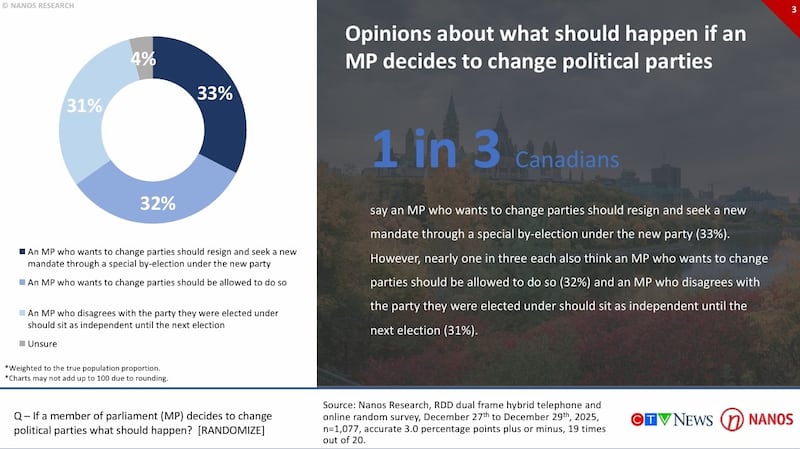
Canadians are virtually evenly split, meanwhile, on how they believe MPs hoping to cross the floor should handle it, according to new Nanos Research data.
According to the numbers, a third of Canadians — 33 per cent — believe MPs planning to cross the floor should resign their seat and trigger a byelection, running on the mandate of the party they hope to join.
Roughly the same number of respondents — 32 per cent — believe MPs who want to change parties should be able to do so. And, another third — 31 per cent — say would-be defecting MPs should sit as Independents until the next general election.
 Nanos poll floor crossing
The Nanos Research figures, commissioned by CTV News, come in the wake of two floor crossings.
In the fall, two Conservative MPs quit caucus to join the Liberal ranks. First, Chris d’Entremont, just hours after the federal government tabled its budget in early November. Then, rookie MP Michael Ma in mid-December.
There was speculation in November that Conservative MP Matt Jeneroux was also considering crossing the floor, though he instead announced his intention to resign his seat altogether by the spring. As of now, Jeneroux has yet to do so.
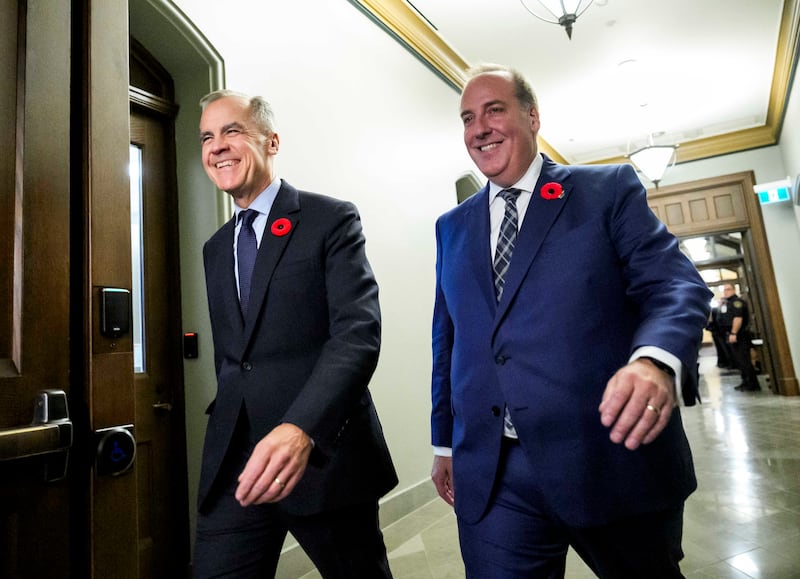 Chris d’Entremont floor crossing Mark Carney Prime Minister Mark Carney walks with MP Chris d’Entremont, who crossed the floor from Conservative caucus to join the Liberals, to a meeting of the Liberal Caucus on Parliament Hill in Ottawa, on Wednesday, Nov. 5, 2025. THE CANADIAN PRESS/Justin Tang
While the April election and subsequent floor crossers had the governing Liberals two seats shy of a majority, two longtime Trudeau-era ministers have since resigned as MPs to take on other roles, so there will be byelections to replace them later this year.
According to the Nanos numbers, the three options for would-be floor crossers — triggering a byelection, changing parties, or sitting as an Independent — are also largely evenly split according to gender and age, with no significant outliers.