
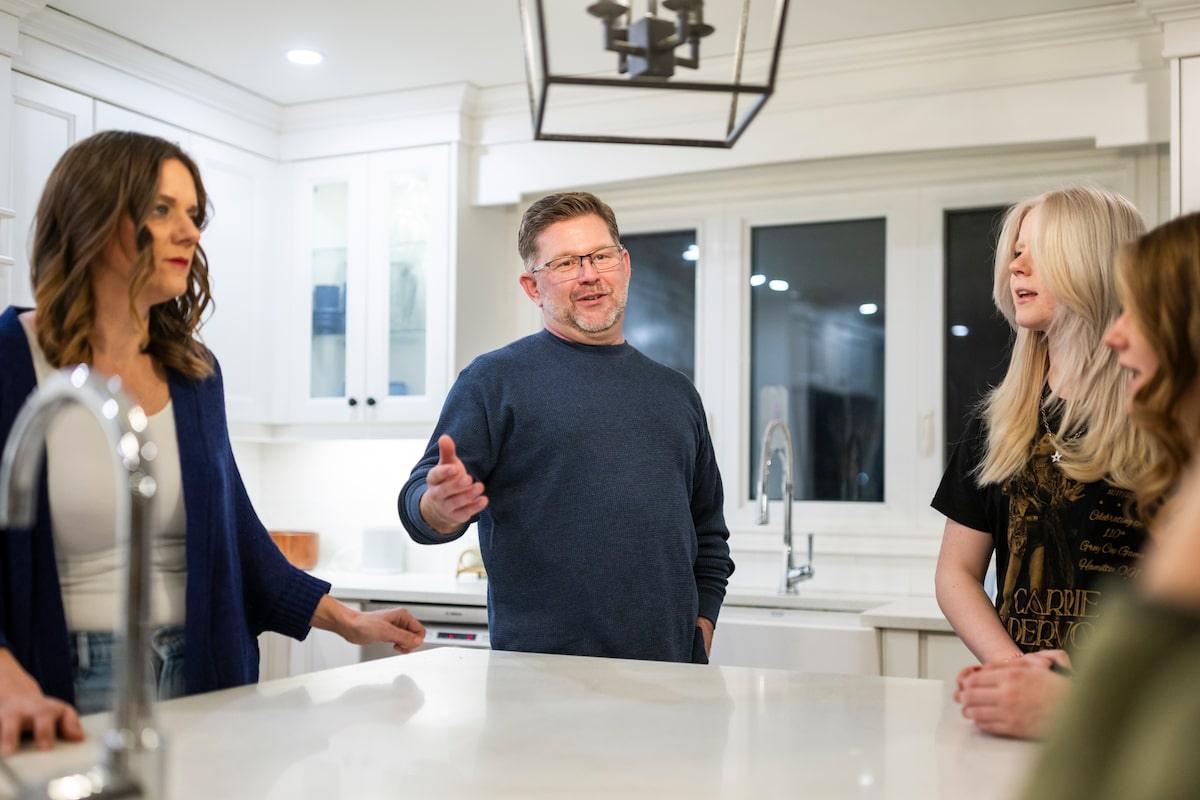
Kevin Heyink, talking with his family in their Hamilton, Ont., home, participated in a Texas-based early-phase trial for the Nous-209 vaccine.Nick Iwanyshyn/The Globe and Mail
Cancer has stalked Kevin Heyink’s big Dutch-Canadian family through the generations.
His maternal grandmother, Geertruida Heyink, died in 1947 of what was believed to be stomach cancer, at the age of 36. She had eight siblings, seven of whom died of cancer.
Kevin’s maternal grandmother Geertruida Heyink, who died in 1947.Supplied
That bleak pattern carried on with Geertruida’s children, including Kevin’s late father, John Heyink, who only lived to see his children grow up because he had his entire colon removed in the mid-1980s, before his cancer could spread.
Like many of his relatives, Kevin, a 48-year-old police officer based near Hamilton, Ont., has Lynch syndrome, an inherited genetic condition that dramatically raises the risk of colon, endometrial, stomach and other types of cancer.
His oldest brother died of cancer at the age Kevin is today. Two of his younger brothers have already survived bouts with the disease.
But so far, Kevin is cancer-free. He hopes to stay that way, and to have a small part in saving future generations through his participation in a Texas-based clinical trial of a promising vaccine to prevent cancer in Lynch carriers.
“Before, it was a matter of when – when am I going to get cancer?” Kevin said. “And now, there’s a very strong possibility that I may not get cancer.”
Kevin’s father John, who had his colon removed in the mid-1980s, died in 2009 at 65.Supplied
Kevin is one of 45 people to have participated in an early-phase trial of Nous-209, a vaccine designed to teach the immune system to recognize and attack specific proteins found on precancerous cells in people with Lynch syndrome.
Lynch syndrome is believed to affect at least three in 300 Canadians. Carriers have a 50-50 chance of passing it on to a child.
It’s too early to say whether the Nous-209 vaccine, which Kevin first received in January, 2023, will prevent cancer. The small trial, the results of which were published last month in the journal Nature Medicine, was only meant to test the vaccine for safety and to see whether it produced the right immune response in healthy participants with Lynch syndrome. A larger, randomized control trial will be necessary to test the shot’s efficacy.
But the early findings are encouraging, said Raymond Kim, medical director of cancer early detection and the Bhalwani Familial Cancer Clinic at the Princess Margaret Cancer Centre in Toronto.
Dr. Kim was not involved in the trial, which was run out of the MD Anderson Cancer Center in Houston and partly funded by the U.S. National Institutes of Health.
“The fact that these investigators were able to say that the immune response is actually specific to the peptides that are frequently seen on patients who have Lynch syndrome cancers is quite promising,” Dr. Kim said. “They’re on the right track.”
2025 was a year of breakthroughs in health and medicine. Here are five
If Nous-209 or another candidate to prevent cancer in Lynch patients were to succeed, it would be a milestone. At least one other U.S. clinical trial is under way for a competing Lynch vaccine called Tri-Ad5, given in combination with an immune-boosting agent.
Right now, there are no approved vaccines to prevent hereditary cancers. The vast majority of cancer vaccines in drug company pipelines are therapeutic. They’re meant to train the immune system to treat cancer or keep it from recurring in people who’ve already been diagnosed with the disease.
Existing vaccines that prevent cancer do so indirectly by preventing infection with the human papillomavirus (HPV) and hepatitis B viruses that cause cervical and liver cancer, respectively.
“This falls into a very new category,” Nous-209 trial leader Eduardo Vilar-Sanchez said of preventative vaccines for Lynch carriers.
The biology of Lynch syndrome makes it an ideal target for a vaccine, said Dr. Vilar-Sanchez, professor and interim chair of the department of clinical cancer prevention at MD Anderson.
The syndrome is caused by an inherited mutation in one of four mismatch-repair genes. These genes are supposed to fix the errors in DNA sequencing that inevitably pop up as millions of cells divide. But when the mismatch-repair system isn’t working properly, mistakes pile up and cells produce proteins called frameshift peptides, which are common on Lynch-induced tumours.
Cancer mortality rates fall across Canada, but progress stalls on cervical cancer
The good news, at least in theory, is that a vaccine could train the immune system to recognize these frameshift peptides and eliminate the cancerous or precancerous cells on which they reside.
The early-phase study found that the Nous-209 shot, developed with an inactivated adenovirus by the Swiss biotech company Nouscom, was safe and prompted an immune response in all participants, although the response was stronger in some than others.
But the finding that was “obviously exciting for everybody,” Dr. Vilar-Sanchez said, was the outcome of participants’ colonoscopies one year after receiving the vaccine. Precancerous lesions were less common in patients who mounted a strong immune response to the shot, something researchers can ascertain through blood tests.
“And overall, we didn’t see any advanced polyps, any advanced lesions in the population that we vaccinated,” Dr. Vilar-Sanchez said.
Kevin says his brother Dave’s death was a catalyst for him joining the vaccine trial. A father of four, he raised money through GoFundMe to help cover the costs of travelling to and from Houston.Nick Iwanyshyn/The Globe and Mail
Kevin Heyink’s colonoscopies have been clear since he travelled to Houston to receive his first shot of Nous-209. Before the trial, he had precancerous cells or lesions removed during annual colonoscopies going back to his 20s, when genetic testing confirmed his Lynch status.
He was surprised the first time a Canadian doctor told him his regular scope found nothing of concern. “He just said it so cavalier,” Kevin recalled. “I was like, ‘I don’t know if you recognize how incredible this is.’”
Kevin, a father of four, raised money through a GoFundMe campaign to help with the cost of travelling to and from Houston to participate in the trial.
He had long kept an eye on Lynch research, much like his father, who was the first in the family to discover that he had hereditary nonpolyposis colorectal cancer in the 1990s.
The syndrome was later renamed after Henry Lynch, a U.S. physician renowned for his research into the genetics of cancers passed down through families. His son, Patrick Lynch, was a gastroenterologist and researcher at MD Anderson who collaborated with Dr. Vilar-Sanchez’s team, and retired around the time the Nous-209 trial began.
Brain cancer treatment using air bubbles, ultrasound could prolong patients’ lives, study finds
Kevin’s father died of cancer in 2009 at 65. He and his wife had six children whose experiences showcase the capricious nature of Lynch.
Kevin is alone among his siblings in testing positive for Lynch and not yet having cancer. His only sister tested negative. One brother has decided not to get tested and has not had cancer.
The two youngest brothers, James and Nathan, have Lynch and got cancer in their 30s. The eldest sibling, Dave, died in 2022 of adrenal gland cancer. He was 48.
Nathan, now 40 and a father of six, has survived stomach and liver cancer. Fighting cancer is hard enough in itself, but Nathan and his wife have the added challenge of raising children who might carry Lynch.
Nathan said one of his sons was particularly close to his late uncle.
“That was really hard on him. I guess when I was sick too, he was worried that it was contagious and that he would get it,” Nathan said. “So that’s really tough to have to deal with.”
Dave’s death was a catalyst for Kevin to find and join the vaccine trial.
“After Dave passed away,” Kevin said, “I felt a certain level of responsibility towards his kids as well as mine.”