
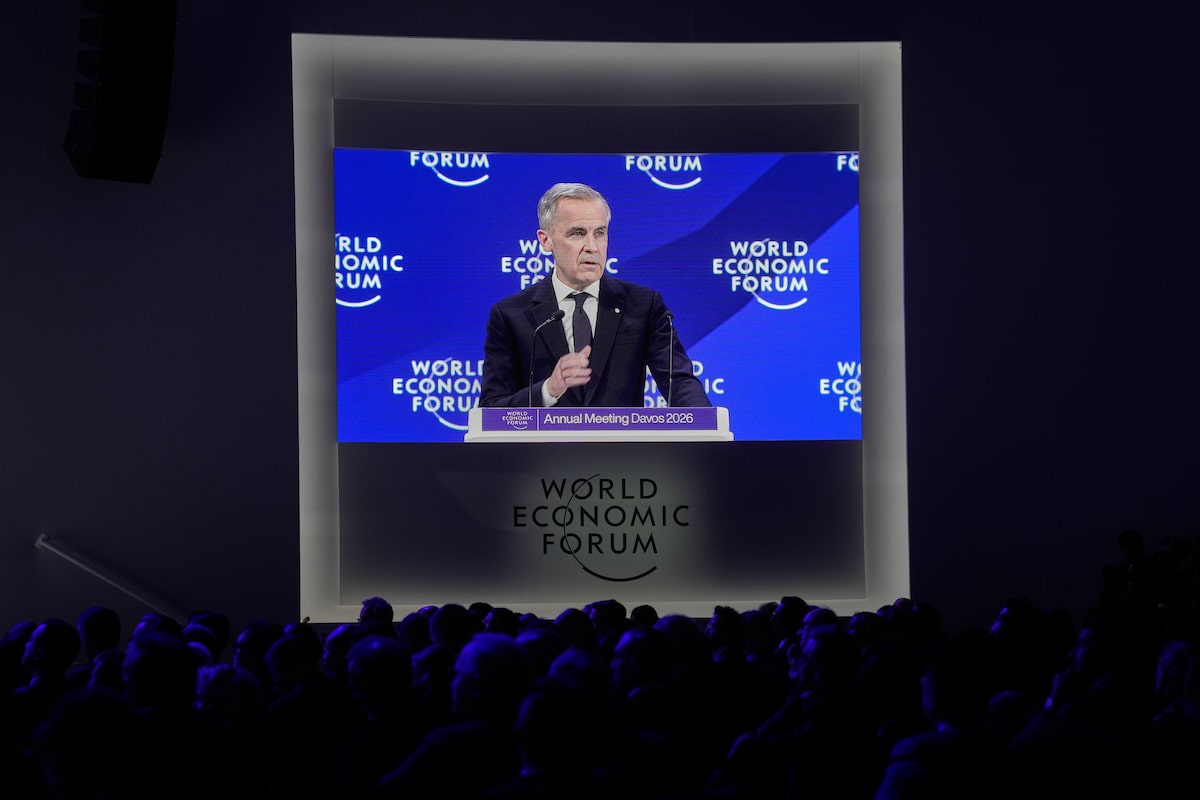
Prime Minister Mark Carney speaks during the Annual Meeting of the World Economic Forum in Davos, Switzerland, on Jan. 20.Markus Schreiber/The Associated Press
John Kirton is a professor emeritus of political science at the University of Toronto.
U.S. President Donald Trump has reacted harshly to Prime Minister Mark Carney’s acclaimed speech at Davos. First Mr. Trump claimed Canada was a small-power satellite dependent on the U.S. Then Mr. Trump threatened 100-per-cent tariffs if Canada made a deal with China.
Till this day, we are still feeling the aftershock of the speech. Some observers have criticized Mr. Carney for provoking Mr. Trump. McGill University’s Andrew Potter called Mr. Carney “reckless.”
But to Mr. Carney it wasn’t reckless. That’s because he likely does not agree with Mr. Trump’s statement that “Canada lives because of the United States.” Despite a Trump official saying Mr. Carney had walked back his speech in private, the Prime Minister said on Tuesday that he told Mr. Trump, “I meant what I said.”
In his speech at the World Economic Forum, Mr. Carney repeatedly asserted that Canada’s position was that of a “middle power.” But a careful analysis of his entire speech, and of his behaviour as leader since the spring of 2025, shows he really sees the country as a whole level above that – as a principal power in today’s rapidly changing world.
And Mr. Carney is right.
Opinion: Mark Carney delivered hard truths at Davos. Canadians deserve to hear the same
Lawrence Martin: Carney’s speech makes Canada a threat to Trump
In 1983, David Dewitt, now a York University professor emeritus, and I introduced the complex neo-realist theory of foreign policy, and concluded that it showed that Canada was then emerging as a principal power. Such a development was due to the U.S. defeat in its then longest war, in Vietnam, and its Republican president’s domestic assault on democracy in the Watergate scandal.
In 2006, I argued that Canada had achieved that status – it had become an established principal power. That was due to the further decline of the U.S. and the diffusion of its previous power to several rising principal powers.
Since then, Canada has spent years pulling back from the world, and its stature wavered. But under Mr. Carney, and under this new world order, it is coming back. Or, at least, this is the world that Mr. Carney sees and how his Canada acts in it.
The complex neo-realism theory argues that international standing comes primarily from hard power: military, yes, but also economic.
At Davos, Mr. Carney emphasized the “rupture in world order,” where “great-power geopolitics is unconstrained.” He said Canada “was amongst the first to hear the wake-up call.” So, “We are no longer relying on just the strength of our values. But also on the value of our strength.”
Canada’s overall strength is now on the rise. Its GDP continues to grow and following Mr. Carney’s Davos address, the value of its dollar has risen against the declining U.S. one.
Following years of decline in this area, Mr. Carney’s Canada is also rapidly expanding its military spending, its Armed Forces’ reserves and its regular force recruitment rates.
At Davos, Mr. Carney more expansively declared that Canada is an “energy superpower,” adding: “We have the most educated population in the world. Our pension funds are amongst the world’s largest and most sophisticated investors. We have capital, talent and a government with the immense fiscal capacity to act decisively.”
The hard facts bear this out in a bigger, broader way. Canada is now No. 1 in the world in many critical capabilities, including coastlines, potash and canola. This country has the world’s largest intact boreal forest, which holds 67 billion tonnes of carbon, is frequently ranked No. 1 in battery supply chains and has the world’s most educated population. And if a country is No. 1 in the world, by definition, a middle power it cannot be.
Campbell Clark: Carney calls for resistance in a world of ravenous powers
Tony Keller: What Mark Carney got right, and wrong, about Vaclav Havel’s story
Soft power matters, too, in complex neo-realism theory, and Mr. Carney touched on this aspect as well. In its soft power brought by its economic performance, as Mr. Carney wisely added, various reports have ranked Canada as No. 1 globally in a wide range of areas: in being loved, friendliness, safety for travellers, religious freedom, health care coverage and economic optimism.
On the other side of the equation of the complex neo-realism theory, power comes from how a country conducts itself internationally.
At Davos, Mr. Carney said Canada is “engaging broadly, strategically, with open eyes … We are prioritizing broad engagements to maximize our influence.” He pledged unwavering solidarity with Greenland and noted Canada is the largest per capita contributor among G7 countries to Ukraine’s defence and security.
On trade relations, Mr. Carney said, “Allies will diversify to hedge against uncertainty.” And he rattled off the list of international agreements Canada has struck: “We have agreed a comprehensive strategic partnership with the European Union, including joining SAFE, Europe’s defence procurement arrangements.
“We have signed 12 other trade and security deals on four continents in the last six months. In the past few days, we have concluded new strategic partnerships with China and Qatar. We are negotiating free-trade pacts with India, ASEAN [Association of Southeast Asian Nations], Thailand, Philippines, Mercosur.”
John Turley-Ewart: At Davos, a new great game dawns for the world. Which way, Canada?
Mr. Carney said Canada was also leading the effort to bridge the Trans-Pacific Partnership and the European Union – linking two major trade blocks.
More specifically, he noted, “on critical minerals, we are forming buyer’s clubs anchored in the G7 so that the world can diversify … On AI, we are co-operating with like-minded democracies to ensure we will not ultimately be forced to chose between hegemons and hyperscalers.”
Mr. Carney did both as chair of the G7 in 2025, designing and guiding its Kananaskis Summit in June to make 149 commitments on these and related subjects, with Mr. Trump present and agreeing with every one.
More broadly, Mr. Carney laid out his ambitions: “To help solve global problems, we are pursuing variable geometry – different coalitions for different issues, based on values and interests.”
The bottom line is that, in Mr. Carney’s view, the traditional institutions of the world, such as the United Nations, have diminished. So those like Canada, with the power to build a new order, can and must do it.
This is why Mr. Carney feels he can stand up to Mr. Trump.
Mr. Carney sees, and his Canada acts, not as a mere liberal internationalist middle power, but as a principal power in this much changed world, just as the theory of complex neo-realism suggests.