
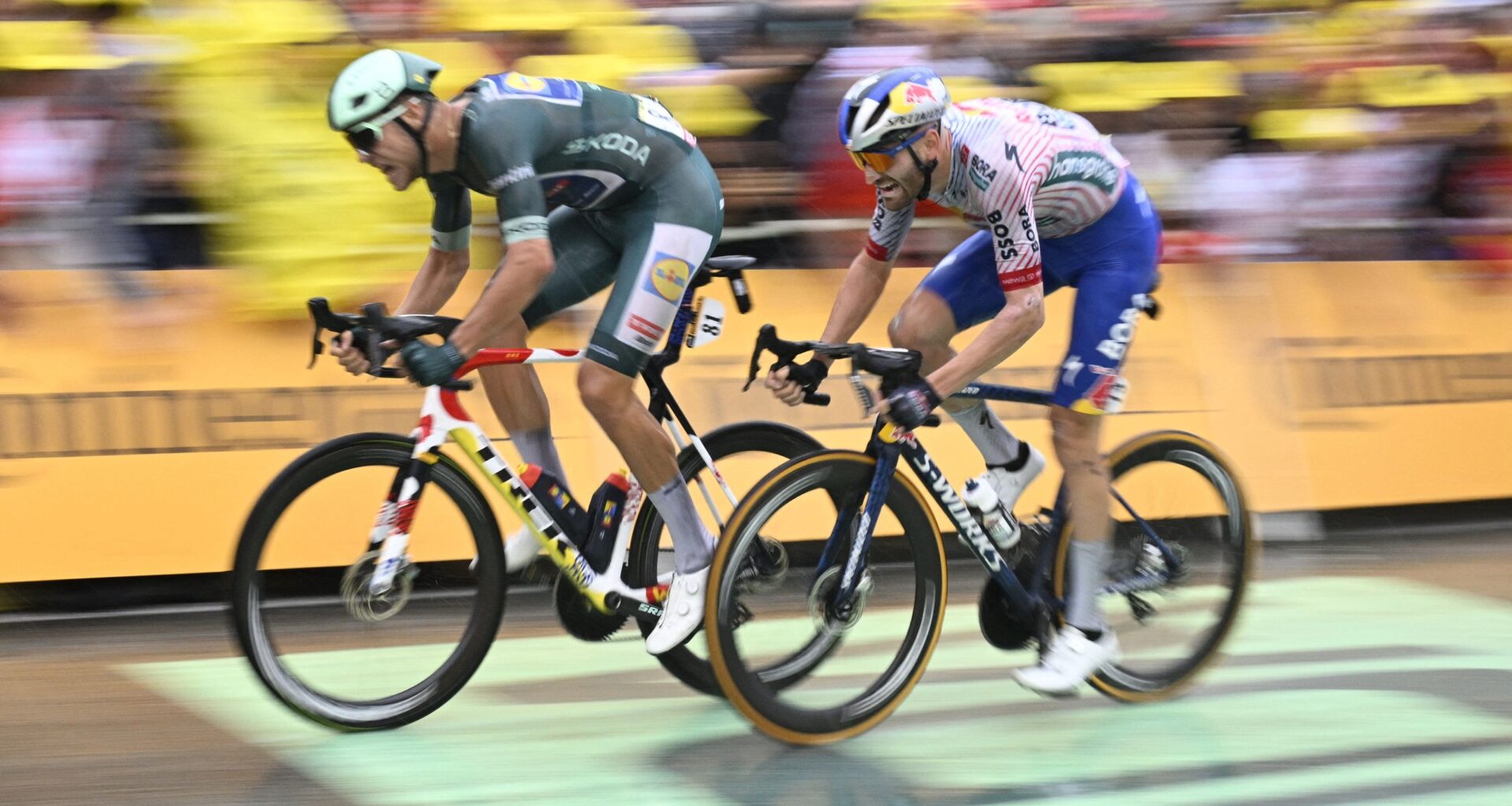
There are few more recognisable sporting arenas than the Champs Élysées. However, its fiftieth inclusion in the Tour de France last summer saw a stage that was anything but recognisable in the history of the sport’s premier stage race. Inspired by the route used during the 2024 Paris Olympics, stage 21 of the Tour featured three ascents of the cobbled Butte Montmartre before finishing on the iconic Parisian boulevard, instead of the long-used circuit around the Champs-Élysées.
Now, neither is considered easy, especially with the cobblestone terrain and infernal pace set by the bunch. However, the 2025 route drastically swung the opportunity for a stage win on one of cycling’s most iconic backdrops into the hands of the puncheurs and Classics specialists and away from the out-and-out sprinters. Was this just a one-off switch to garner more fan enthusiasm for a processional stage, or a broader indication of how sprinting is changing across the sport?
The last rider to win a traditional sprint stage on the Champs Élysées in 2023, Red Bull-Bora-Hansgrohe’s Jordi Meeus, is certain that as the speed of the peloton has increased, the way sprinters ply their trade has changed.
You may like
You may like
One rider whose versatility has led him to rapidly be considered one of the greatest riders ever to grace the sport is Tadej Pogačar (UAE Team Emirates-XRG). The Slovenian’s cannibalistic approach to racing has even seeped into the sprinters’ territory in recent years, such as the opening stage of last season’s Critérium du Dauphiné.
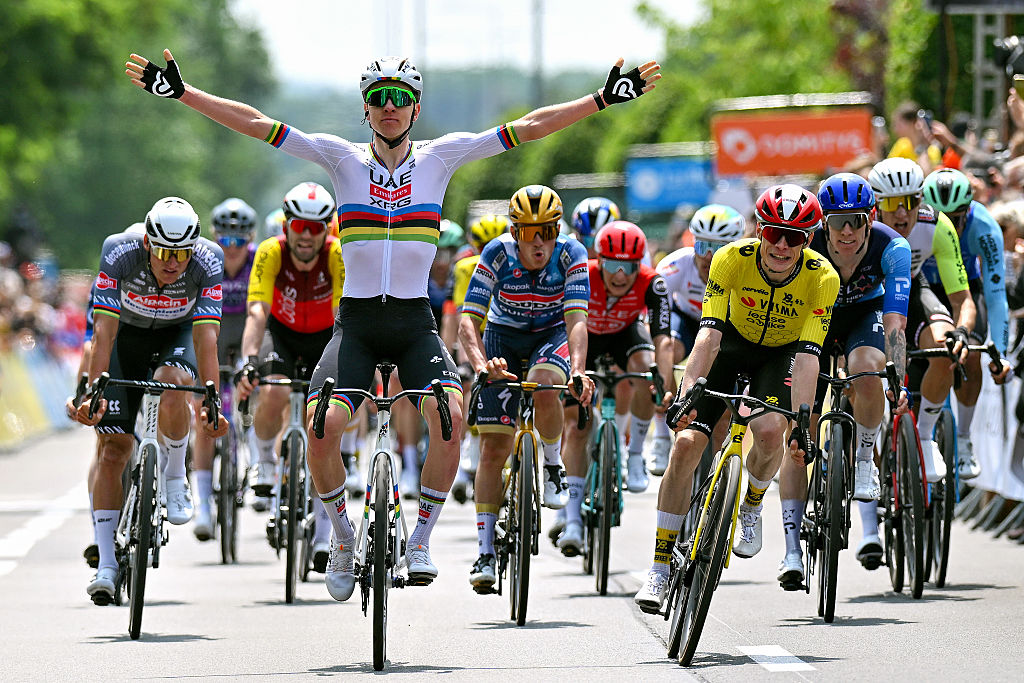
Pogačar, Van der Poel, Vingegaard, Evenepoel and Santiago Buitrago launched a late break to spoil the sprinters’ fun (Image credit: Getty Images)
While Philipsen doesn’t want organisers to ramp up the difficulty of a race to the extent that only a handful of riders, such as Pogačar, can contest the stage finish, he doesn’t necessarily believe that the Slovenian is the root cause either. “He’s just the strongest at the moment, and he will drop everyone anyway,” the 27-year-old added. “If it’s also about tactics, about aerodynamics, about positioning, it’s not only about being the strongest.”
Meeus, now teammate to another of the sport’s superstars in Remco Evenepoel, added that knowing the likes of Pogačar or Mathieu van der Poel (Alpecin-Premier Tech) are capable of challenging for a race win is one thing, but doing something about it is completely different.
“Nowadays, it’s really hard to anticipate because the pace is so high. Guys like Pogačar or Van der Poel, they have such a strong team, and they like a hard race, so they go fast from the beginning to the end, so it’s really hard to get some distance ahead.”
Could it be that by adding complexity and variation into parcours, race organisers are actually hoping to balance the playing field? That looks to be their hope.
Yet, sprinting and its changing image can’t be discussed without touching on safety.
As the average speed of the peloton increases, so too do the risks of crashing. A study by the UCI, as part of the SafeR project, found that 13% of crashes during the 2024 season were a result of tension generated by the approach of tactically important points in the races, such as climbs, cobbled sectors or sprints. Higher speeds and battles for the racing line mean that there is always an increased chance of crashes and collisions during race finales. But is enough being done to mitigate the risk?
In 2025, after an initial trial during the opening week of the previous year’s race, the Tour de France introduced an extension of the 3km rule, which gives any rider who falls victim to a crash or mechanical within the final 3km of flatter stages the same time as the group they were with, to 5km for seven of the 2025 edition’s stages. The UCI also introduced a yellow card system, with irregular sprinting, decelerating during a sprint and endangering other riders all deemed to be against the rules. Two yellow cards in 30 days result in a race disqualification and seven day ban.
However, Girmay argues that race organisers could go further to improve safety.
“The 3km rule, and sometimes 5km, why don’t they put it at 10km to go? It doesn’t change anything. It’s flat anyway, and then we finish in the city most of the time. If you take [rider finish times] at 10km to go, we’ll only have 10, nine or eight sprint teams [contending for the win], so we will be safer.”
Meeus echoes the belief that while sprinter safety is moving in the right direction, more can still be done. “I think the organisers try their best, for example, with the new barriers in the big races, and removing the traffic islands. I think there’s still a lot to improve, but it’s definitely going in the right direction.”
Girmay added that vocal members of the peloton are constantly discussing changes, whether it be in the bunch or on the riders’ group chat, but fail to see them come to fruition, something he puts down to organisers’ priorities.
“First, they have to think about the riders, then the business, that’s important.” As is often the case in cycling, the future of sprinting may come down to a battle between the needs of the riders and the wants of the fans and sponsors.