

Prime Minister Mark Carney on Thursday announced a new program to give rebates to Canadians who buy electric and plug-in hybrid electric vehicles as part of a five-point plant to “transform” the Canadian auto sector.

Carney says he will also repeal the electric vehicle mandate, and put in place new emissions standards.
Speaking in the Greater Toronto Area, Carney said the program, which he called the Electric Vehicle Affordability Program, will include $2.3 billion in funding for these purchases.
Carney said Canadians who purchase or lease a battery-electric or fuel cell electric vehicle will receive up to $5,000 and up to $2,500 for plug-in hybrids priced up to $50,000.
“To support the Canadian auto industry, this $50,000 cap will not apply to Canadian-made EVs and plug-in hybrids,” Carney said.
Story continues below advertisement
“And these incentives will only apply to vehicles produced in countries with whom Canada has a free trade agreement.”
Carney said the five-point plan which includes major spending on electric vehicle charging infrastructure and tax credits to incentivize domestic production “will shape the future of mobility and advance manufacturing in Canada as part of the coordinated plan to build a stronger, more competitive, more independent country.”
Canada’s automotive sector currently faces steep tariffs of 25 per cent from U.S. President Donald Trump and the president has threatened further tariffs on “all goods” from Canada over a trade deal with China.
1:15
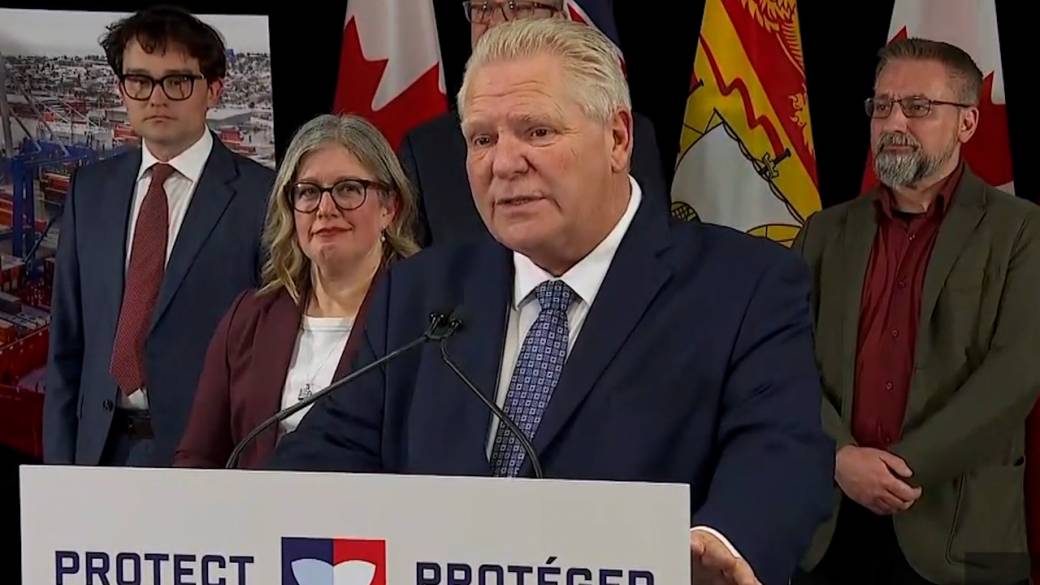
Doug Ford says his stance is clear on ‘Chinese spy vehicles,’ looks forward to auto strategy with Carney
What will the new standards be?
Carney said Ottawa’s plans to “transform” the auto sector amid the ongoing trade war with the U.S. rests on five key pillars, which includes updating national policies on emissions reduction “to focus on outcomes,” including by driving up electric vehicle sales in Canada through these incentives.
Story continues below advertisement
“We’ll drive down emissions by more than doubling the stringency of Canada’s vehicle GHG [Greenhouse Gas] standards by 2035 achieving the equivalent emissions reductions of a 75 per cent EV [Electric Vehicle] adoption,” said Carney.
“We won’t stop there. By leveraging new investments in EV production, consumer incentives and charging infrastructure, we’ll work towards achieving the equivalent of a 90 per cent EV adoption rate by 2040.”
More on Canada
More videos
This comes after Carney, in September, announced Ottawa was pausing plans to impose minimum EV sales requirements on car companies for 2026 model years and said the government would launch a 60-day review of the current EV mandate program.

Get daily National news
Get the day’s top news, political, economic, and current affairs headlines, delivered to your inbox once a day.
On Thursday, Carney said these new measures will enable the government to effectively replace the previous EV mandate.
“The more stringent emissions standards will enable the Government of Canada to repeal the electric vehicle accessibility standard, so-called EVAS. Replacing EVAS with those stronger vehicle emission standards focuses on the results that matter to Canadians, while avoiding placing undue burdens on the Canadian auto industry,” said Carney.
Story continues below advertisement
“This approach allows manufacturers to use a wide range of technologies to meet the standards and to respond to consumer preferences in the near term.”
The Canadian auto industry has been critical of the previous mandates which they say were not aligned to the demand of consumers, with data showing a drop in EV sales among Canadians in recent years.
0:40
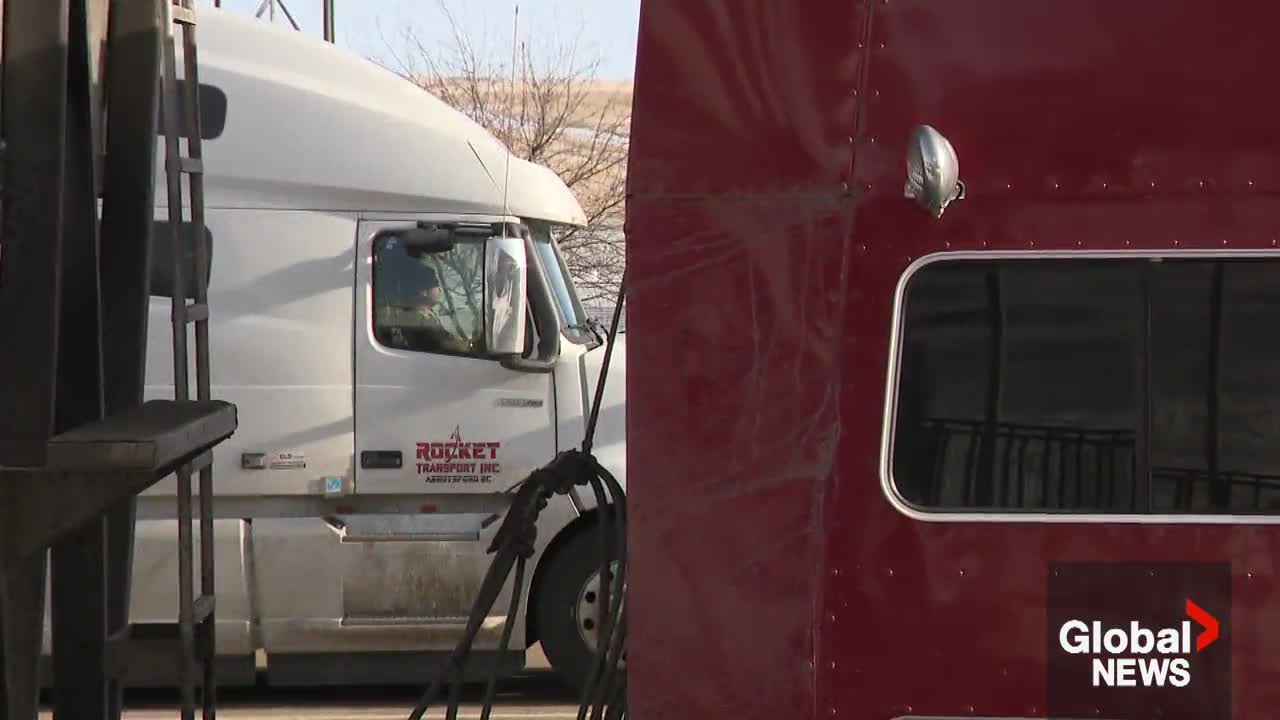
Trump signs order slapping 25% tariffs on medium and heavy-duty vehicles
Tax incentives for industry to build more
Trending Now

Mark McMorris crash overshadows Canada’s opening curling win at Olympics

Gavin McKenna, projected No. 1 NHL draft pick, charged with felony assault
Carney vowed to make it more attractive for businesses to invest in these strategies by offering tax breaks.
Story continues below advertisement
“We’re also implementing the most comprehensive investment incentives for the auto value chain anywhere in the world. The new productivity super deduction will reduce Canada’s marginal effective tax rate on investment to 13 per cent. That’s more than four percentage points lower than in the United States,” said Carney.
“It means businesses can immediately expense 100 per cent of their investments in manufacturing machinery, in equipment, in buildings, in zero emission vehicles, in clean energy equipment, in scientific research and development and productivity enhancing assets including patents, data network infrastructure, computers and beyond.”
Carney also said the government will introduce new and expand several currently available tax incentive programs “to accelerate investment across the low carbon mobility value chain,” although no specific numbers were immediately provided.
“We’re implementing the Clean Electricity Investment tax credit. We’re expanding the Clean Technology Manufacturing Investment tax credit, and we’re including a wide range of critical minerals.
“And we are reducing the tax rate for zero emission technology manufacturers so they benefit from one half of the normal corporate tax rate. And that is before these deductions. Put simply, we’re making Canada the best place to invest, the best place to build, the best place to build green.”
Expanding charging station infrastructure
The same way gas powered vehicles need gas stations, boosting electric vehicle sales in Canada will also require increasing the number of charging stations.
Story continues below advertisement
Carney on Thursday announced these new measures will include over a billion dollars in spending to expand Canada’s charging station infrastructure.
“We’re also going to make it easier and more convenient for Canadians to charge their EVs. Because too many Canadians worry about being able to reliably get charging on journeys, especially in rural and northern communities,” said Carney.
“To help fix that, we’re developing a new national charging infrastructure [with a] new strategy: $1.5 billion of investment through the Canadian infrastructure bank, so wherever you live in Canada, charging your vehicle should become as simple as filling your gas tank.“
More electric vehicles and more charging stations are also expected to increase demand for electricity, and Carney said Thursday details will be announced “in the coming weeks.”
“Our government will unveil a new electricity strategy to double – I’ll repeat – to double our grid capacity. To modernize our infrastructure and to deliver electricity that’s more reliable, more efficient, [and] crucially, more affordable for Canadians,” said Carney.
– More to come
© 2026 Global News, a division of Corus Entertainment Inc.