
NBANBAFrom Giannis’s non-move to a surprising amount of real ones, we sort through a chaotic (and confusing) deadline Getty Images/Ringer illustration
 By Michael PinaFeb. 5, 11:48 pm UTC • 16 min
The 2026 NBA trade deadline was filled with an excessive amount of unexpected developments that may or may not impact this season’s run to the Finals. Some teams that probably should’ve showed more urgency sat on their hands. Some teams that probably should’ve sat on their hands decided to pick up the phone and make some strange decisions.
As you may have heard, the Milwaukee Bucks did not trade Giannis Antetokounmpo. As you may not have, a bunch of teams did everything in their power to get under the luxury tax But some very familiar faces are still on the move, and a couple contenders are better today than they were 48 hours ago. So, with that preamble out of the way, let’s take a look around the league and announce some Winners and Losers!
Winners: NBA OwnersLosers: NBA Fans
Let’s start here: It’s never been more clear just how useful the apron system is for owners to justify personnel moves that are primarily made to save them money. Whether getting under an apron or ducking the tax, teams are now able to spin decisions that make their present day roster worse at basketball by pointing at the flexibility it may afford sometime down the line. This stinks. (On a personal note, I’m very much not a fan of how deeply ingrained it’s become when analyzing a trade or determining a player’s value. The basketball should be able to speak for itself.)
There were at least half a dozen instances of it happening over the past 48 hours. The Toronto Raptors are one example. Here’s a pretty good playoff team that decided to dump Ochai Agbaji’s expiring contract onto the Brooklyn Nets. Instead of adding talent amid a surprising season, Toronto decided to subtract it for the sake of avoiding a tax bill. (I am aware that the Raptors also traded for Trayce Jackson-Davis—an undersized center who couldn’t crack Golden State’s rotation.)
The Orlando Magic are another. Given how terrible the vibes are down there, I’m not necessarily advocating for a ton of action, but this could’ve still been an opportunity for them to shake things up and right the ship. Instead, all Orlando did was attach a pair of second-round picks to Tyus Jones and ship him to Charlotte in a move that helps them avoid the tax. If your reaction to these two trades is “getting off that money was logical,” then congratulations, you’ve made my point!
Ever since it was implemented in 2023, the Collective Bargaining Agreement has encouraged a warped incentive structure. More and more attempts to build the best team possible have either been postponed or short-circuited by transactions that only look shrewd because of the stringent parameters under which they are made.
The sharpest front offices are still able to have their cake and eat it too, parrying harsh financial restrictions without sacrificing their ability to compete at a high level. The Cleveland Cavaliers found ways to cut a crap ton of salary while, on paper, filling some holes and adding more useful players. The Boston Celtics swapped Anfernee Simons for Nikola Vucevic in a two-birds-with-one-stone deal that fortified a weak frontcourt and put them on a path to avoiding the tax altogether. Simons—a dark horse candidate to win Sixth Man of the Year—is probably still in Boston if the aprons didn’t exist. (Well, actually Jrue Holiday, Luke Kornet, Al Horford, and Kristaps Porzingis would all probably still be in Boston, too.)
The current system exists because, a few years ago, Steve Ballmer and Joe Lacob—two mega-wealthy owners who aspired to be light-years ahead of the competition—started outspending everybody else by an untenable margin. It wasn’t really fair, so the NBA and NBPA responded by creating rules that would disincentivize the Los Angeles Clippers and Golden State Warriors from splurging as they pleased. It dramatically narrowed the wealth gap between the haves and the have-nots
Creating a system that levels the playing field is one thing, but having it encourage (and sometimes celebrate) belt-tightening is another. What’s happening now is ironic. Adam Silver has long yearned for competitive balance, and this season has played out like his dream come true. But instead of watching good teams beef up for the stretch run, a few that have a chance to win their conference were frugal. The league can celebrate parity all it wants. But what good is every team having a fair shot to win if a whole bunch of them would rather save cash than push all in?
What we generally saw at the deadline was the opposite of how things should look. To spell the situation out in the simplest terms: Right now it’s smart for NBA owners to spend less money on their teams. The whole thing needs to change tomorrow, but unfortunately we’re stuck with it until at least 2029. Hurray!
Loser: Joel Embiid’s Opinion
This is very much related to the point above. Last week, Joel Embiid made a public plea to Philadelphia’s front office: “We’ve been ducking the tax the last couple of years. So hopefully we keep the same team. I love all of the guys that are in here. I think we got a shot. I don’t know what (the front office is) going to do. But I hope that we get a chance to go out there and compete because we got a good group of guys in this locker room, and the vibes are great. … Hopefully we think about improving because we have a chance.”
Instead, the Sixers, at 29-21 and 3.5 games back of the no. 2 seed, traded Jared McCain away to essentially duck the luxury tax. There should be no urgency for the 76ers to move on from someone who was on track to win Rookie of the Year last season before a couple surgeries sidetracked his career. McCain is still only 21 years old on a rookie-scale contract. At best, a speedy ball handler who can get into the paint and drill 3s off the dribble.
V.J. Edgecombe and Quentin Grimes may have ultimately made him expendable, and the Sixers could’ve done a lot worse than getting a late first-round pick back for their trouble. (Thanks to Paul George’s suspension, the Sixers could’ve dumped Kyle Lowry or Justin Edwards and gotten under the tax by likely losing some kind of draft-related asset. Daryl Morey clearly preferred to add said asset by moving on from McCain instead.) But with Embiid playing as well as he is and Tyrese Maxey having a first-team All-NBA caliber season, a move that signaled confidence in this year’s chance to reach the NBA Finals would’ve been nice. Instead, it’s clear the Sixers preferred to save money and add an asset that won’t score any points in the playoffs.
Winner: Minnesota’s Decision to Acquire Ayo DosunmuLoser: Minnesota’s Decision to Draft Rob Dillingham
The Timberwolves, by and large, had a very productive trade deadline. They exchanged several players who wouldn’t have been in their playoff rotation for Ayo Dosunmu, a combo guard who’s made over 45 percent of his 3s for the Chicago Bulls this season. That’s a big move. The Wolves are a genuine contender currently riding some of the most sustained continuity in the league. But they badly needed another ball handler who can space the floor, defend with intensity, and function in a fast or slow environment. Dosunmu checks all those boxes.
One of the players Minnesota included in the deal to get him, though, was Rob Dillingham, whom the team drafted eighth overall in 2024. The Wolves had to attach four (!) second-round picks to shed Dillingham’s contract. For those counting at home, that means Tim Connelly has spent a first-round pick in 2031, a pick swap in 2030, and those four (!) seconds on one of the worst players in the league Maybe it’s all for naught, Dosunmu keeps cooking throughout the postseason, and Minnesota reaches the NBA Finals. Or, maybe if you’re a team that’s, you know, trying to trade for Giannis Antetokounmpo this summer, having all that draft capital would have been really useful. Just a thought.
Also, Dosunmu is on an expiring contract. Keeping him isn’t impossible, but keeping him while staying under the first apron may be.
: Nico Harrison
I mean:
So the Mavericks turned Luka Doncic into
Max Christie
2029 Lakers first-round pick
2026 Thunder pick (30th)
2030 Warriors first (if 21-30)
3 seconds
Generational fumble
— Yossi Gozlan (@YossiGozlan) February 4, 2026
Winner: Los Angeles Clippers
Say what you want about the Clippers and how they’ve handled the last couple of years. They have one of the sharpest front offices in the league. And at Thursday’s deadline, facing a pretty dire set of circumstances, they successfully pivoted toward the future. In the process of trading James Harden and Ivica Zubac, the Clips added young talent (Darius Garland, Bennedict Mathurin, Isaiah Jackson) and up to two valuable first-round draft picks. There’s a world where the Clippers land the fifth pick in this year’s draft. (The Utah Jazz had the worst record last year and ended up with the fifth pick. It’s possible!)
Losing Harden is a tough pill to swallow in the short term. But he was swapped out for a two-time All-Star who’s 26 years old. (It’s amazing that they received a second-round pick in that deal, when all the reports before it went down signaled that Cleveland was the team in search of compensation.)
Losing Zubac is even more difficult. He’s a dependable two-way center who’s on a fabulous contract and only 28 years old. But Indiana’s offer was clearly too good to pass up for an organization that has to turn the page. The Pacers gave up their 2026 first-round pick (top-four protected and 10-30 protected), their unprotected first in 2029, and a second-rounder via the Dallas Mavericks in 2028.
Going from Zubac to Jackson frees up $13 million worth of cap space for a team that already has a ton of it. (Mathurin is a restricted free agent.) Point being, the Clippers have a ton of options. They can either quickly retool around Kawhi Leonard with a much more athletic roster, or see what Leonard can fetch this summer in the last year of his contract. The Clippers have been compromised for quite some time. Somehow they’ve managed to give themselves a chance to wriggle free.
Loser: Patience in Washington
A very small part of my brain can be persuaded into liking Washington’s blockbuster trade for Anthony Davis. I’m theoretically excited to watch him and Trae Young form a dangerous pick-and-roll duo. I’m curious to see whether they can function beside Alex , in lineups that would allow AD to play his preferred position and surround Young with enough size to obscure his defensive warts. If some of Washington’s young core takes a step forward next season, or it lands one of the blue-chippers atop the draft, the Wizards could be a decent team that’s still nowhere near the tax.
But the rest of my brain turned to sludge when I first saw the deal, unable to process what, exactly, the Wizards were thinking. This is how they want to use their precious cap space? You, Washington, a 13-win team that’s several miles outside shouting distance from being competent on either end? This is what you sacrificed Deni Avdija for? The right to fill over 50 percent of your cap for the foreseeable future with two overpaid talents who are either always hurt, in clear physical decline, or both?
And if they don’t re-sign Young and/or Davis, what was the point? Yes, the price was low. And yes, everyone in the NBA is acting like the headliners in next year’s draft class might as well show up to the lottery in a clown car. But just because something is on sale doesn’t mean you should buy it. There’s a real opportunity cost at play.
Young and Davis do not make sense in an environment where player development is the top priority, which is strange because player development should still be Washington’s first priority. Why not see this rebuild through? Sarr, Kyshawn George, and Tre Johnson form a promising young trio; there’s a decent chance Washington could land a true franchise centerpiece in this year’s draft. What’s the rush?
The Wizards own all their own picks and have a few incoming assets down the line: a swap with the Suns in 2030, and the second-most-favorable first between the Bucks, Blazers, and Celtics in 2029. What’s wrong with committing to a youth movement that can ascend as some of the better teams in the East start to recede? What happened to being patient?
Here’s what Wizards GM Michael Winger said last week when asked whether he regrets trading Avdija. “No, because we did it for the reasons we said then, which is to, in effect, take us back a couple years, so that we could reset the roster and everybody was sort of on the same age curve. And Deni’s ahead of that As a reminder, we are not pursuing short-term success. We are not pursuing moderate success. We believe that mediocrity, frankly, is just easily achievable, but there’s a very low ceiling on hope.”
In a vacuum, getting Young and for CJ McCollum, Corey Kispert, Khris Middleton, AJ Johnson, Malaki Branham, Marvin Bagley III, a 2026 first-round pick via the Thunder, a 2030 first-round pick via the Warriors that’s top-20 protected, and three second-round picks is a boon. But for Washington, it’s expensive and shortsighted—an oddly timed pivot that doesn’t entirely feel motivated by basketball
The Eastern Conference is bad. But it’s not this bad. Can the Wizards be better than the Hornets next season, let alone the Celtics, Knicks, Cavaliers, Raptors, Sixers, or Pistons? Probably not! Maybe I’m foolish to write Davis off as a top-12 player who’s still able to anchor a playoff team. But even if that happens, the move to get the 32-year-old stands in direct contrast with an organization that’s “not pursuing short-term success.”
Teams that chase relevance do not enjoy stability, but teams that strive for stability will always be relevant. The Wizards, suddenly and shockingly, find themselves in that former camp.
Loser: Evan Mobley’s Development
This hasn’t been the breakout offensive season I thought Mobley would have. His true shooting is only league average, the lowest it’s been since his rookie year. His playmaking opportunities have not flourished and his offensive has dropped, according to Thinking Basketball.
And now he’s about to share the floor with two high-usage guards who enjoy dictating half-court offense with the ball in their hands. So much for Mobley doing more. Zooming out, this is not a negative short-term development for Cleveland. Harden and Mitchell are unguardable one-on-one scorers who draw enough attention to spoonfeed open teammates. There aren’t a ton of defenses out there who have the personnel to handle both at the same time. These Cavs will cook.
As it stands, though, finding ways to better accentuate and support Mobley could have short- and long-term benefits for Cleveland. Here’s a graph that shows how his daily plus-minus is progressing:
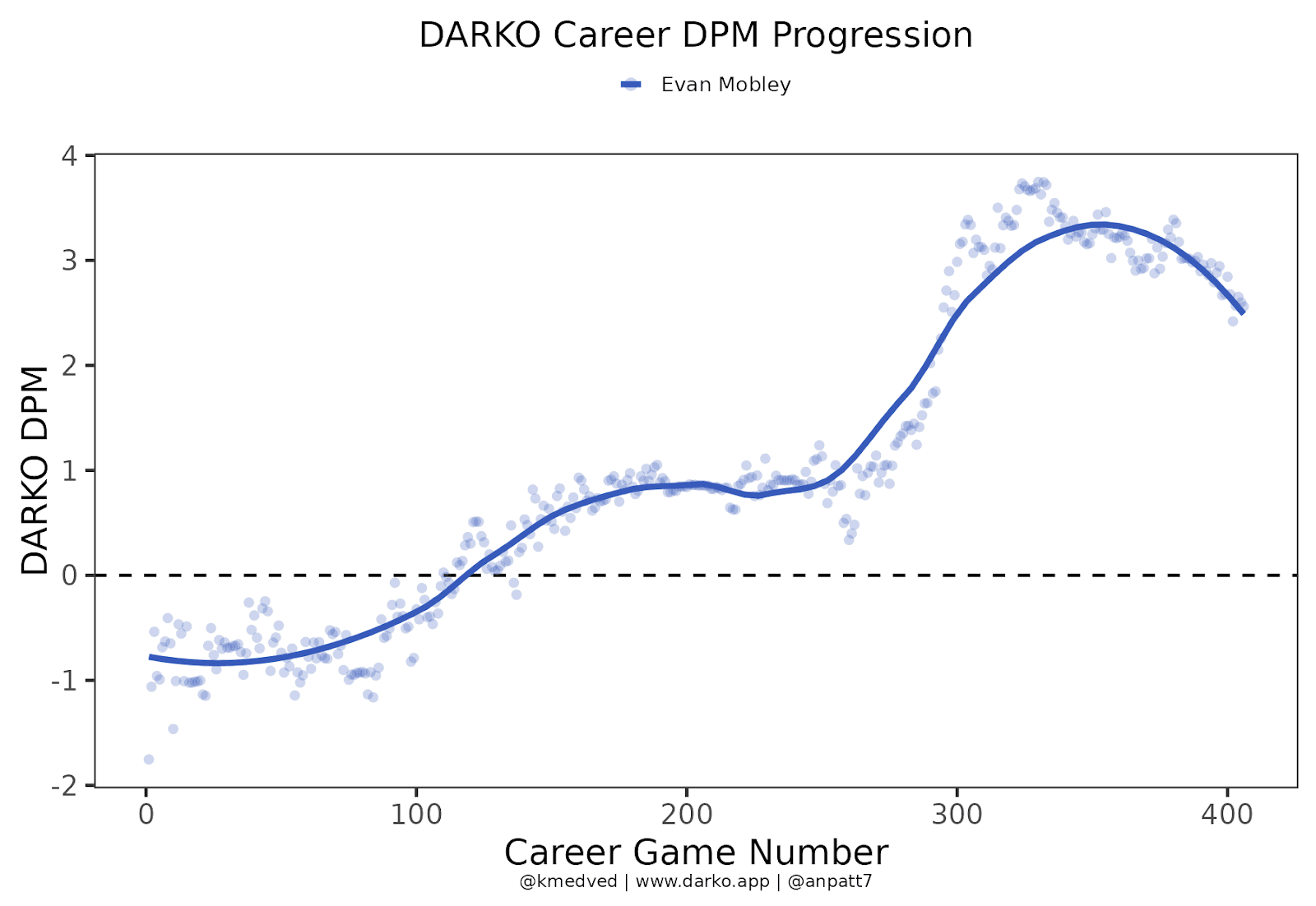
Mobley is only 24 years old, and has every tool to be an all-time great. He was drafted onto a winning team that dramatically accelerated its timeline by trading for Mitchell in his second year. There are benefits to coming up in that type of environment. But the downside is a total lack of patience with shifting priorities—like the need for him to focus on 3s when becoming a more consistent shot creator inside the arc would’ve served Cleveland well. And with Mitchell’s free agency looming and Harden 36 years old, it’s only a matter of time before Mobley is the franchise pillar the Cavaliers fall back on and build around. Whenever that actually happens, he may not be as evolved as he could’ve been.
Winner: Cleveland Cavaliers
Just to confirm, in case the blurb above came off a little too negative: The Cavs should be significantly better with Harden, who would’ve been an All-Star this season had he spent the first half in the Eastern Conference. Their floor goes up significantly with him on the roster. Their ceiling probably does too. No one is confusing Harden for Scottie Pippen, but his size makes him a meaningful upgrade over Darius Garland on defense. The postseason meltdowns are well known and impossible to dispute, but I’m cautiously optimistic in Cleveland’s ability to win multiple playoff series this spring with the roster it has right now. I couldn’t say the same thing two weeks ago.
TBD: Giannis Antetokounmpo and the Milwaukee Bucks
It’s impossible to call either side a winner or a loser at this point. Giannis clearly hates the fact that he won’t get to compete for a championship this year, and the Bucks have to feel at least a little bit shitty knowing zero teams were willing to make Godfather-type offers before the deadline passed. Time will tell how this resolves itself. If Giannis doesn’t expand his reported list of preferred destinations beyond Minnesota, Golden State, and Miami, then Milwaukee may not come close to maximizing its return this summer.
If Giannis does broaden his horizons and is open to playing for a team that disappoints in the playoffs (like the Rockets or Spurs), things will obviously get a bit more interesting.
And if the Bucks can somehow convince Giannis they can build another contender around him by packaging every asset they have—a.k.a. three first-round picks at the draft—to get a bona fide star, well, crazier things have happened.
Winner: Nikola Vucevic
This is pretty simple. Vucevic is exiting an organization that’s completely indifferent to success, has no identifiable team-building strategy beyond a sudden obsession with second-round picks, and isn’t very good. He’s joining an organization that’s committed to winning the championship every single year, boasts a rock-solid culture that’s based on accountability, and is very good. The Bulls are asleep. The Celtics are awake. The Bulls are unserious. The Celtics are shrewd.
This move is a life raft for Vucevic, a 35-year-old center who’s never won a playoff series. He’s also on an expiring contract and now finds himself in an ideal position to alter how he’s perceived around the league. Most likely sliding in as a backup who can make spot starts when tapped for it, Vooch is still skilled enough to have a second unit run its offense through him. He can facilitate from the mid-post, stand on the perimeter and space, pop out for open 3s, set sturdy screens, and duck into the paint to seal smaller defenders who’ve switched on to him.
The Bulls have been pretty bad with Vucevic on the court ever since they traded for him. They’ve also been better, every single season, when he’s on the bench. Those numbers don’t exactly inspire a vote of confidence for a two-time All-Star who doesn’t move particularly well on defense, but he’s never been surrounded by this much talent or intelligence while competing in an environment with high expectations. On defense, Boston will scheme to keep Vucevic out of pick-and-rolls and keep him near the paint—where his new teammates will do their best to shrink the floor—as often as possible.
It’s a terrific, mutually beneficial situation for Vucevic and the Celtics. He’s on an expiring contract, looking to increase his worth on the market this summer. Boston gets the frontcourt depth it was looking for.
Winner: Oklahoma City Thunder
If you haven’t heard, the Thunder are owed an unprotected 2026 first-round pick from the Clippers and a top-eight-protected pick from the Jazz. Also if you haven’t heard, the Clippers just got worse by trading away Harden and Zubac, and the Jazz may have gotten better by trading a bunch of meh players and draft picks for Jaren Jackson Jr.
Now, it’s definitely possible, if not likely, that we’ll see Los Angeles avoid the lottery by punching its way into the playoffs via the play-in tournament. (If Kawhi Leonard and Garland are in the starting five, the Clippers can carry the ultimately pointless “team nobody wants to face” label into Round 1.) Meanwhile, like, I’m sorry, but the Jazz will rearrange the solar system if that’s what’s necessary to keep their pick. Six-figure fines be damned, they will shamelessly tank down the stretch and ensure their chance to add a franchise-changing prospect to one of the most intriguing rosters in the league.
But even if Oklahoma City’s odds are exceedingly low to land one or two high draft picks, the moves made this week improved them, ever so slightly. That’s, possibly, kind of a big deal. I also liked their decision to take a flier on McCain, and look forward to watching him immediately average 19 points a game with one of the highest true shooting percentages in the league.
Loser: Houston Rockets
One day after Rockets assistant coach Royal Ivey used the word “selfishness” to describe his team’s play in the first half of a devastating beatdown against the “Maine” , Houston has all but admitted that it’s not a championship contender right now. Despite having five tradable first-round picks and some significant areas in need of improvement—on a roster that’s down Steven Adams and Fred VanVleet for the season—the Rockets were whisper quiet at the trade deadline.
If/when they flame out in the postseason, there won’t be a more unpredictable offseason wild card in the league. Would Houston, feeling the pain of defeat, give Milwaukee whatever it wants for Giannis? Is there another star on the horizon who could be had at a lower price? (Kawhi, anyone?) Who knows? But the Rockets have a ton of draft capital and more than one young star on their roster. How committed will they be to maximizing what’s left of Kevin Durant’s career? Do they go the other way and see what they can get for KD? I’m admittedly a little over my skis right now, but the point stands: Keep an eye on Houston.
Winners: Golden State and Jonathan Kuminga
Our longstanding national nightmare is finally over. On Wednesday, the Warriors traded Jonathan Kuminga and Buddy Hield to the Hawks for Kristaps Porzingis. Everyone should be happy. Kuminga gets to join a young team that could use another athlete on the wing. Golden State gets one of the most potent stretch 5s in NBA history. And the general public never has to hear about Kuminga vs. the Warriors ever again.
Now, obviously Porzingis’s health makes it impossible to count on his availability. He’s appeared in just five games since December 1. But he has the exact skill set Golden State could use. On his best day, Porzingis is an elite paint protector who can’t be ignored 30 feet from the rim. Maybe the Warriors will be able to bring him back on a cheaper contract next year, get extremely lucky, and head into the playoffs with Steph Curry, Jimmy Butler, Draymond Green, and Porzingis in their starting five? On second thought, none of this is actually that appealing or realistic even as I type it out, but at least they no longer have to think about Kuminga. Thus, they’re winners.

Michael Pina
Michael Pina is a senior staff writer at The Ringer who covers the NBA.