

Listen to this article
Estimated 4 minutes
The audio version of this article is generated by AI-based technology. Mispronunciations can occur. We are working with our partners to continually review and improve the results.
A Transportation Safety Board report into a fatal helicopter crash in central Alberta recommends pilots think twice before practising potentially risky safety manoeuvres with passengers aboard.
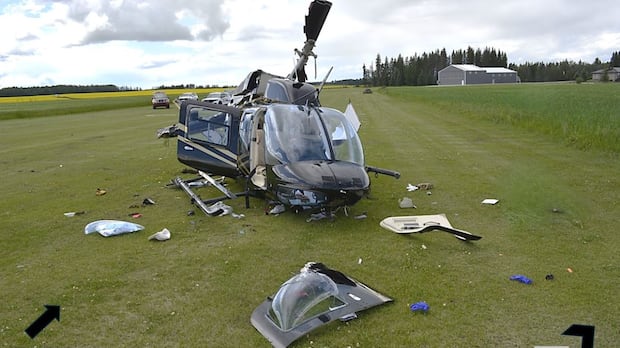
The report, issued Thursday, examined a crash of a Bell Textron 206L-4, known as a LongRanger. The aircraft experienced a hard landing in July 2025 during a private flight west of Red Deer with the pilot and one passenger on board.
The report says the pilot began practising autorotation, an emergency procedure typically used in helicopters when the engine fails.
The first autorotation landing was uneventful, but the report says a second attempt resulted in the helicopter pitching upward, banking and then descending rapidly before hitting the ground.
The passenger, a 54-year-old woman from Benalto, Alta., was killed, and the 63-year-old pilot who was a resident of Lacombe County, Alta., was seriously injured.
‘Riskier than regular flight’
The report says that while practising autorotations is essential to helicopter pilot training, it’s riskier than regular flight, and exposing passengers to the elevated risk “should be carefully considered” before pilots do it.
“In Canada, there are regulations restricting emergency training with passengers during commercial operations but not during private operations,” the TSB report noted.
Allison Dymond, a senior investigator with the TSB, called what happened “a tragic event.”
She also said while practising autorotations is a normal and essential part of helicopter training, it carries a higher risk than a regular flight, adding another element in this case was a lower altitude.
“We do practise autorotations from all altitudes and often we do them high up as well,” Dymond said. “He (the pilot) was closer to the ground, coming in to land. And that does add an element of risk anytime we’re close to terrain.”
With the risk involved higher than a regular flight, she said pilots should consider doing it without a passenger on board.
“It’s just a factor of risk where it decreases the risk, improves safety,” Dymond said, adding that there was also no indication of any mechanical failure.
The report also said neither person on board wore a helmet. While not required, it said the pilot suffered a serious head injury.
“Pilots are reminded that the use of helmets has been documented as a defence in preventing serious injury and helicopter accidents,” Dymond added.
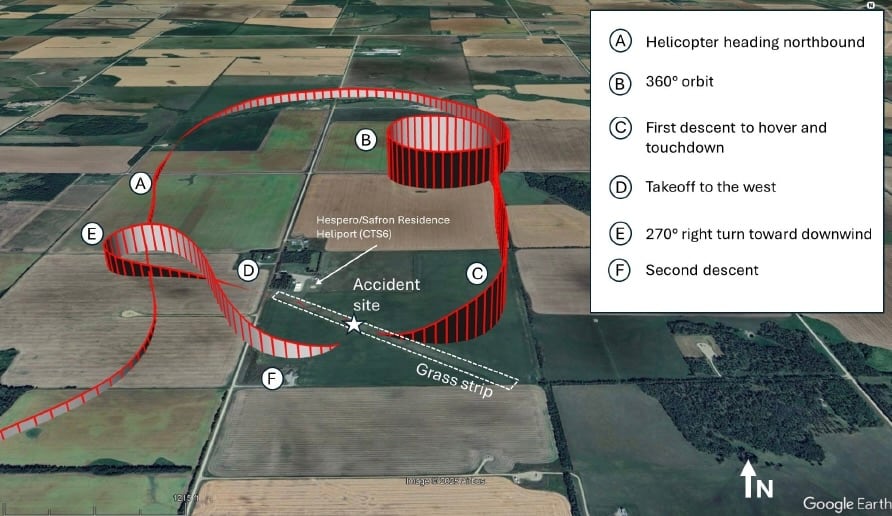 Map showing the helicopter’s flight path leading to the crash. (Transportation Safety Board)
The report said an article was published in 2024 in Transport Canada’s Aviation Safety Letter, advocating for the use of a helmet for all helicopter operations.
That article noted a high percentage of helicopter accidents occur at low speed during the hovering phase.
It said that in a rollover, the chopper’s main rotor blades strike surrounding obstacles or the ground with such tremendous force that “the shock felt by the occupants is brutal.”
A helmet can also protect the pilot during bird strikes where the bird smashes through the window, the article said.
“It is common and it is recommended and I was kind of surprised to read that … the pilot … [and] the passenger were not wearing one,” said Mina Enayatollahi, an assistant professor at Mount Royal University.
She said it is unfortunate that the cost of learning is very high in aviation safety, and it all comes down to better pilot training and to be prepared for maneuvering in risky situations.
“Safety in aviation is a learning curve,” Enayatollahi said.
“Many of the preventive actions come down to training if it’s not technological … to be able to prevent such incidents in the future.”