
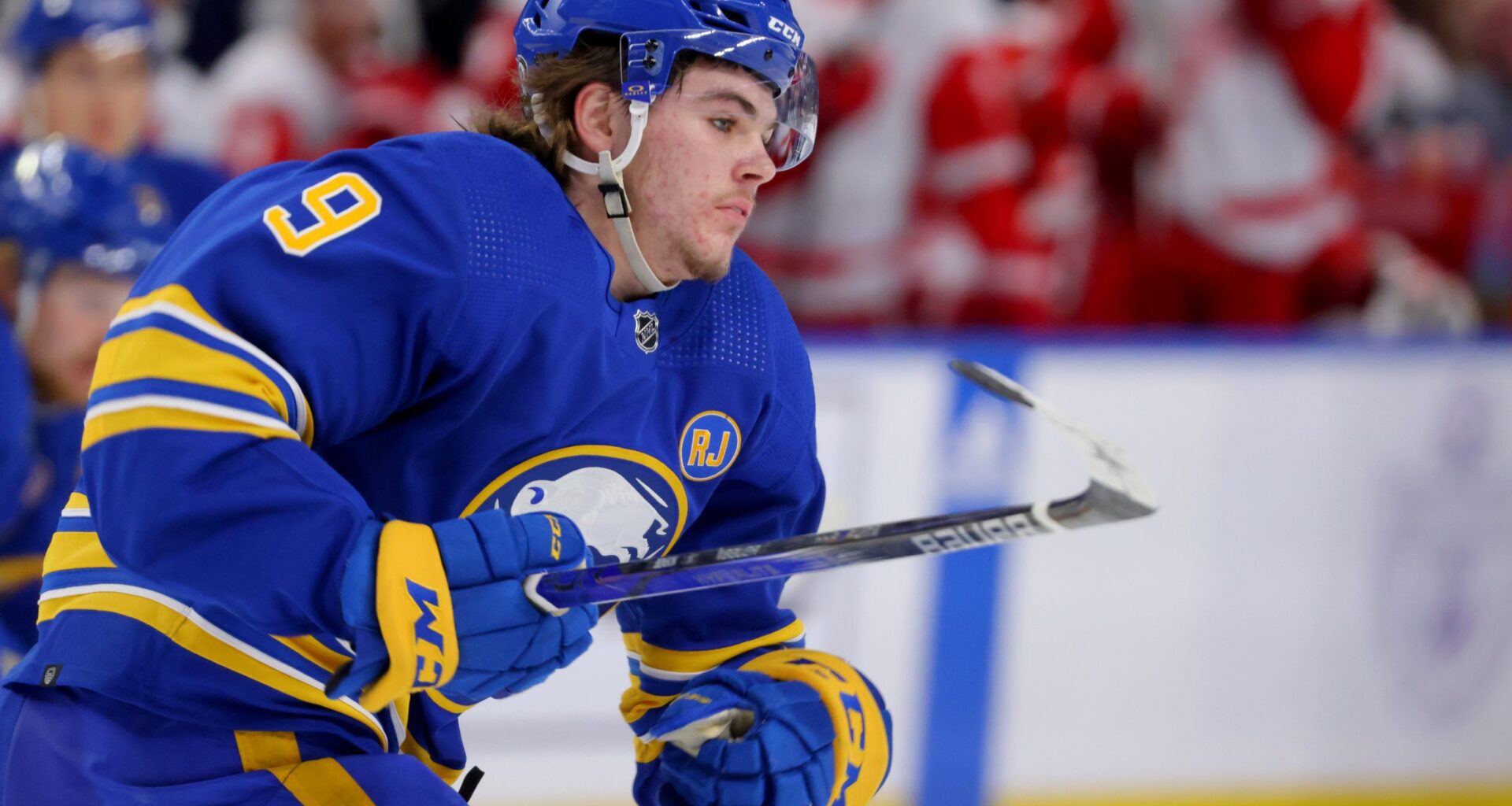
In a bit of a surprise, as there had not been any indications it would be the case, Pierre-Luc Dubois returned to the Washington Capitals lineup on Thursday night. Dubois has not played since October following multiple surgeries, and the initial timeline was 3-4 months. The three-month mark would be a couple of days from now, so he’s ahead of schedule of even the low end of things. It gives him a bit of time to acclimate himself to game action before the three-week Olympic break when he can get as close to game-shape as he can.
The return of PLD is great news for the Caps but not great news for Justin Sourdif‘s fantasy value. Sourdif averaged 11:50 per game over his first 20 games of the season with just three points in that span. Since the 20-game mark, he averaged 16:19 per game and posted 23 points in 34 games (a 56-point pace over 82 games). With Dubois, Tom Wilson, Dylan Strome, Alex Ovechkin, and Aliaksei Protas, there is just one spot in the top-6, and they could probably use Sourdif as a reliable third-line centre. Sourdif’s run as a roster-able fantasy commodity (in most formats) has come to an end.
*
It was announced on Thursday that Tampa Bay Lightning centre Brayden Point would not be attending the Olympics and that Carolina Hurricanes winger Seth Jarvis would be taking his place. Point was injured a few weeks ago and has not played since, so Jarvis will be the replacement for Team Canada. Good for Jarvis as he gets a chance to improve his standing after a very modest performance at the Four Nations Cup.
*
Calgary Flames winger Jonathan Huberdeau had hip resurfacing surgery and will be out for the remainder of the season. The only real question is at which point he returns in the 2026-27 season because hip resurfacing surgeries take months of recovery and rehab, let alone be ready for an NHL season.
*
Here at Dobber Hockey, we like to keep the 200-game players in mind. For the uninitiated, Dobber himself has written about 200 regular season NHL games being the mark that regular-sized forwards (between 5’10 and 6’2) need to really start hitting their offensive upside. It doesn’t mean their offensive peak, but generally when they start their real upward trajectory towards that offensive peak. (For bigger/taller forwards, they need closer to 400 games).
Here are a few names who’ve reached 200+ games so far this season: Egor Chinakhov, Luke Evangelista, Jack Quinn, Pavel Dorofeyev, and Dylan Guenther. Each are having great campaigns for their respective roles, and each has a points/60 minutes rate that exceeds their career rate before this season started.
Among the top forwards reaching that mark later this year, provided they’re healthy down the stretch: Connor Bedard, Adam Fantilli, Logan Cooley, and Leo Carlsson. But telling the readers how good Bedard or Carlsson could be feels redundant. For that reason, let’s review a few down-the-roster forwards who are set to reach the 200-game mark later this season and whom fantasy managers will want to keep an eye on.
Player data is from Evolving Hockey, tracking data is from All Three Zones, and all is current as of Thursday, February 5th.
Bobby Brink (Philadelphia Flyers)
As things stand, Brink is already having the best season of his career with 0.27 goals, 1.69 shots, and 0.59 blocks per game all being career-best marks. The big problem is that he has just 10 assists in his 49 games, an 82-game pace of 17 assists, one season after posting 29 helpers in 79 outings. If Brink had his 2024-25 assist rate in 2025-26, his 82-game pace would be for 22 goals and 55 points. For a guy also on pace for close to 100 hits, that would play very well in multi-cat leagues.
When looking some of the 5-on-5 tracking data we associate with assists – carrying the puck into the offensive zone, or assists on teammate scoring chances – the comparable forwards to Brink’s season look pretty good:
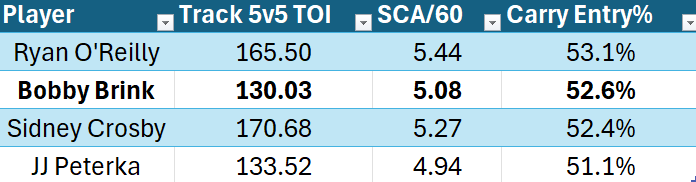
Sidney Crosby, Ryan O’Reilly, and J.J. Peterka are averaging 1.27 assists per 60 minutes at 5-on-5 between them, with Crosby being the lowest at 1.23 assists/60. Brink, on the other hand, is sitting at 0.68 assists per 60 minutes at 5-on-5, a rate 47% lower than the average of the other three players.
It isn’t as if this is just a Flyers problem, either, as they have six forwards with at least 400 minutes played at 5-on-5 with an assist rate north of 1.0 per 60 minutes (and four over 1.2). This is about Brink’s line mates shooting 6.9% with him on the ice at 5-on-5 against a three-year average of 10.2%. With Brink getting close to that 200-game mark, the tracking data comparing similarly to other good-to-great producers, and perhaps some positive regression coming for his line mates’ shooting percentage, the potential for Brink’s upswing after the Olympic break.
Zach Benson (Buffalo Sabres)
Things were looking up for Benson in the month of January as he skated 16:20 per game and had eight points in the final 12 games of the month. A lot of that had to do with being moved to the top line with Tage Thompson and Alex Tuch – not a bad place to be on one of the hottest, and highest-scoring, teams in the NHL over the last two months. However, he suffered an upper-body injury on Monday and did not play on Tuesday or Thursday. The good news is that with the Olympic break coming, he’ll have a few weeks to rest up.
There is also a lot of good under the hood for Benson. While the 5-on-5 tracking data sample isn’t large so far in 2025-26, his rate of assists on teammate scoring chances (SCA/60) and offensive contributions on the rush (Rush Off/60) are much higher than the average from his first two seasons:

There is a reason why his rate of goals (0.54) and assists (1.19) per 60 minutes are higher this season than the average from his first two seasons (0.53 and 1.04, respectively). His per-minute shot rate is also up 8% with a slightly higher hit rate (but lower block rate).
All that it to say there is a lot that Benson has already done this season that shows he’s on the verge of his breakout, and hopefully he’s healthy down the stretch to make good on that promise. The issue is whether he A) stays on the top line, and B) can ever get top power-play time. Upon his return, if Benson is stuck on the third line with secondary power-play time, then his real breakout will have to wait until next season.
Alex Holtz (Vegas Golden Knights)
The last player we’ll look at today is Alex Holtz. While he’s not having a big production season, he does have eight points in 25 games for Vegas, already far ahead his pace from last season when he had 12 points in 53 games with the Golden Knights. All those points have come at 5-on-5, too, so his 1.76 points/60 minutes at that strength is 71% higher than what he did last year. That rate is also higher than some Vegas regulars like Tomas Hertl (1.57) and Pavel Dorofeyev (1.54).
There are a couple reasons for including Holtz here. The first being that he was moved up to Jack Eichel‘s line for Vegas’ 5-2 win over Vancouver on Wednesday night. He was eventually moved down to Tomas Hertl‘s line, but either way, he was skating with one of Vegas’ top two healthy, natural centres (Mitch Marner excluded) in that game.
The other reason is that besides Holtz sitting at 188 regular season games played, he’s also shown a big improvement in his expected goals (xG) rate. I have discussed before how some public xG models have been over-counting their xG rates this season, so that’s worth noting. Here are the average rates of individual expected goals per 60 minutes among forwards at 5-on-5 against actual goals per 60 minutes at 5-on-5 from 2021-2025, and then the same for this season alone:

So, if we just straight-up discount individual expected goals rates by 10%, we can get an approximation of what the true xG count would be, at least compared to the average from 2021-2025. Let’s do that with Holtz to compare his career up until this season, and this season, by individual xG per 60 minutes at 5-on-5:
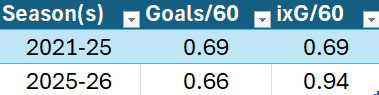
Overall, Holtz’s ixG/60 rate is over 1.0, but if we subtract the 10%, we get to 0.94, which is considerably higher than what he’s done for his career up to this point.
The real problem is Holtz just getting a regular role. He was in the lineup on Wednesday largely because of injuries to Brett Howden, Brandon Saad, William Karlsson, and Colton Sissons. If all those guys are healthy, Holtz probably isn’t in the lineup, let alone skating with either Eichel or Hertl, so a breakout after the Olympic break is very unlikely. Also, as a Holtz booster since his draft year, even I have to admit he hasn’t shown enough all-around game to warrant a top-9 role on a Cup-contending roster. This is more about keeping him in mind for next season as Sissons, Saad, and Reilly Smith are all unrestricted free agents.