
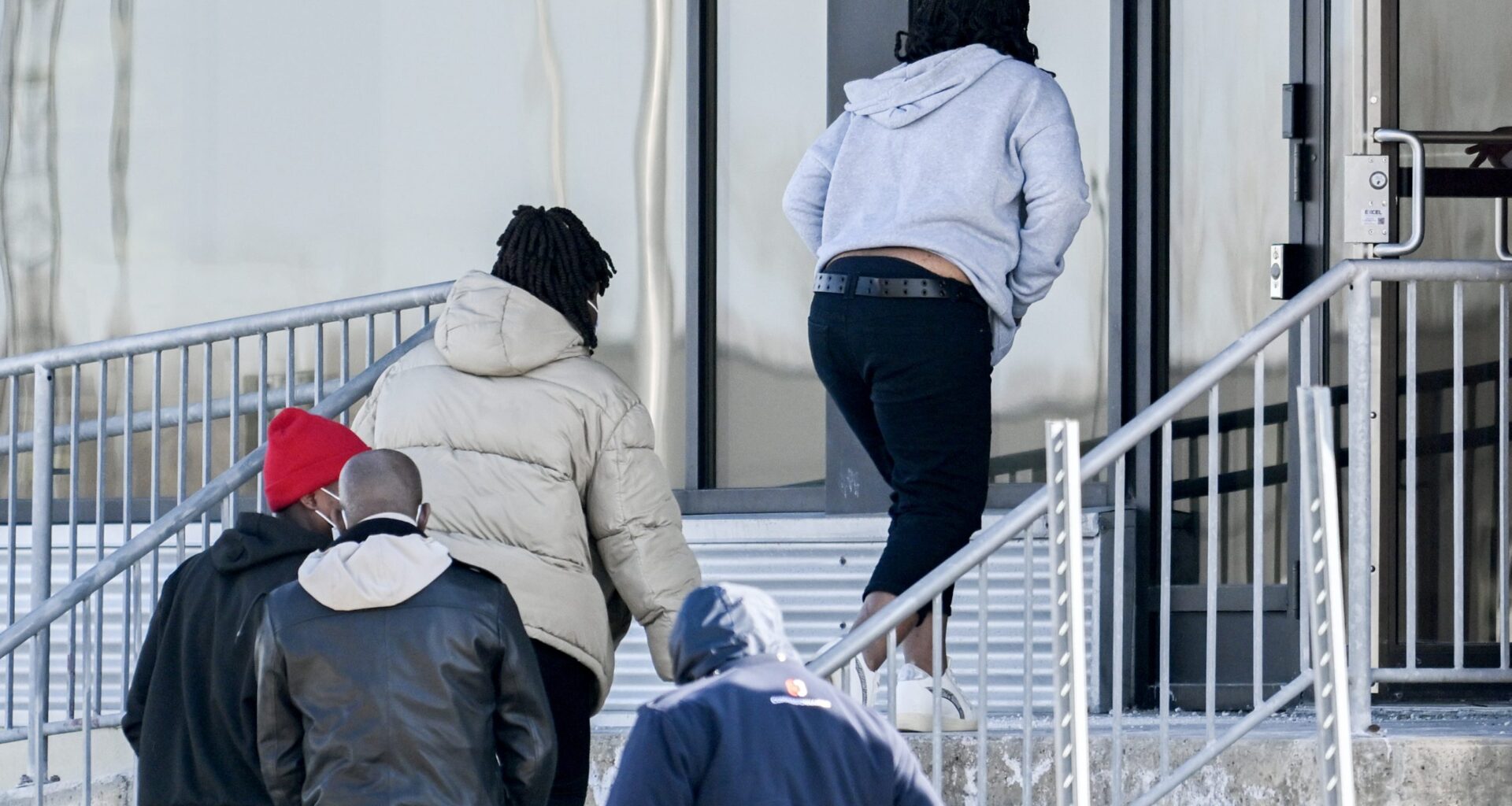
In the first month of the year, Quebec’s Saint-Bernard-de-Lacolle border crossing saw an increase in asylum claims from Haitians who were living in the U.S.
According to Canada Border Services Agency (CBSA), as of Feb. 1, Haitians have made the most asylum claims processed at CBSA land border ports of entry — which includes those who entered irregularly between ports of entry — and then were brought to a land port of entry for processing.
Frantz André, coordinator, Action Committee for People Without Status, says the Trump Administration’s decision to end two programs that were offering protective status to Haitians living in the U.S. and its aggressive deportation policy were behind the surge in Haitians crossing into Canada.
“There was a first wave of people coming from April on — people that were actually staying home for a month coming to Canada and finding a way to get in,” says André.
Back in November, the Trump Administration announced that it will end temporary protective status (TPS) for the 350,000 Haitian immigrants living in the U.S. However, on Tuesday, a U.S. federal judge temporarily blocked the attempt.
 Frantz André, coordinator, Action Committee for People Without Status, says Canada should create a special program for Haitians fleeing the U.S., on Feb. 6, 2026 (Emily Pasquarelli, CityNews)
Fear among Haitians in U.S.
While the ruling was favourable to Haitians with the TPS status in the U.S., there is a still skepticism among the community, according to Jean Ernest Pierre, a Montreal-based lawyer and director of the radio station CPAM.
“(The ruling) doesn’t really favour them in practice because the judge can’t say, ‘I order you, Mr. President, to keep these Haitians in the United States for five, 10 years, or one year, or six months,’” Pierre said. “So it is still up to the President to decide whether to keep them.”
The Trump administration is expected to appeal the ruling to the U.S. Supreme Court which is seen as doing Trump’s bidding, Pierre said.
“We already had an example with the Venezuelans, didn’t we? And even though there was a good ruling, the Supreme Court decided to side with Donald Trump. So he was able to send his Venezuelans back,” he added.
Pierre said the possibility of the ruling being overturned and the Trump administrations aggressive deportation policy are driving many Haitians to attempt to cross the border into Canada to avoid by deported to Haiti, which has been overrun by violence.
“If I were a Haitian in the United States, constantly on the move without a permanent residence, given what I see there, I would have taken the opportunity to enter Canada, where I can receive better treatment,” Pierre said.
André agreed with Pierre’s assessment of the unstable situation in Haiti.
“We’ve seen gangs actually controlling — and when I’m talking gangs, I’m talking mercenaries,” André says. “There are people working even for the United States to keep Haiti unstable.”
 Jean Ernest Pierre, Montreal-based lawyer and director of CPAM 1410 radio, says the situation in Haiti and the U.S. is causing Haitians to attempt crossing over to Canada, on Feb. 6, 2026 (Emily Pasquarelli, CityNews)
Montreal preferred by Haitians, but risks exist
André says Montreal is seen as a preferred destination for Haitians leaving the U.S.
“There’s a big community of Haitians here, but also there are family members here in Quebec,” André says.
However, André says Canada has put in place stringent measures such as requiring those crossing in to have direct family members in Canada, in order to be allowed to stay.
CBSA also said 165 asylum applicants who crossed the border between Canada and the U.S. were sent back under the Safe Third Country Agreement and the additional protocol signed between the two countries in March 2023.
“I have people that I was following to see if they would get into Canada (who) have been sent to (Immigration and Customs Enforcement) and they are currently in Haiti,” André says.
André says the increase in asylum seekers despite the closure of Roxham road shows the desperation among people.
“The United States is no longer a safe country,” André says. “They can put a special program the same way they put for the Ukrainian, where hundreds of thousands of Ukrainians came here.”
Pierre agrees. “It’s not easy, but they say they would rather risk their lives than be caught in the United States and deported to Haiti. So the only alternative left is the border between Canada and the United States, to enter into Canada,” he said.
Americans came in second in terms of the number of asylum claims made so far this year, according to data shared by CBSA with CityNews.
Between Jan. 1 to Feb. 1, 2026, a total of 797 asylum applications were received at Saint-Bernard-de-Lacolle — an approximate 28 per cent increase from the same period last year.
“The 28 per cent jump is greater than that because there’s people coming in illegally in the woods and they’re currently on soil waiting 14 days at the risk of being abused, kidnapped, whatever, even dying and being buried,” said André. “They don’t exist right now in Canada.”
However, the total asylum applications processed by CBSA in Quebec, during this period, dropped from 1,437 in 2025 to 1,055 in 2026.
Neighbouring Ontario processed 481 applications in 2026, compared to 963 in 2025, between Jan. 1 and Feb. 1.