
If you had asked me just a few months ago whether Apple would consider dipping its toes into AI devices like the kind being pursued by Jony Ive and Sam Altman’s mysterious company, I would have given you a laugh the size of OpenAI’s water bill.
Things change quickly, though, and what seemed like a joke just a short time ago is actually starting to feel a little bit real. Here are Tim Cook’s recent musings on the topic from an internal meeting reported by Bloomberg (emphasis mine):
“I truly believe there is no company better positioned to let our customers use AI in profound and meaningful ways than Apple… There will be new categories of products and services that are enabled through AI, and we’re extremely excited about that…We’re excited about the opportunities that it opens for Apple.”
First of all: vague much? There’s nothing earth-shattering in Cook’s comments, but it’s those words next to recent news and behind-the-scenes reports that have my alarm bells going off. The most important context comes from a report by The Information that suggests (and this is not a joke) that Apple could be working on its own wearable AI pin a la Humane.
The Information says that Apple’s pin is a “thin, flat, circular disc with an aluminum-and-glass shell” and that it also has two cameras—one standard and a wide-angle that’s built into the front. With those cameras, the device is designed to take in the wearer’s surroundings with photos and videos, and most likely use some kind of computer vision-based features thanks to AI. If Cook is serious about his recent comments regarding AI, especially the “new categories” part, then there is really no newer category than AI gadgets.
If anonymous reports aren’t enough to convince you, though, Apple also seems to be investing heavily in what feels like an obvious segue into more AI-centric hardware. Last week Apple spent a reported $2 billion to buy Israeli company Q.ai, which makes technology that can recognize “silent speech” by taking in cues like muscle micro-movements in the face and whispers. That could apply to loads of devices and products, including Siri and any device that uses it.
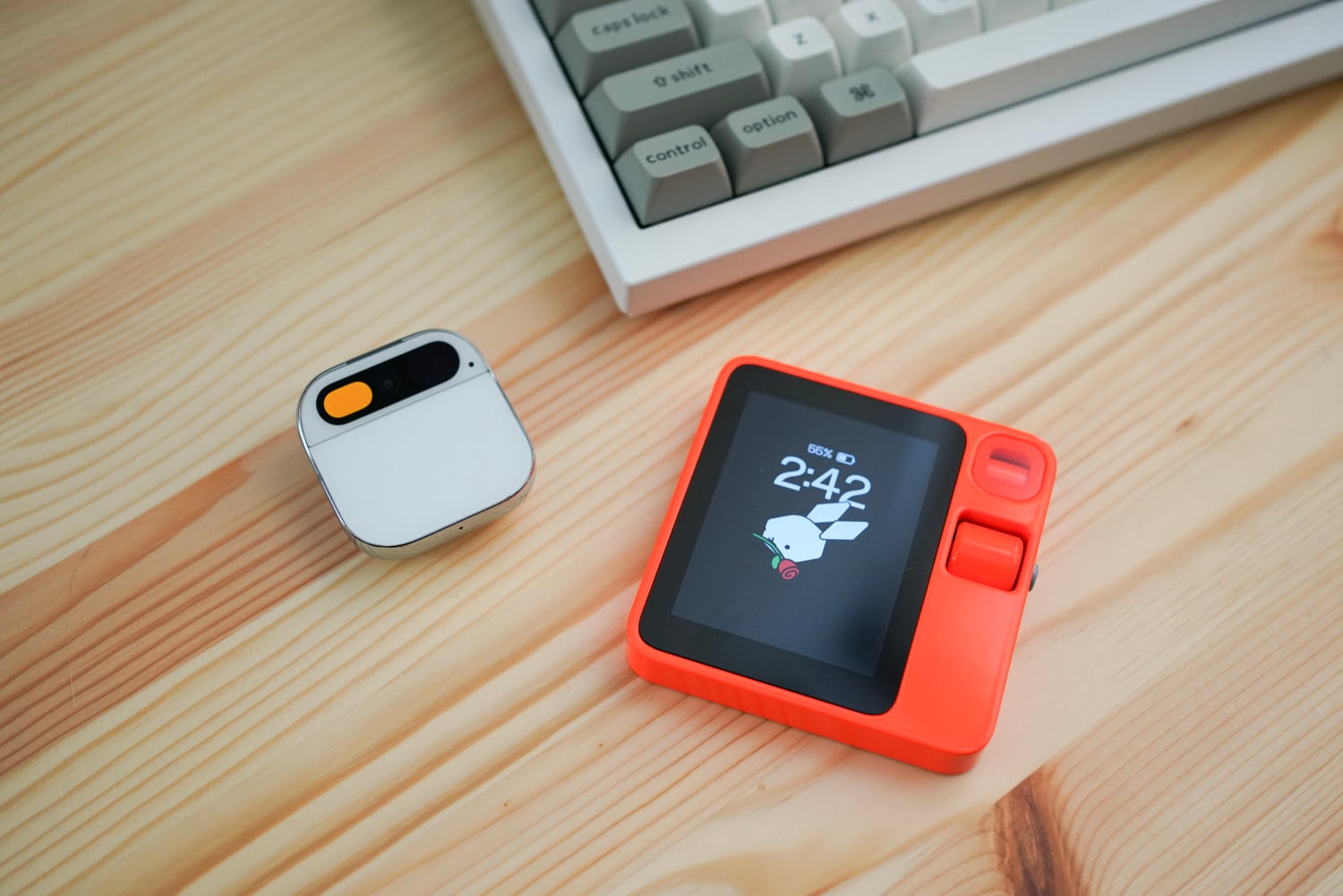 Humane’s Ai Pin and the Rabbit R1 probably aren’t the AI gadgets Apple would model their own after. © Raymond Wong / Gizmodo
In particular, though, Q.ai fits in with the more boundary-pushing tech that Apple may have planned. Rumored AirPods with infrared cameras, for example, could use Q.ai and computer vision to vastly improve Siri or enable a more full-featured ambient computing experience. Alternatively, smart glasses, which Apple is also rumored to be making, rely heavily on voice computing and would benefit greatly from a less obvious voice assistant experience—being able to silently dictate a text or command to your glasses, for example, would make smart glasses more usable in a public setting.
As long as we’re spitballing, Apple’s rumored wearable pin would also benefit from Q.ai’s technology in a similar way to smart glasses, if it can actually pave the way for a more seamless voice computing experience.
It’s all hypothetical, to be sure, but I’d be lying if I said the pieces weren’t there for Apple to start pushing more heavily into the world of AI gadgets, and while Apple doesn’t tend to rush, it’s clearly feeling the heat after stumbles like AI Siri, which—years after the fact—has yet to roll out to Apple devices in the way the company had originally pitched to consumers.
Apple might not be the first to jump on the trend (it rarely ever is), but something tells me, based on recent news, that it might be a little more serious than we thought. Whether it can actually crack the code on making AI devices more useful and appealing is an open question, though. Competitors in the space, like Jony Ive and Sam Altman, seem to be struggling with basic stuff like the whole computing part, but needless to say, they’re not Apple. If nothing else, whatever Apple potentially does will likely be a lot less of a dumpster fire than Humane and Rabbit.