

A Nanaimo gynecologist is advocating for Vancouver Island general surgery departments to roll out a procedure after a new report shows a high success rate in reducing the risk of ovarian cancer.
New research out of UBC published in JAMA Network on Feb. 2, 2026 shows that opportunistic salpingectomy, a preventive procedure that removes the fallopian tubes, reduces the risk of the most common and lethal type of ovarian cancer by nearly 80 percent.
“What’s very exciting this week with the publication of this study is it’s now demonstrated – this followed more than 85,000 women in British Columbia – and it’s demonstrating nearly an 80 per cent reduction in ovarian cancer when we remove their fallopian tubes,” said Dr. Evelyn Eng, obstetrician and gynaecologist in Nanaimo.
The procedure isn’t new among gynecologists, first pioneered by Dr. Diane Miller out of B.C. in 2010.
But the success rate is, and because of this Eng wants to see the procedure become more common practice on the Island.
“As a gynecologist since 2010 I’ve been offering to patients that if you’re having surgery in the pelvis for another reason, we think that ovarian cancer actually starts in the fallopian tubes. So we’ve been offering, ‘Would you like us to remove your fallopian tubes at the same time because we think this will help prevent ovarian cancer?’”
“The study is exciting because after years of theoretically doing this, now the data is showing, ‘Yes, it has been making a difference’ – 80 per cent reduction in ovarian cancer, with no change in how the ovaries function and provide hormones for the rest of the patient’s life.”
In Canada, there are 3,000 new diagnoses and 2,000 deaths from ovarian cancer each year
Ovarian cancer is one of the most lethal types of cancer, seeing 3,000 new diagnoses each year in Canada, 2,000 deaths annually, with a five-year survival rate and no early screening process to prevent it, according to the Canadian Cancer Society.
Eng says it’s a type of cancer that is often found late in the game, and that she often meets with patients who first presented with bloating or changes in their weight to the emergency department or to their family physician.
“We do our best….But the five year survival rate is very low because it’s often diagnosed at this advanced stage and so it’s devastating for the patients and their families…I think many people will know somebody who has been affected with such vague symptoms when it first shows up and often diagnosed at this very late, aggressive stage.”
With a low survival rate, she’s pushing for this procedure to move into general surgery departments when patients are already coming in for issues related to the abdomen.
“I think it was fascinating to me that a lot of women who were diagnosed with this aggressive ovarian cancer had actually undergone surgery in their belly for a different reason in a prior year or two. So now we can see, actually, if those surgeries had included removing the fallopian tubes, they might not have gotten ovarian cancer.”
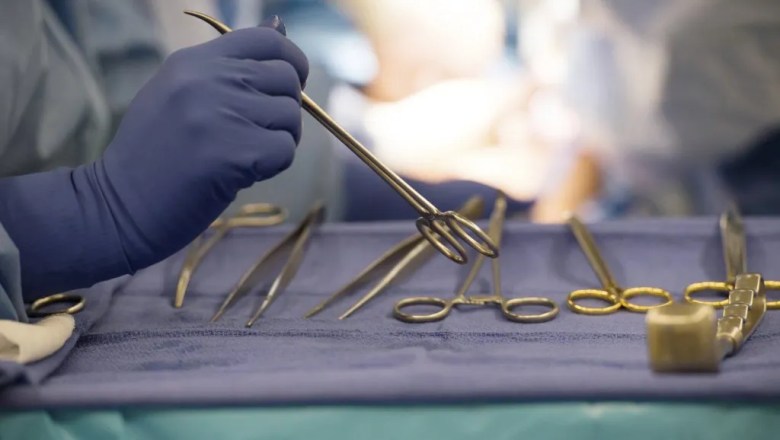 Surgical instruments are used during an organ transplant surgery at a hospital in Washington on Tuesday, June 28, 2016. THE CANADIAN PRESS/AP, Molly Riley
General surgeons on the Island are adopting the procedure
Eng says gynecologists currently perform opportunistic sapingectomy procedures in all communities on Vancouver Island, but now with the latest studies, there’s a push for general surgery and urology departments to take on the procedure.
“I can confirm that some general surgeons and urologists in Victoria are offering this procedure, and expanding to the whole group of general surgeons will be ongoing with an educational session planned next month,” she says.
“And I’m involved with some of the general surgery colleagues, for instance, in Port Alberni, Powell River, other communities.”
To date, she is in contact with colleagues who are working to roll out the ovarian cancer preventative surgery in Victoria, Nanaimo, Port Alberni, and Powell River, and hopes to see more Vancouver Island communities get on board.
Part of her work includes sharing surgical videos, speaking with colleagues in meetings and at medical conferences, and in April and May she will be having general surgeons join her in the operating room.
“I think that’s a strength of the general surgeons on the Island specifically – they are used to working in smaller communities and so they are generalists who are good on operating everywhere.”
However, in Nanaimo, she says there are general surgeons that are ready and it could happen as early as this week.
“This is new and upcoming with our general surgeons. In Nanaimo, I feel there’s a number of our general surgery colleagues who are prepared to start offering it now. So if you are undergoing a general surgery procedure for another reason please discuss it with your general surgeon.”
Conversations with patients
In talks with patients, Eng lays out the possible risks, as well as the function of the fallopian tubes and the risk of ovarian cancer among other details.
According to Eng, the procedure adds three to five minutes with no increase to complication, and no change to recovery time.
In terms of whether a person needs their fallopian tubes later in life, she says there is no other function if a person does not desire fertility.
“Fallopian tubes exist for fertility so that the sperm and egg can meet and go through the fallopian tubes,” explains Eng.
“The ovaries continue to make all the hormones that a person needs for the rest of their life. The uterus remains intact. Those fallopian tubes, really, we see no purpose that they serve other than for fertility.”
In April and May, Eng will be working with general surgeons in Port Alberni and Powell River and hopes to hear interest from more rural communities.
“Let’s offer this to women. That it’s something that they could choose to do in a way that has no impact on their hormones, no impact on menopause. It’s for those who are done with fertility, who don’t want to ever get pregnant, their fallopian tubes can come out with very little impact other than up to 80 per reduction in the risk of ovarian cancer.”
Until then, she encourages patients to advocate and ask their doctors about this procedure to see if it is an option for them.
“If they’re done with fertility, it should become the new standard,” she says.
Eng says while general surgeons can suggest the procedure, she wants to empower patients to ask if this is an appropriate option.
“If there’s a surgery that’s happening in their belly, they could ask, ‘Are you in the same space as where my fallopian tubes are? I’m done thinking about being pregnant again and I would like to consider having my fallopian tubes removed at the same time.’”
For more information, visit Opportunistic Salpingectomy | SSC
READ MORE: