
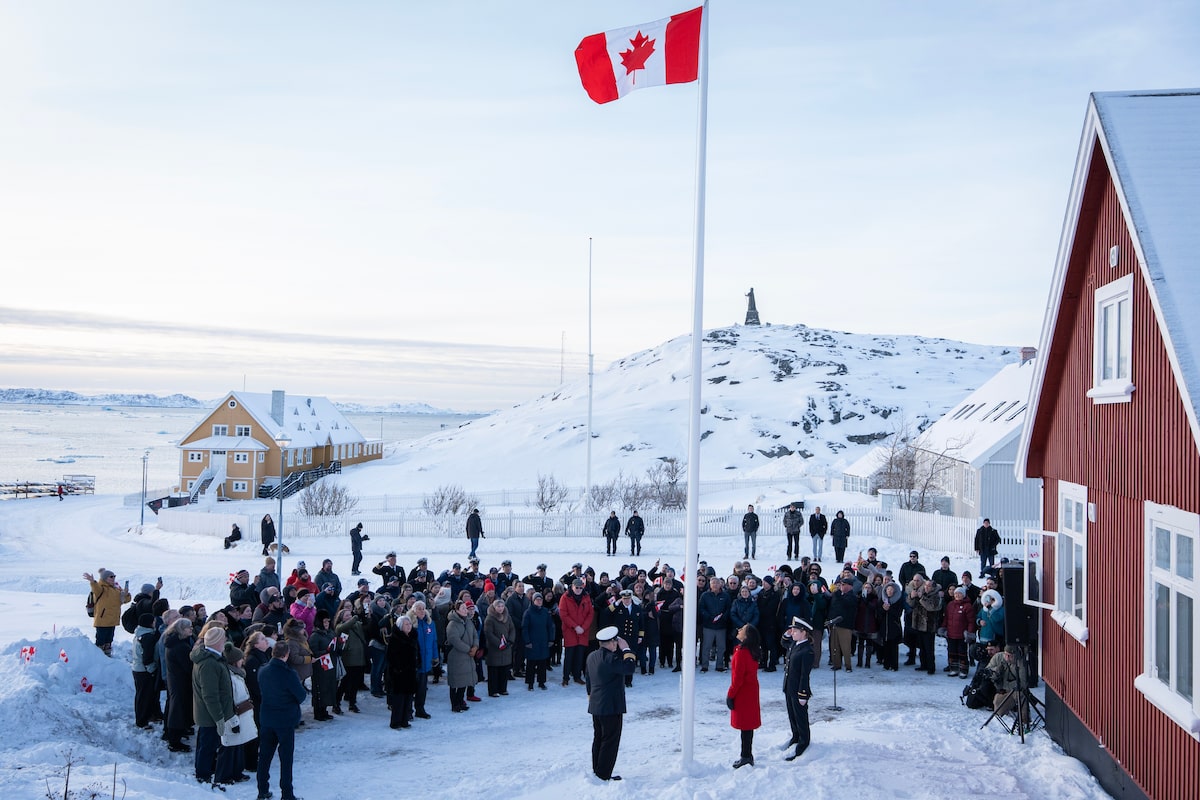
The Canadian flag is raised during the official opening of Canada’s consulate in Greenland’s capital Nuuk on Friday.Siegfried Modola/The Globe and Mail
Governor-General Mary Simon still bristles at U.S. President Donald Trump’s description of the Greenland as little more than a “piece of ice.”
As someone who grew up in Nunavik, Ms. Simon knew how painful the U.S. President’s offhanded comments were to Greenlanders and the anxiety his relentless threats to acquire the island have caused.
“It was very hurtful,” she said in an interview Friday in Nuuk. “When you know that people are very proud of their identity and their culture and their homeland is so important, for it to be called a piece of ice, even for me, not even living here, was very, very, painful for people.”
She added that families “were scared and people don’t feel that it’s over yet.”
Ms. Simon made her comments hours after she joined Foreign Affairs Minister Anita Anand and Greenland’s Foreign Minister Vivian Motzfeldt in raising the Canadian flag over a new consulate in Greenland’s capital. The ceremony was also attended by a group of more than 70 Inuit leaders from across Canada.
Canada’s Foreign Affairs Minister Anita Anand and Canada’s Governor General Mary Simon attend the official opening of the Canadian consulate in Nuuk, Greenland, on Friday.Stoyan Nenov/Reuters
It was a remarkable show of support for Greenland, a self-governing part of Denmark. While Canada had been planning to open a consulate in Nuuk since late 2024, the idea took on new significance in the wake of Mr. Trump’s threats to take the island by almost any means. Canada is now among only a handful of countries that have a diplomatic presence on the island.
Although he has backed off talk of invading Greenland, Mr. Trump has suggested that he’s negotiating a deal that could give the U.S. greater access to Greenland’s mineral wealth and sovereignty over some sections. Leaders in Greenland and Denmark have ruled out any discussion of handing over sovereignty but they acknowledge that Mr. Trump has not given up on his expansionist dream.
“We are going through a very difficult time. The world order has changed,” Ms. Motzfeldt said in a brief interview before the flag raising. “Co-operation has never been so important as it is today. And it’s not only about Greenland, it’s all our principles that have been shaken.”
She added that the new consulate meant that “you will have a piece of Canada here and it will be easier to talk.” She said Greenland plans to open a consulate in Ottawa in 2028.
Canada and France set to establish diplomatic presence in Greenland amid Trump threats
Greenland’s warming temperatures create uncertainty for hunters, fishers and tour operators
Natan Obed, president of Inuit Tapiriit Kanatami, an advocacy organization that represents Canadian Inuit, said Mr. Trump has resurrected the outdated idea of Manifest Destiny, an 19th century notion that it was America’s destiny to expand its interests around the world. Mr. Trump is pursuing the same philosophy in Greenland, Mr. Obed said in a speech to Greenlandic dignitaries on Friday.
Mr. Trump is pursuing “this idea that you have to use the land in a particular way that satisfies capitalist interests in order to have control and ownership of that land,” Mr. Obed said.
“Yes, we might have small populations within geographically large territories, but we use and occupy, and know and cherish, every single centimetre of this entire space.”
Canada wasn’t the only country showing support for Greenland on Friday. France has also opened a consulate in Nuuk, and the French and Canadian flags flew in front of Greenland’s Parliament building.
“It’s a powerful signal, definitely,” said Christophe Parisot, France’s ambassador to Denmark who was on hand to formally introduce the new French consul, Jean-Noël Poirier. “It’s also a question of solidarity. It is like when you need friends, you just turn back and you say, ‘Who’s there?’ And we are there.”
Both Mr. Parisot and Ms. Anand stressed that the new consulates were not intended to be direct responses to Mr. Trump.
“This is not symbolism,” Ms. Anand told reporters after the flag raising. “We are building ties with the Kingdom of Denmark and Greenland in the short and the long term, on defence and security, on bilateral economic ties, on shared values.”
Ms. Anand has also made it clear that Greenland’s future can only be decided by Greenlanders and Danes.
A delegation of supporters wave flags from Greenland and Canada during the official opening of Canada’s consulate.Siegfried Modola/The Globe and Mail
Ms. Simon made the same point in a speech on Friday in Nuuk, but she’s also worried about where Mr. Trump will next turn his attention. “I do worry about it, because I never know what’s going to come out. It’s always a surprise,” she said in an interview.
The prospect of a U.S. takeover of Greenland smacks of colonialism, she added, something Greenlanders have only started to address when it comes to Denmark, which has governed the island for centuries.
“When you listen to the rhetoric that was talking about the piece of ice with no people, what does that tell you? It could be another bad situation for Inuit,” she said.
Aviaq Brandt, like many Greenlanders, welcomed the new consulates and the support shown by Canada and other allies. But she still feels compelled to make her own views known about Mr. Trump.
Each morning for an hour or so, Ms. Brandt stands in front of the small American consulate in Nuuk. She cuts a stunning presence: bright red lipstick, a ring of red flowers in her hair and a large Greenland flag in her hands.
Aviaq Brandt holds the flag of Greenland as she stands in front of the American consulate as a daily protest against U.S. President Donald Trump in Nuuk on Friday.Siegfried Modola/The Globe and Mail
It’s a deliberate way of drawing attention to her rights as a sovereign Greenlander and a proud Inuit, she said.
“It’s the core principle of democracy, of sovereignty, to show your flag,” she said Friday as she headed home from her morning ritual. “I have to – for myself, for my children, for my country – make that statement.”
People passing by usually give her a thumbs up and sometimes the consulate staff say hello. They even offered her coffee one morning. She turned it down.
How long will she keep up her protest? “When do I feel that our children aren’t afraid any more? Maybe that’s the level of when I stop.”