
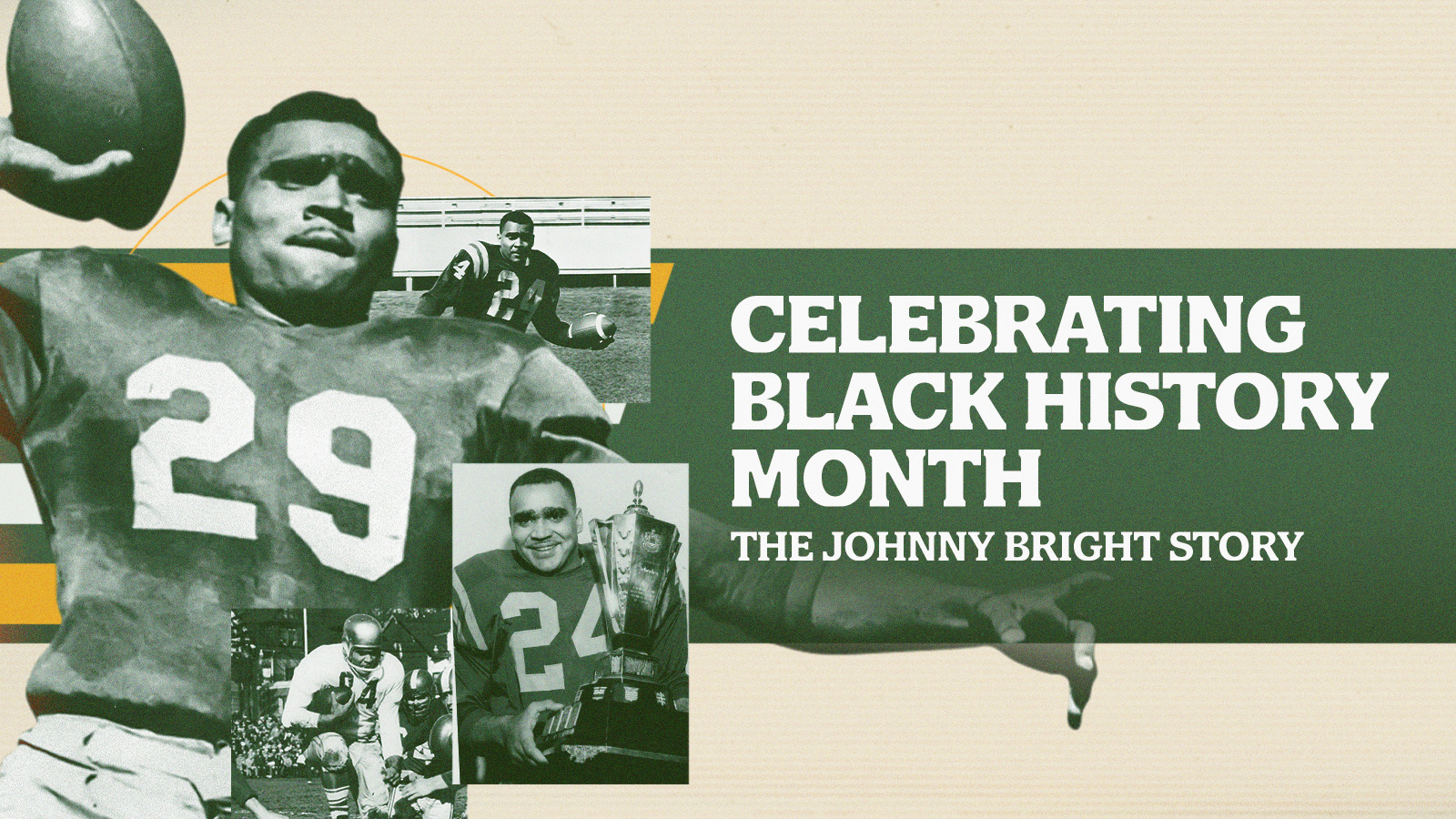
One of the best players to ever suit up for the Green and Gold, Johnny Bright’s story is synonymous with overcoming the racial prejudice Black athletes faced in the earliest days of the sport.
Bright is a Canadian Football icon. He exemplified resiliency and class, becoming both a legend of the game and the Edmonton community. He hung up his cleats as the league’s all-time leading rusher, a three-time Grey Cup champion, and in 1959 he became the first Black athlete to win the CFL’s Most Outstanding Player Award. Bright was named to the Canadian Football Hall of Fame in 1970 and added to the Double E’s Wall of Honour in 1983.
However, all of that success may never have happened if not for one of the most infamous acts in College Football History — the Johnny Bright Incident
The Johnny Bright Incident
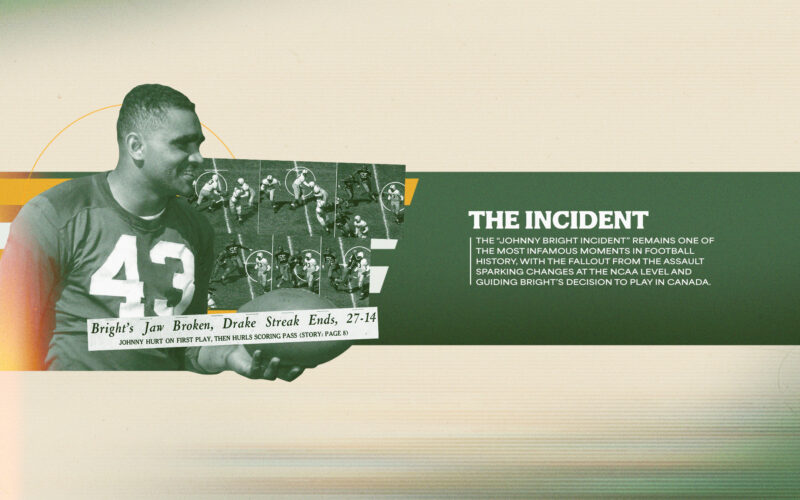
In 1951, Bright was one of the top players in College Football at Drake University and entered the season as a Heisman Trophy favourite. Midway through the college season, it appeared as if Bright would deliver on the Heisman hype, leading the nation in offence and Drake University to a five-game win streak heading into a matchup against Oklahoma A&M.
Early in the Oct. 20, 1951, contest, Bright was subject to a violent assault still referred to as the Johnny Bright Incident. Within the first seven minutes of the game, Bright was knocked unconscious three times by Oklahoma defender Wilbanks Smith – the last of which broke Bright’s jaw. The incident was caught in a sequence of photographs by Don Ultan and John Robinson, showing the malicious intent of the attack. Robinson and Ultang’s photos would go on to win the 1952 Pulitzer Prize for Photography.
The assault would change the trajectory of Bright’s career. He was drafted in the first round of the 1952 NFL Draft (fifth overall) by the Philadelphia Eagles, but Bright declined to play in the league, unsure of the treatment he would receive. Instead, Bright headed North to Canada to play in the Western Interprovincial Football Union (a precursor to the CFL). Bright would be traded to the Edmonton Eskimos in 1954, setting of a run of three consecutive Grey Cup Championships by the Green and Gold.
Legacy
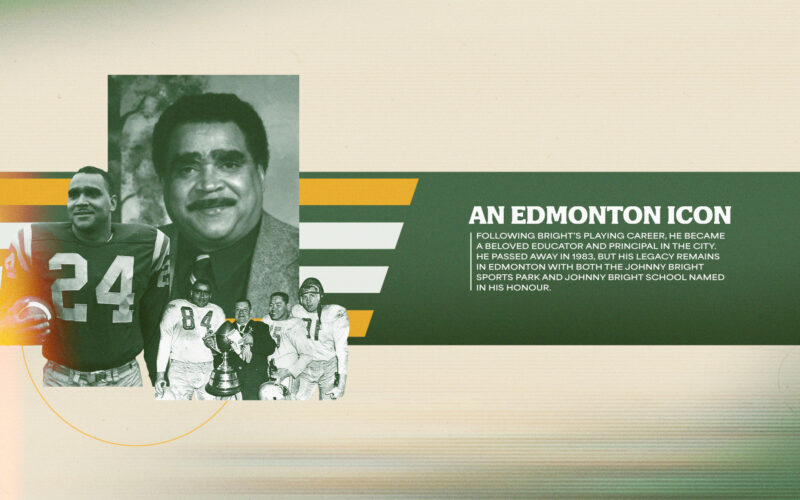
As a member of the Edmonton Eskimos, Bright shone both on and off the field. The fullback still holds multiple Double E records, including career rushing yards (9,966), the single-season rushing record (1,722), and the most 100-yard games (36). Bright garnered every major accolade achievable, entering the Alberta Sports Hall of Fame, Canadian Football Hall of Fame, the EE Wall of Honour, and he is the only player in Drake University history to have his number retired.
Following Bright’s playing career, he became a beloved educator and principal in the city. He passed away in 1983, but his legacy remains in Edmonton with both the Johnny Bright Sports Park and Johnny Bright School named in his honour.