
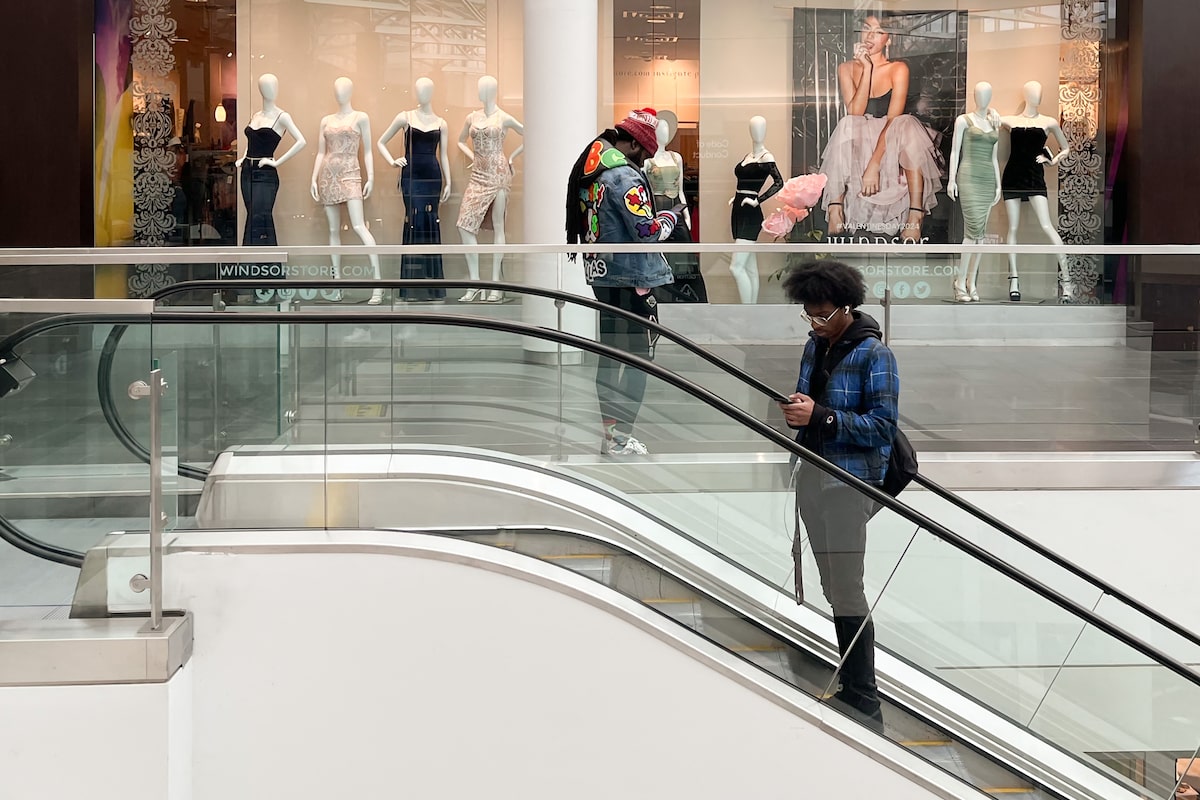
Shoppers walk through a shopping mall in Arlington, Va., in 2024. U.S. consumer sentiment increased to a six-month high in February.SAUL LOEB/Getty Images
U.S. consumer sentiment increased to a six-month high in February, though anxiety over the labour market and the rising cost of living because of import-tariff-related inflation remained widespread.
The third straight monthly improvement in sentiment reported by the University of Michigan’s Surveys of Consumers on Friday was mostly driven by consumers with the largest stock portfolio holdings, confirming a so-called K-shaped economy, where higher-income households are doing well but lower-income consumers are struggling.
“We may have seen the trough in consumer sentiment as positive fundamentals should support attitudes in 2026, as long as the recent stock market sell-off doesn’t continue,” said Oren Klachkin, financial markets economist at Nationwide.
“That said, we aren’t optimistic for a sharp rebound in consumer sentiment.”
Wealthy Americans spending more while poorer households face higher inflation, study finds
The University of Michigan said its Consumer Sentiment Index increased to 57.3 this month, the highest reading since last August, from a final reading of 56.4 in January. Economists polled by Reuters had forecast the index easing to 55.0. Still, the index remained about 20 per cent below its level in January, 2025.
The survey was completed before this week’s stock market sell-off, driven by investor caution over heavy spending by technology firms on artificial intelligence. Stocks on Wall Street rebounded on Friday. The dollar was steady against a basket of currencies. U.S. Treasury yields rose.
“Sentiment surged for consumers with the largest stock portfolios, while it stagnated and remained at dismal levels for consumers without stock holdings,” said Joanne Hsu, the director of the Surveys of Consumers. “Concerns about the erosion of personal finances from high prices and elevated risk of job loss continue to be widespread.”
Sentiment improved among consumers identifying as Republicans and Democrats, but dipped among Independents. The rise in sentiment was in stark contrast with the Conference Board’s Consumer Confidence Index, which plunged in January to the lowest level since May, 2014. Both surveys, however, underscored the growing apathy over the labor market.
The government reported on Thursday that job openings fell to a more than five-year low in December. There were 0.87 job openings for every unemployed person compared to 0.89 in November.
Though consumers continued to stress over high prices, they expected inflation to moderate in the next 12 months.
The survey’s measure of consumer expectations for inflation over the next year fell to a 13-month low of 3.5 per cent from 4.0 per cent in January. Some economists said this suggested consumers believed the worst of the pass-through from tariffs to prices was behind. But consumers’ expectations for inflation over the next five years rose to 3.4 per cent from 3.3 per cent last month.
“The Fed has emphasized medium-term expectations and these edged up for the second consecutive month,” said John Ryding, chief economic advisor at Brean Capital.
“None of this changes the March rate decision for the Fed, however, and to the extent that the outcome of this meeting depends on the data, it will come down to the January and February employment reports.”