
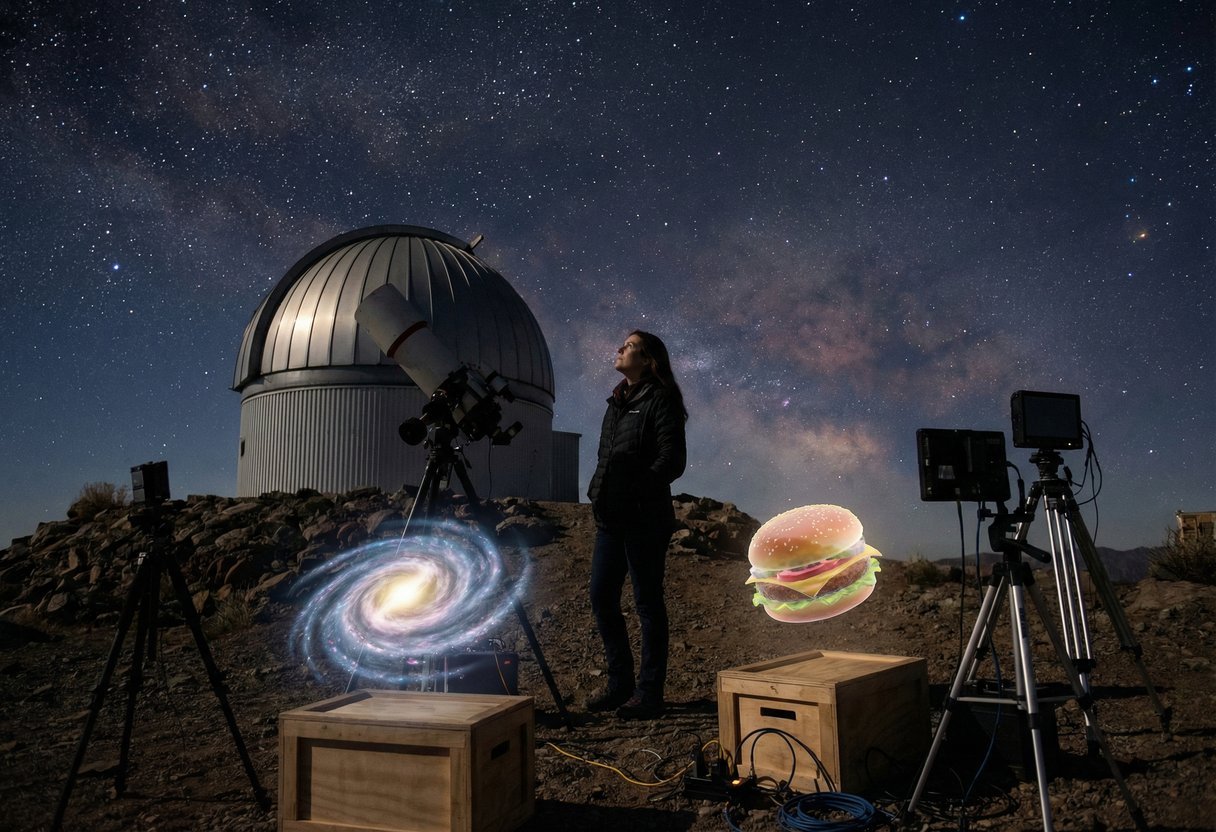
Something in Hubble’s attic won’t fit in the boxes we made for the universe. When an algorithm says look here, are we seeing mistakes, mirages shaped like burgers and jellyfish, or the rulebook we never learned to read?
Decades after Hubble began filling its vaults, a fresh set of eyes has rifled the shelves: an ESA-built algorithm that can binge through space photos faster than any human. In just two days, the AnomalyMatch system combed 100 million cutouts and flagged roughly 1,300 oddities, from jellyfish-like galaxies to quirky lookalikes nicknamed space hamburgers. Some are familiar phenomena in unfamiliar guises, others refuse to fit existing boxes, hinting at work for astronomers and perhaps new physics. With Euclid and the Vera C. Rubin Observatory on the way, this is a preview of how sky surveys will be navigated by humans teaming with machines.
Hubble’s enduring legacy
Hubble has been orbiting since 1990, sending back a treasury of images that reshaped astronomy. Those frames aren’t just pretty pictures; they’re dense with clues. Indeed, an AI system has now sifted the archive and flagged over 1,000 oddities that slipped past decades of scrutiny. It’s a reminder that even veteran instruments like Hubble can spring fresh surprises when new eyes take a look.
AI steps in for human limitations
Astronomy’s bottleneck isn’t collecting data, it’s digesting it. With millions of frames spanning 35 years, manual review hits a hard wall. Enter AnomalyMatch, built by ESA researchers David O’Ryan and Pablo Gómez (published in Astronomy & Astrophysics). In just 48 hours, the tool scanned 100 million image cutouts and flagged about 1,300 unclassified phenomena. According to this study, roughly 800 of them had never been cataloged before—a staggering acceleration of discovery.
A cosmic menagerie of anomalies
The haul reads like science fiction that wandered into a database. There are “jellyfish galaxies” with tendrils of gas, and “space hamburgers”—edge-on disks that resemble layered buns of dust. Some entries look familiar in principle, yet they stretch the categories astronomers lean on. Others are simply baffling, hints of processes we have not modeled yet. Could some mysteries even demand revisiting the laws of physics?
Jellyfish galaxies racing through clusters, stripping gas into glowing tails
Space hamburgers: razor-thin, edge-on disks where planets may form
Gravitational lenses that warp starlight into arcs and rings
Violent mergers and ring-shaped collision galaxies caught mid-drama
The dawn of an AI-powered era
This is more than a Hubble epilogue; it’s a preview of astronomy’s next act. AI will be essential to parse torrents from Euclid and the Vera C. Rubin Observatory (both set to stream petabytes of images). In addition to speed, AI offers consistency: it never tires, never blinks. Pair that with human judgment, and pattern-finding turns into insight-making at scale.
Old telescope, new secrets
Hubble may be an elder, but its archive is alive again. Machine learning has breathed new life into familiar pixels, revealing anomalies that might have remained invisible. More importantly, this collaboration reframes the craft: humans define the questions, AI scouts the terrain, and together they move faster. That’s how a decades-old telescope yields tomorrow’s discoveries.