
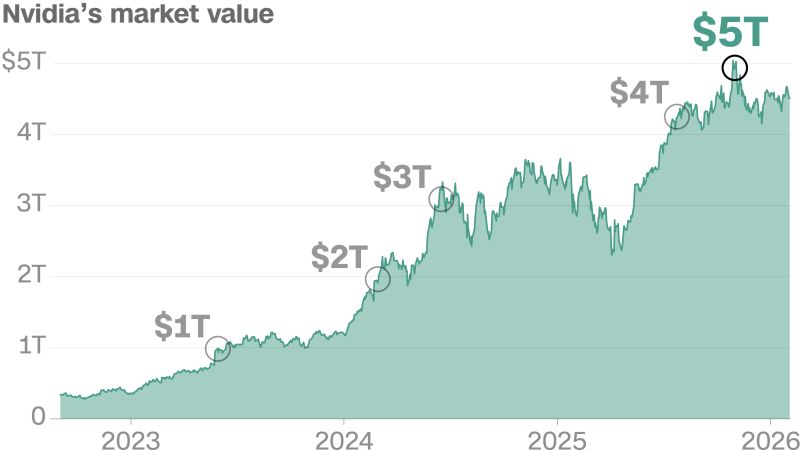
Tech giant Nvidia became the first company in corporate history to briefly surpass a $5 trillion valuation in October thanks to its role in the AI boom.
Insatiable demand from global companies for its AI chips has cemented its dominance with an 81% market share by revenue for data center chips, according to research from the International Data Corporation. That, in turn, has propelled the explosive growth of Nvidia’s stock (NVDA), which has surged 12-fold since the groundbreaking release of OpenAI’s ChatGPT AI chatbot in November 2022.
Nvidia’s sales and profits were up more than 60% in the October quarter compared to the previous year, soaring past Wall Street’s expectations. Last month, it unveiled the next generation Vera Rubin chip, widely seen as the company’s next growth driver. Nvidia now expects its total sales to hit new records in 2026, projecting around $500 billion in revenue.
Still, the tech giant is facing a growing set of challenges, from intensifying competition to lingering concerns of an AI bubble and relentless pressure to demonstrate growth after several explosive quarters.
Here’s a look at Nvidia’s success in four graphics:
Nvidia CEO Jensen Huang founded the company in 1993 with a focus on chips known as graphics processing units for video games. Its GPUs were later found to be well suited for AI training.
But the company’s breakout moment didn’t come until after ChatGPT’s arrival in late 2022, widely considered to be the kickoff to today’s AI boom.
Shares of Nvidia climbed at steep pace, making the AI giant the ninth company in the world to reach a $1 trillion valuation in 2023, three decades after its establishment. While the AI giant has shed some value in recent months, it remains the world’s most valuable company.
But Nvidia’s secret sauce is more than just GPUs. It also offers full server racks packed with other types of chips that are critical to AI workloads and software that allows developers to tailor their code to make the most of its chips. Now it’s trying to lay the foundation for data centers of the future, which it calls “AI factories.” The company is also trying to position itself at the center of emerging technologies like robots, quantum computers and self-driving cars. It announced partnerships with Uber to build self-driving cars and with the US Department of Energy to develop quantum supercomputers with its AI chips last year.
For much of 2025, the company, like other major tech firms, raced to strike deals and pour in investment. In April, Nvidia said it plans to build $500 billions of AI infrastructure with its partners in the US. In September, Nvidia invested $5 billion in Intel to develop custom data centers. Days later, Nvidia announced a strategic partnership with OpenAI, under which it will invest up to $100 billion in the latter in expanding AI data center capacity built around its chips. Despite reports of recent friction between the two AI giants the executives of both companies have since publicly said they remain committed to the deal.
As Nvidia’s chips have become the backbone of the global AI industry, the company’s partnerships have expanded well beyond North America. In Europe, Nvidia is working with telecoms and governments in France, Germany, Italy and the United Kingdom to deploy sovereign AI infrastructure and build AI technology centers. In South Korea, it is collaborating with government and businesses to deploy over 26,000 chips.
However, fears of a bubble have clouded the outlook for AI, a worry Huang has repeatedly brushed aside. At the same time, Nvidia is facing growing pressure from rivals like AMD and customers developing their own chips to reduce reliance on the industry’s dominant supplier.
In China, once a major market for Nvidia, US tech controls have restricted exports of its cutting-edge chips, significantly impacting sales in the world’s second largest economy. Although Huang has managed to convince President Donald Trump to reverse some restrictions and allow sales of its second most powerful chips, Beijing has yet to confirm it will allow its companies to purchase them.
These concerns have not stopped Nvidia and Huang. The company’s new Rubin chips, currently in production, will arrive in the second half of 2026. Major cloud providers, including Microsoft, Amazon Web Services, Google Cloud and CoreWeave, will be among the first to deploy it.
In his effort to diversify Nvidia’s business, Huang also rolled out new AI models for autonomous driving and robotics – deepening his push for the company to become a major player in these fields.
“Our vision is that, someday, every single car, every single truck will be autonomous,” he said.