

Listen to this article
Estimated 5 minutes
The audio version of this article is generated by AI-based technology. Mispronunciations can occur. We are working with our partners to continually review and improve the results.
Fast-tracking project permits came up in just about every session last month at Roundup, the Vancouver international mining conference, including in the latest promises from the new Yukon government.
Addressing a crowd at Yukon Night, a celebration of the territory’s industry, Yukon Mines Minister Ted Laking said change is on the way.
“You said the length of time it takes for government to turn decisions around is taking too long,” he said. “In response […] we will now be developing new regulatory timelines that will respect our obligation to consult with affected First Nations as well as industry’s need for increased regulatory certainty.”
It’s a commitment industry leaders are impatient to see carried out.
“While we’re encouraged by the shift in tone – the proof of that shift is still a ways off,” said BMC Minerals CEO Michael McClelland, who also spoke at Yukon Night in Vancouver. “It should not take 10 to 15 years to secure permits to develop a project.”
BMC Minerals’ Kudz Ze Kayah project was sent back to the consultation phase in 2024 after a Yukon appeal court found the territorial and federal governments failed to have proper conversations with Kaska Nation about the project’s economic feasibility. Kudz Ze Kayah was recommended to proceed – with conditions – last June.
But some Yukon First Nations feel there’s no point speeding up a broken system.
‘They can’t even manage the timelines they have now’
Hähké Darren Taylor, leader of the Tr’ondëk Hwëch’in First Nation in Dawson City, said until mining benefits the public and First Nations, there’s no rush to develop.
“We’re selling our resources for the pennies on the dollar with no substantive benefit,” he said. “The money, the resources, can stay in the ground until we have more favorable benefits. It’s money in the bank.”
Taylor also took issue with Roundup presenters who referred to the Eagle mine failure as an “unfortunate event.”
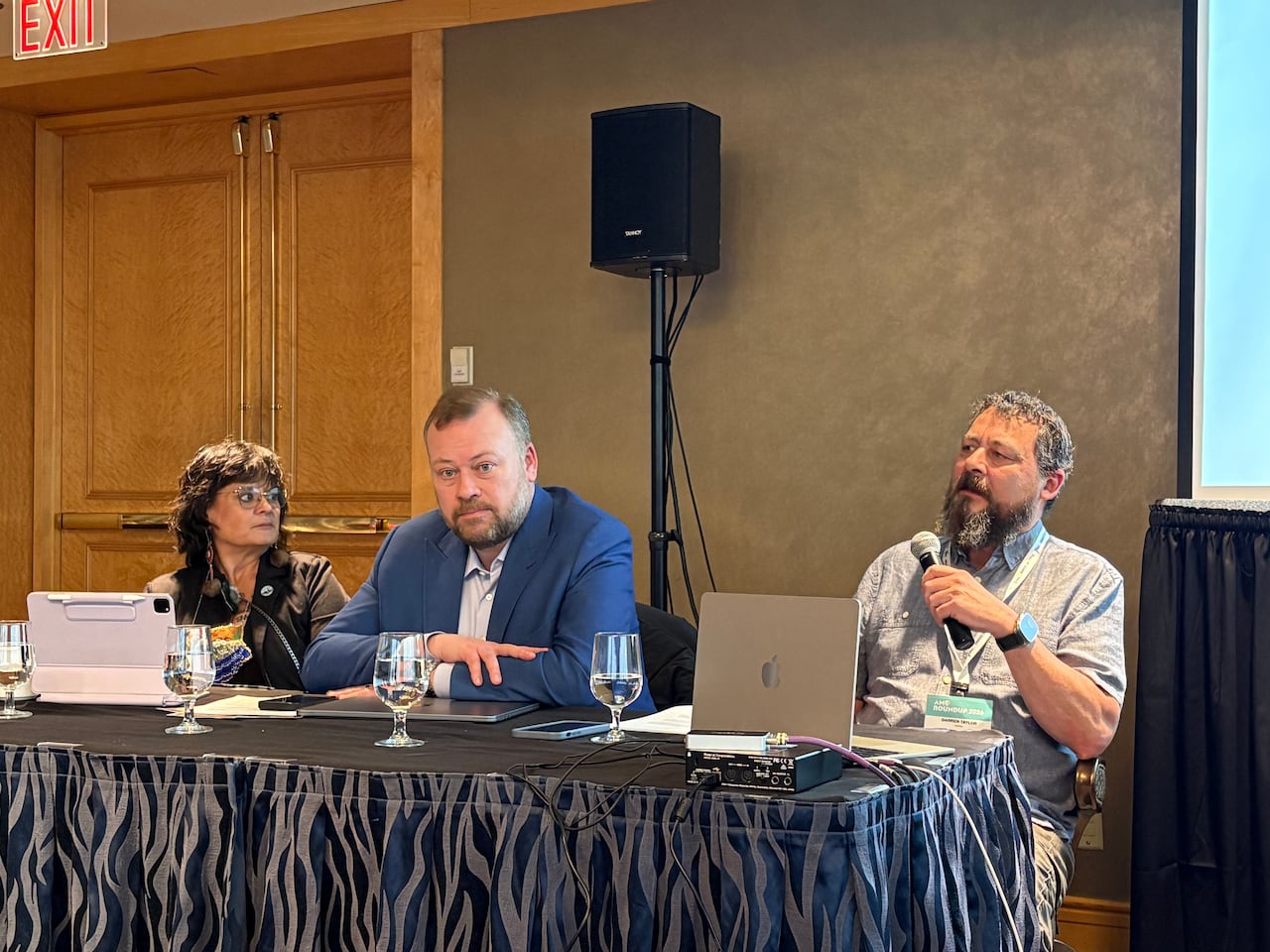 Hähké Darren Taylor, leader of the Tr’ondëk Hwëch’in First Nation, speaking at Roundup in Vancouver on January 28, 2026. (Caitrin Pilkington/CBC)
“We’re downplaying the significance of this tragedy. We gotta take responsibility and ownership,” he said. “The Yukon government has got to take responsibility for their lack of oversight, the permitting process, inspections.”
For the First Nation of Na-Cho Nyäk Dun, too, the Eagle mine failure has created a break in faith with the current permitting system.
“Fast-tracking is a concern to us,” said Na-Cho Nyäk Dun Chief Dawna Hope. “They can’t even manage the timelines they have now, and they want to fast-track? We ended up with Eagle Gold.”
The Yukon Environmental and Socio-economic Assessment Board (YESAB) is a key part of the current mine application process. It’s currently being reviewed to improve efficiency, which could see projects sorted into simple, standard, or complex evaluations, among other proposed changes.
For Hope, the biggest cause for concern is that the initial Eagle mine proposal that was reviewed by YESAB was significantly different from what was actually built out on the land.
CBC News asked YESAB if stronger oversight is needed to ensure the board issues recommendations on proposals that reflect the reality of what gets built.
“I think it’s important to remember that YESAB was created to be one piece of the puzzle for sustainable development in the territory,” said Kent Bretzlaff, YESAB executive director. “I know there were conversations about YESAB having enforcement capabilities or compliance monitoring capabilities… that’s not what ended up happening on paper.”
Bretzlaff said YESAB is open to working with counterparts at the Yukon Department of Energy, Mines and Resources and other regulators.
First Nations say they’re not to blame for delays
Hope said First Nations get blamed for holding up the system and throwing off timelines, but the territory is still operating under “centuries-old legislation” that “never considered First Nations rights at all.”
The Yukon’s minerals legislation has not been substantially updated since the 1890s and has long led to clashes between industry, First Nations and the public over low royalty rates and the free entry staking system.
Laking said the government hopes to have something to announce in the “next couple months” on new mineral legislation.
Both Na-Cho Nyäk Dun and Tr’ondëk Hwëch’in have also been waiting for years for the land use plans promised in their 1993 and 1998 final agreements, which would create guidelines for resource management and help reduce conflict over development.
“In the absence of land-use planning and successor resource legislation, the only way I could see any project being fast-tracked is through direct engagement and dialogue [with First Nations] by way of [impact benefit agreements],” said Taylor.