
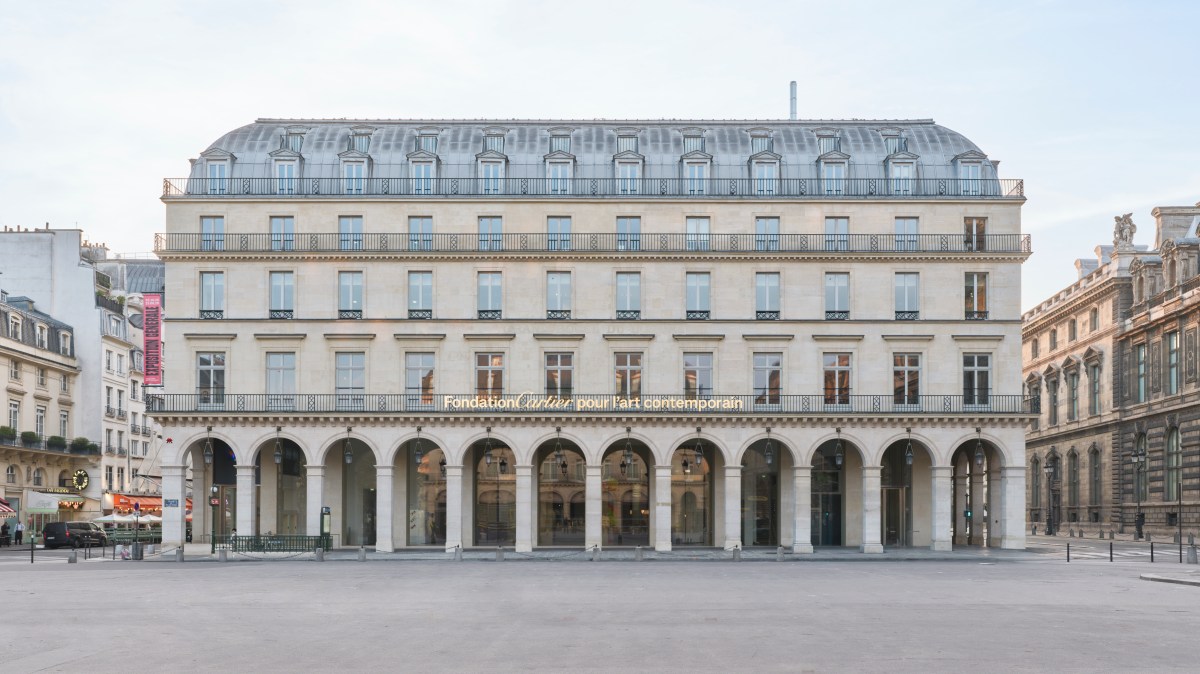
The Fondation Cartier is all about contemporary art, but its new home has a past. It was once a magnificent hotel built for the 1855 Exposition Universelle, then the department store the Grands Magasins du Louvre, and after that a series of antique shops. Now it’s a space to house the collection of the Fondation (4,500 pieces by artists of 50 nationalities), which was founded in 1984 by Alain Dominique Perrin while he was the president of Cartier.
The exterior is all grand, blocky Haussmann, but the inside has been hollowed out and reimagined by the architect Jean Nouvel, who created the Fondation’s last home, a glass and steel indoor-outdoor cube in the 14th arrondissement. This place is six times the size and it has no floors. Not in the conventional sense, anyway. Instead it has five 250-tonne platforms that run the length of the building and can be cranked up or down to change the height and configuration. The vastness of it and the engineering on show reminds me a little of Tate Modern’s Turbine Hall.
It opened at the end of last year and is already attracting a more international crowd thanks, in part, to its brilliantly central location on the Place du Palais Royal, right next to the Louvre. You can even gaze into the Louvre’s more traditional galleries from inside. Look out for burglars! Likewise passers-by can peer in to see a brightly brilliant interior installation, Salon de Eventos, by the Bolivian architect Freddy Mamani, whose work has changed the face of El Alto in Bolivia, or gaze on a giant Murano glass necklace by Jean-Michel Othoniel.
What do you need to know?Where is it? The Fondation Cartier is next to the Louvre, on the Place du Palais RoyalWho will love it? Arty types, the culturally curiousInsider tip Have a drink in the Bourse de Commerce restaurant for views over Paris
• 25 of the best things to do in Paris
What it’s like inside
The opening show, Exposition Générale, draws on the spirit of the building’s past, referencing the exhibitions of the latest designs held by the pioneering Grands Magasins du Louvre, which was among the first buildings to have steam-powered lifts.
Fitting, then, that one of the big show pieces is the giant textile work Muro en Rojos, by Olga de Amaral, made with hundreds of pieces of rust-coloured cloth woven with horse hair and emulating the Bogota rooftops of the artist’s home city. It’s dizzyingly wonderful.
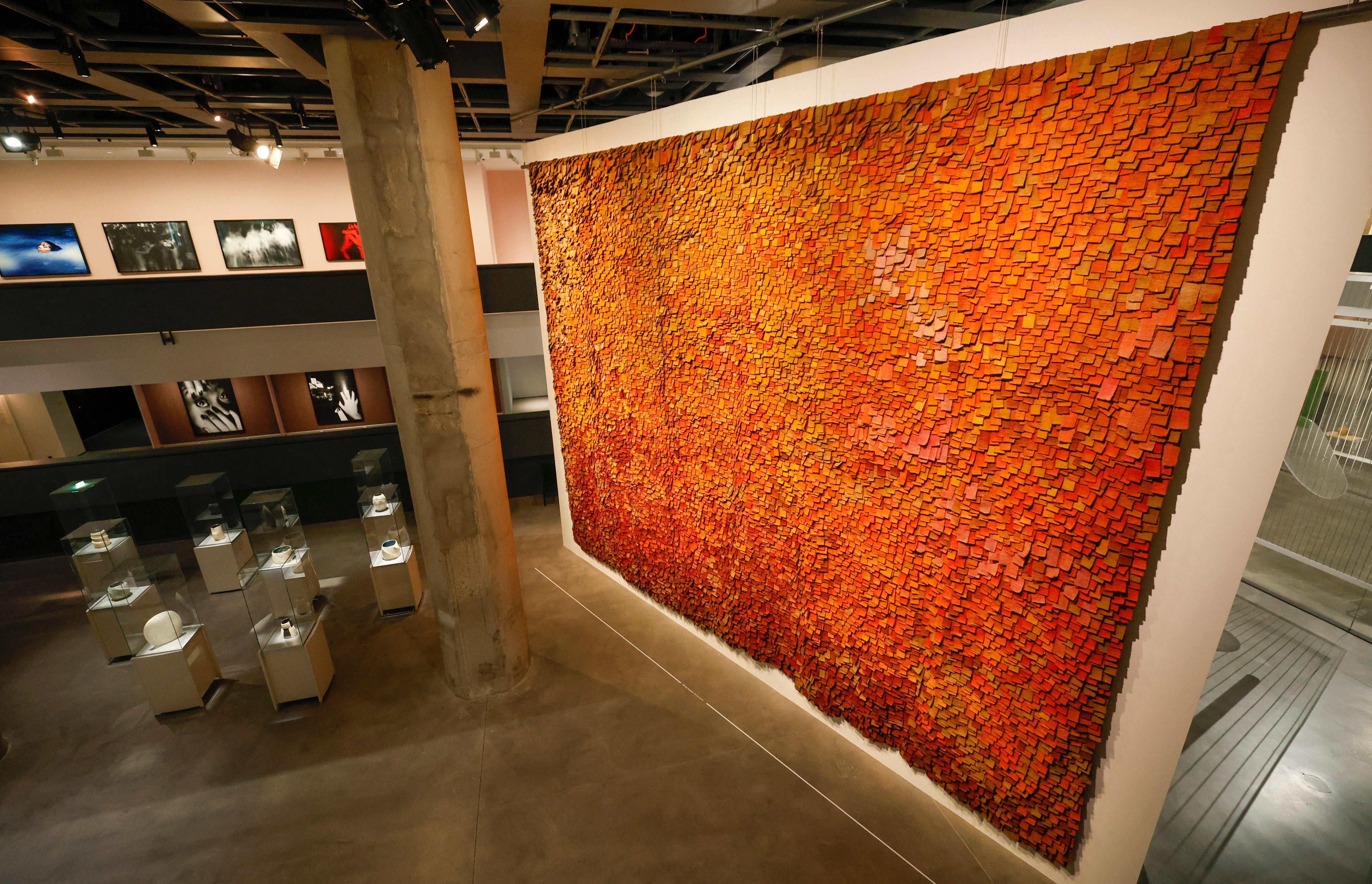
Muro en Rojos by Colombian artist Olga de Amaral
ALAMY
This is not living room art. It has a message, though there is much beauty in the telling. Take the illustrations of animals by the artists of the Gran Chaco forest in the north of Paraguay, which is thought to have the highest deforestation rate in the world — they are full of charm, displaying a love of nature. Or the corridor of birdsong by Bernie Krause, Night Would Not Be Night Without the Cricket, a sound piece from 5,000 hours of recordings. It’s transporting. While in Damien Hirst’s thickly daubed Wonderful World Blossom, the paint is applied so chunkily, it looks good enough to eat.
I was inspired, too, by the story of Sally Gabori, an Indigenous Australian artist who started painting in 2005 when she was in her early eighties. With it, she found a way to explore her heritage and homeland, Bentinck Island off the northern coast, which her people were forced to leave in the 1940s. She created almost 2,000 canvases before she died in 2015.
When I come across the sculpture of a woman carrying a baby under her coat plus two carrier bags of shopping, I feel instant recognition. Woman with Shopping by Ron Mueck was inspired by a scene he saw on the streets of London. It “tells a silent story of fatigue”, the caption says. There is nothing silent about it. She is the embodiment of “knackered mother”.
I sympathise with one onlooker who can watch no more of the data-driven installation Exit, which visualises the displacement of people as well as the impact of floods and deforestation via billions of scattering dots on a map of the world that spans a cinema screen. “It is too depressing,” she announces. Thought-provoking, too.

The gallery can be difficult to navigate in places
MARC DOMAGE
Criticisms? It’s easy to get lost and extremely difficult to find your way back to a work you may have liked to revisit. I can’t always find explanations for the art to hand either.
Tips? It’s apparently quietest on a Tuesday and a friend agrees this is also the day the Metro dulls down. Maybe that’s when the French WFH.Wo
• 23 of the best boutique hotels in Paris
I have a lot to digest come lunchtime. The nearby Café Plume on Rue St Honoré is reassuringly full of locals, some with carafes of red wine at tables for one. A couple of women are smoking on the terrace, one in a fabulous multicoloured coat with an image of Frida Kahlo on the back. The Parisians are still reassuringly Parisian (mains from £15, cafeplume-paris.fr).
I’m staying at the handily located and thematically appropriate Drawing Hotel, on Rue de Richelieu, a five-minute walk from the Fondation Cartier. There’s a tempting Merci shop next door and I have to practise some self restraint not to purchase a candle in the shape of a garlic bulb or a baguette.
The Drawing Hotel, meanwhile, has an art concierge and each floor displays works by a different artist. There is a rooftop terrace, tucked up for winter.
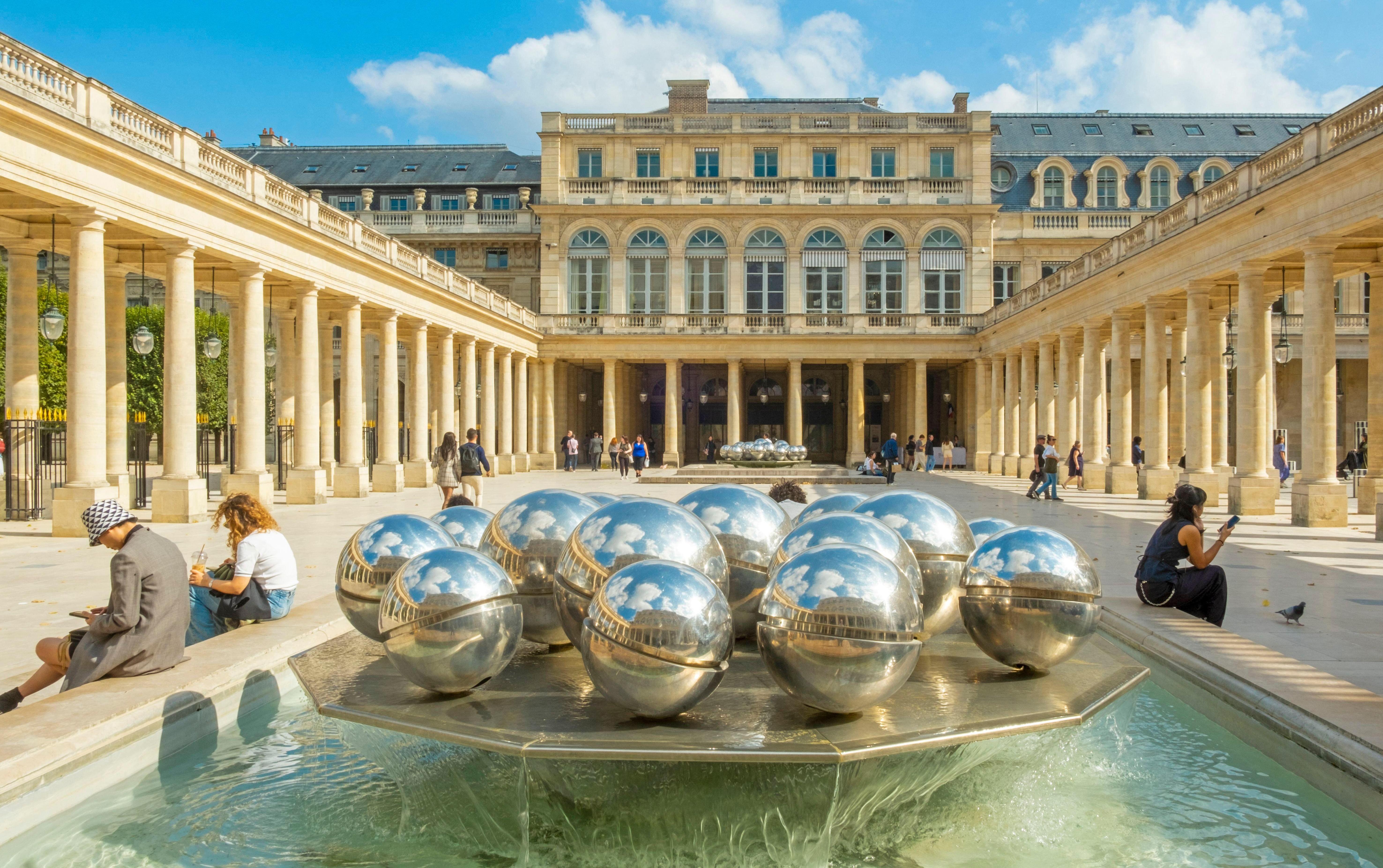
Les Sphérades water fountain by Pol Bury at the Palais-Royal
ALAMY
When I walk through the Palais-Royal (minutes away) on a Friday evening it’s full of gleeful life, being used as a playground, with children scampering around the humbug bollards.
Even though it’s central Paris, there are authentic (and inexpensive) restaurants. À l’Épi d’Or on Rue Jean-Jacques Rousseau, less than a ten-minute walk from my hotel, is your quintessential bistro. Tiny, rammed, moody lighting, moodier service, but you’ll forgive it all for the food and the atmosphere. Charcuterie, perfectly dressed salads, classic croques, rice pudding (two courses from £25).
The next day I stomp my way around a further five galleries (exhibitions are a much less expensive pursuit in Paris compared with London). My theme is contemporary art but I allow myself a dip into the Palais Galliera fashion museum to see the embroidery exhibition — which includes a velvet Balenciaga gown twinkling with jewels and a shimmering corset by Aurélia Leblanc (adults £12, palaisgalliera.paris.fr).
By the time I’m on the Eurostar heading home, I’ve clocked up six galleries, 22,000 steps, one shopping trip to Monoprix (very good children’s clothes) and two fantastic croissants. Best of all I’ve seen a vast breadth of creativity and, thanks to the Fondation Cartier, work by people from places I had never heard of. Next time you’re in Paris, you don’t need to do all six, but give this exciting new space a go.
This article contains affiliate links that will earn us revenue
Jenny Coad was a guest of the Fondation Cartier (£13; fondationcartier.com), and the Drawing Hotel, which has B&B doubles from £205 (drawinghotel.com). Take the Eurostar to Paris
• Best time to visit the Louvre: top tips for your trip
Three other contemporary art galleries
By Jenny Coad
Bourse de Commerce, Rue de Viarmes
Round the corner from the Fondation Cartier is the Pinault Collection in a landmark building, the Bourse de Commerce, so-called because it was once a grain exchange. It was reimagined by the architect Tadao Ando, who created a showstopping central concrete cylinder. It’s between exhibitions at the moment, but what a setting, with its restored paintings on the domed ceiling with its glass roof. The next show, Chiaroscuro, starts on March 4 (adults £13, pinaultcollection.com). In the meantime, it’s worth having a drink in its third-floor restaurant La Halle aux Grains, from which you can see the Pompidou Centre, closed until 2030 for a big refurb (mains from £31; halleauxgrains.bras.fr).
Palais de Tokyo, Avenue du Président Wilson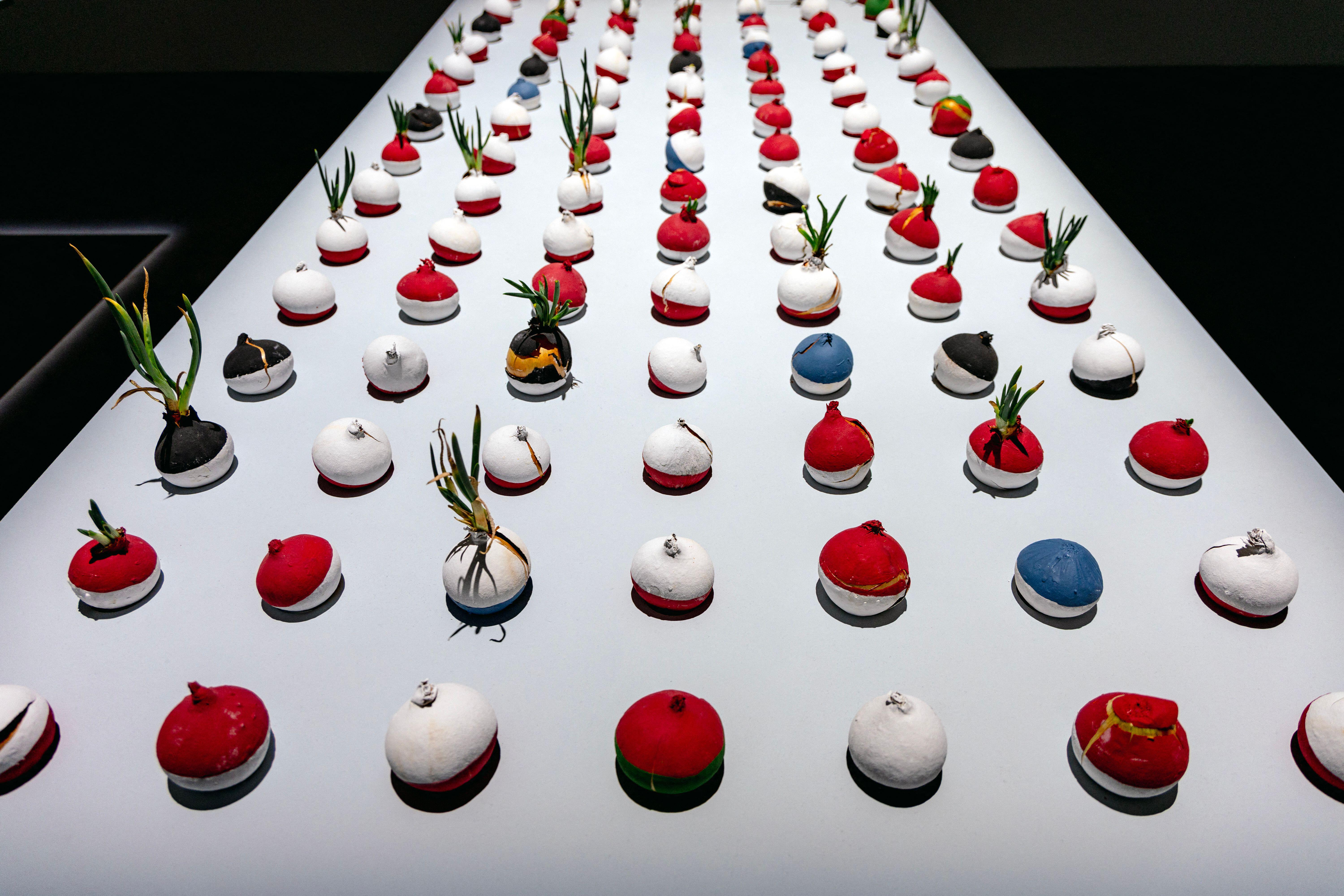
The Polis or the Garden or Human Nature in Action by William Pope.L at the Palais de Tokyo
ALAMY
The Palais de Tokyo is grungier with its yawning industrial interior and draws a youthful crowd. It’s the ideal setting for the abstract sculptures of Melvin Edwards, who specialises in metal work and uses barbed wire too for his unflinching pieces. Also on now is Echo Delay Reverb: American Art, Francophone Thought which explores how American art has influenced French theory. It’s quite a lot to take in and, I have to admit, I find the installation in another room, of 1,200 painted onions (The Polis), some forcing through their painted shells, eventually to decay, a bit of a relief (£11; palaisdetokyo.com). While you’re here, it is worth going to the Modern Art Museum opposite to see the Matisse room with its two giant dance murals (free; mam.paris.fr).
Fondation Louis Vuitton, Avenue du Mahatma Ghandi
Next to the green (even in February) Bois de Boulogne, the Frank Gehry-designed Fondation Louis Vuitton is a sci-fi marvel, with great pieces of roof seemingly lifting off the building like wings. There’s an enormous life-spanning exhibition of the German artist Gerhard Richter on now, which is heaving on my Saturday visit. Skip the basement, is my advice. And don’t neglect the incredible balconies, with their views over Paris including the Eiffel Tower (adults from £14; fondationlouisvuitton.fr).